
Why Teams Miscommunicate Even When Everyone Is Trying
Teams can miscommunicate even with good intentions. Learn how leaders can reduce confusion, clarify expectations, improve handoffs, and strengthen team communication.
LEADERSHIP AND COMMUNICATIONEMPLOYEE EXPERIENCE AND CULTUREELEVATING INSIGHT
7/20/20269 min read
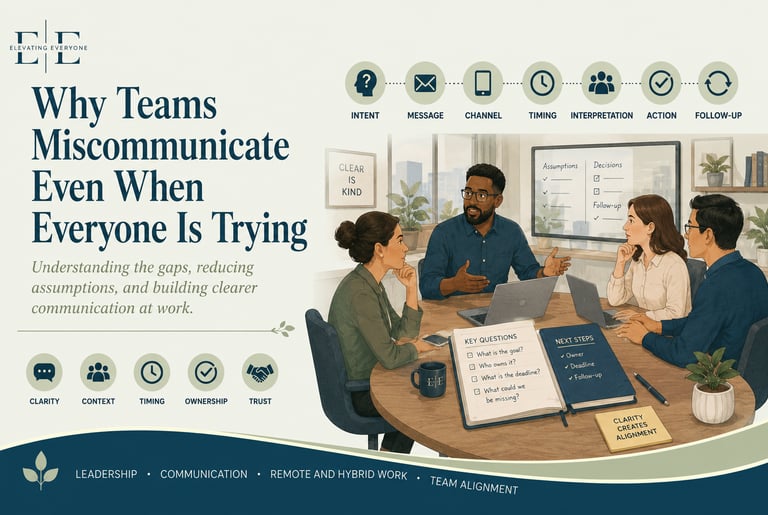

Why Teams Miscommunicate Even When Everyone Is Trying
Team communication problems are often treated as people problems.
Someone did not listen. Someone did not follow up. Someone should have asked a better question. Someone assumed too much, shared too little, waited too long, or used the wrong channel.
Sometimes that is true. More often, the people involved are trying to do good work and still missing each other.
A manager thinks they gave clear direction, but the team heard a suggestion. An employee sends an update, but leaves out the context the leader needed. A cross-functional partner asks for input, but the request sounds optional. A project owner believes everyone is aligned because nobody raised a concern in the meeting.
Miscommunication often happens in the space between intent and interpretation.
People bring different communication habits to work. They have different expectations around urgency, detail, tone, clarity, ownership, conflict, follow-up, and decision-making. When those differences are left unnamed, teams can create unnecessary friction even when everyone is capable and committed.
For leaders, the work is to make communication less dependent on assumptions.
For more support on building stronger communication habits, see team communication consulting.
Miscommunication Is Often a System Problem
When a team struggles to communicate, the first instinct is often to focus on individuals.
Someone needs to be more concise. Someone else needs to speak up. Another person needs to respond faster. Another needs to be less direct. Individual habits do play a role, but communication problems usually become team problems when the system around the communication is unclear.
Teams run into trouble when they have not defined:
where decisions are documented
which channels are used for which types of messages
how quickly people are expected to respond
who owns follow-up after a meeting
what level of detail is needed for different audiences
when something should be escalated
how disagreement should be raised
what “done” means
who needs to be informed versus involved
Without those agreements, people fill in the gaps using their own preferences.
One employee may think a chat message means “respond today.” Another may treat it as casual and respond when they have time. One manager may expect a full written summary before approving a decision. Another may prefer a quick conversation. One teammate may see silence as agreement. Another may see silence as uncertainty.
None of those differences are unusual. They become costly when the team never talks about them directly.
Good Intentions Do Not Guarantee Shared Meaning
Most workplace communication starts with good intent.
A leader wants to give direction without micromanaging. An employee wants to avoid bothering their manager. A teammate wants to be helpful, so they jump in quickly. Another teammate wants to be careful, so they waits until they have more information.
The intent may be positive. The experience can still land poorly.
For example:
“I did not want to overwhelm you with details” may be received as “I was left without enough context.”
“I was giving you space to own it” may be received as “I had no support.”
“I thought we agreed in the meeting” may be received as “I did not know a final decision had been made.”
“I was being direct to save time” may be received as “I was dismissed.”
“I waited until I had all the information” may be received as “I disappeared.”
Leaders need to pay attention to both sides of communication: what was intended and how it was understood.
The gap between those two things is where many team issues begin.
Teams Misread Urgency
Urgency is one of the most common sources of miscommunication.
A message may feel urgent to the sender because they know the background, the deadline, or the risk. The receiver may not have that same context.
A short message like “Can you take a look at this?” can mean several different things:
Please review this sometime this week.
I need your input before my meeting this afternoon.
Something may be wrong and I need help quickly.
I am asking for your opinion, but no action is required yet.
I need you to own the next step.
Without a clear expectation, the receiver has to guess.
Guessing leads to frustration on both sides. The sender thinks the person did not respond with the right level of urgency. The receiver thinks the sender was unclear.
Leaders can reduce this by setting simple urgency norms.
For example:
Use “FYI” when no action is needed.
Use “Input requested” when feedback is needed.
Use “Decision needed by Friday” when timing is important.
Use “Urgent today” only when same-day action is truly required.
Include the deadline and the reason when requesting work.
A team does not need complex rules for every message. It needs enough shared language to prevent people from guessing.
Teams Misjudge the Amount of Context Needed
Some people communicate with a lot of context. Others get to the point quickly.
Both styles can be useful. Both can also create friction.
A detailed communicator may feel frustrated when others provide short updates. They may wonder what is missing or whether the person has thought through the issue. A concise communicator may feel overwhelmed by long explanations. They may miss the key decision because it is buried in background information.
Leaders often see this in project updates.
One employee sends a long summary with history, risks, options, and next steps. Another sends three bullet points and assumes the leader will ask if more is needed.
The problem is rarely the length alone. The problem is mismatched expectations. A useful standard is to define what the audience needs to know.
For example, a leadership update may need:
current status
key risk
decision needed
owner
deadline
next step
A team update may need:
what changed
who is affected
what action is needed
where to find details
A customer issue update may need:
what happened
what has been done
what remains open
who owns follow-up
when the next update will happen
Clear expectations help both detailed and concise communicators adjust without feeling criticized for their natural style.
For related support, see How to Improve Team Communication.
Silence Creates Its Own Story
Silence is rarely neutral at work.
When people do not respond, do not ask questions, or do not challenge a decision, others often assign meaning to the silence.
A leader may assume silence means agreement. An employee may assume silence means disapproval. A teammate may assume silence means the request was ignored. Another may assume the conversation is closed.
Remote, hybrid, and fast-moving teams are especially vulnerable to this.
People may be quiet because they are processing. They may be overloaded. They may disagree but feel uncertain about raising the issue. They may not understand the decision. They may think someone else is responsible for the next step.
Leaders can reduce the risk by creating clearer closing habits.
At the end of meetings or important conversations, ask:
What decision did we make?
Who owns the next step?
Who else needs to know?
What could we be missing?
Does anyone see a risk we have not addressed?
What should be documented before we move on?
These questions can feel simple, but they prevent a lot of confusion.
Silence should never be the only evidence of alignment.
Handoffs Break When Ownership Is Unclear
Many communication issues show up during handoffs.
Work moves from one person to another, one team to another, or one stage to another. Each transfer creates a chance for information to get lost.
A weak handoff often includes:
unclear owner
missing background
no deadline
no decision record
unclear customer or employee impact
assumptions about who will follow up
no confirmation that the next person accepted ownership
This creates rework and frustration.
The person receiving the handoff may feel set up to fail. The person sending the handoff may think they already did their part. The customer, employee, or stakeholder experiences the delay.
A stronger handoff answers five questions:
What needs to happen?
Why does it need to happen?
Who owns it now?
When is it due?
What context should not be lost?
Teams can use this as a simple handoff standard. It is especially useful across functions where people do not share the same operating rhythm or vocabulary.
People Interpret Tone Differently
Tone is another frequent source of friction.
A message intended as efficient can land as abrupt. A message intended as thoughtful can land as hesitant. A question intended as curiosity can land as challenge. A suggestion intended as support can land as criticism.
Written communication increases the risk because people lose facial expression, voice, timing, and relational context.
Leaders can help teams avoid over-interpreting tone by making expectations clear.
A few practical habits help:
Use clear subject lines and headings.
State the purpose of the message early.
Separate facts, opinions, and requests.
Avoid vague phrases when action is needed.
Ask before assuming negative intent.
Use a quick call when the topic is sensitive or complex.
Repair quickly when a message lands poorly.
Tone issues should not be dismissed as oversensitivity. They also should not become a reason to avoid direct communication.
The better path is to build enough trust and clarity that people can check interpretation before frustration builds.
Communication Styles Influence Team Friction
People do not all communicate, process, and respond in the same way.
Some move quickly and want the headline first. Some need details before they can commit. Some think out loud. Some process privately before responding. Some raise risks early. Some focus on possibilities. Some prefer direct feedback. Some need context before feedback is useful.
These differences can be strengths when the team understands them.
They can become friction when people assume their own style is the right one.
A fast-moving leader may see a careful employee as slow. A detail-oriented employee may see a big-picture leader as unclear. A direct communicator may think they are being efficient. A relationship-focused teammate may experience the same message as dismissive.
This is where structured insight can help.
A tool like Elevating Insight can give teams shared language for communication preferences, motivators, work patterns, and potential friction points. Used well, an assessment does not label people. It helps people understand how to work together with more clarity.
Leaders can use those insights to ask better questions:
How do you prefer to receive important information?
What level of detail helps you do your best work?
When do you want a quick conversation instead of a written message?
How do you tend to respond under pressure?
What helps you feel prepared for a decision?
What communication habits create friction for you?
Those conversations can make the invisible parts of teamwork easier to discuss.
For related reading, see The 4 Workplace Communication Styles and Your Team Took a Workplace Assessment. Now What?
Leaders Set the Communication Climate
Team communication improves when leaders model the habits they expect from others.
If leaders are vague, the team will learn to guess. If leaders make decisions in side conversations, the team will learn that formal meetings are not where alignment happens. If leaders respond inconsistently, the team will create its own rules for urgency. If leaders punish disagreement, people will stay quiet until problems become harder to fix.
Communication climate is shaped by repeated behavior.
Leaders set the tone through:
how they make decisions
how they share context
how they respond to questions
how they handle disagreement
how they clarify ownership
how they close meetings
how they follow up
how they respond when someone misunderstood
A leader does not need to be perfect. Employees will usually give grace when they see consistency, honesty, and a willingness to clarify.
The bigger issue is when confusion becomes normal and nobody owns the pattern.
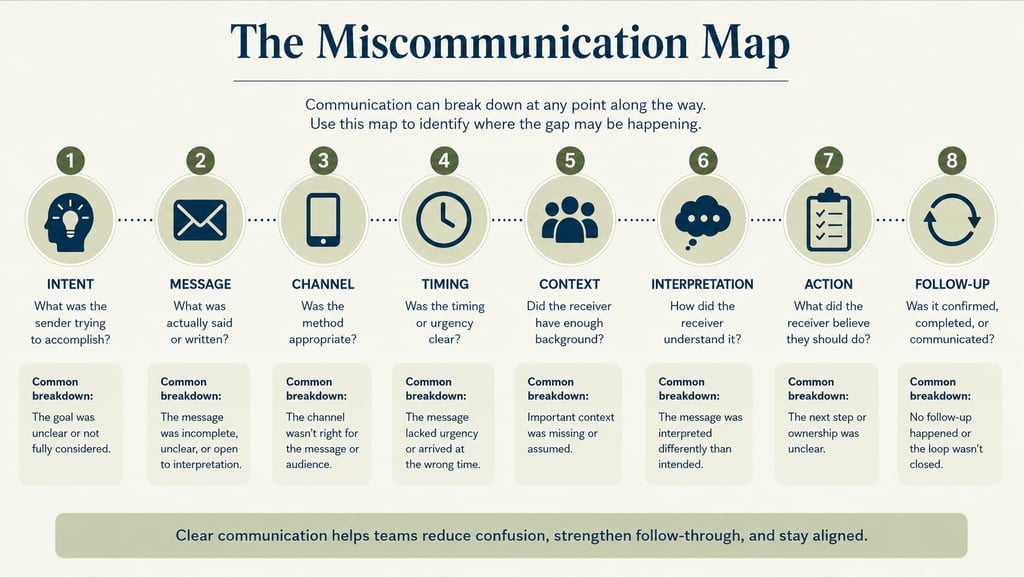
A Simple Framework: The Miscommunication Map
When a communication breakdown happens, it helps to look at the full path instead of focusing only on the moment of failure.
Use this simple map:
Intent
What was the sender trying to accomplish?
Message
What was actually said or written?
Channel
Was the method appropriate for the message?
Timing
Was the urgency or deadline clear?
Context
Did the receiver have enough background to understand the request?
Interpretation
How did the receiver understand the message?
Action
What did the receiver believe they were supposed to do?
Follow-up
Was ownership, completion, or the next step confirmed?
This framework can help leaders diagnose communication issues without turning the conversation into blame.
For example, if a project update failed, the issue may not be that someone “communicated poorly.” The issue may be that the decision was shared in the wrong channel, the deadline was unclear, and no one confirmed ownership.
A clear map helps the team fix the system.
Practical Questions for Managers
Managers can use these questions during one-on-ones, team meetings, retrospectives, or project reviews.
Clarity
What information do people need earlier?
Where are expectations still too vague?
Are we clear about who owns each next step?
Are decisions documented where people can find them?
Urgency
Do people know what requires a same-day response?
Are deadlines included with requests?
Are we overusing urgent language?
Are people comfortable asking how quickly something is needed?
Context
Are leaders sharing enough background before asking for action?
Are employees explaining risks and dependencies clearly?
Do different teams understand each other’s constraints?
Are handoffs carrying the right information forward?
Trust
Do people feel safe asking clarifying questions?
Are disagreements surfaced early enough?
Do people check interpretation before assuming intent?
Are communication misses treated as learning moments?
Habits
Are meetings ending with decisions and owners?
Are updates shared in consistent places?
Are communication norms written down?
Are leaders modeling the habits they expect?
These questions are simple enough to use immediately and specific enough to reveal where communication is breaking down.
How to Start Improving Communication Without Overcomplicating It
A team does not need a full communication overhaul to get better.
Start with one or two habits that reduce the most confusion.
Good starting points include:
Define which channels should be used for urgent, important, and informational messages.
Add deadlines to requests.
End meetings with decisions, owners, and next steps.
Create a simple handoff standard.
Ask people how they prefer to receive feedback and important updates.
Document decisions in one shared place.
Build five minutes of communication reflection into project reviews.
Use a team health check to identify the biggest friction points.
The Team Communication Health Check can help leaders see where communication may be creating confusion, delay, or frustration.
The most useful improvements are usually practical and repeatable. Teams need habits they can use during real work, not a complicated model that gets forgotten after one meeting.
Final Thought
Teams can miscommunicate even when everyone is trying.
The issue is often a mix of assumptions, unclear norms, different communication styles, weak handoffs, and uneven context. Good intentions help, but they do not replace shared expectations.
Leaders can reduce confusion by making communication more visible, specific, and consistent. They can define how decisions are made, how urgency is communicated, how handoffs work, and how people should ask for clarity.
Strong communication does not require everyone to communicate the same way. It requires enough shared understanding for different people to work together with less guessing.
When teams build that shared understanding, communication becomes less personal, less reactive, and more useful to the work.
Elevating Everyone
Stay Connected
doug.ward@elevatingeveryone.com
843-259-2055
© 2026. All rights reserved.
Elevate Everywhere Enterprises, LLC.