
Performance Gap Diagnostic Tool
Before you treat a performance issue as a training problem, take a closer look at what may really be getting in the way.
This free diagnostic helps leaders, managers, HR partners, and L&D professionals think through performance concerns with more clarity. Use it to explore whether the issue may be tied to skill, expectations, communication, feedback, process, workload, motivation, or leadership follow-through.


FREE TOOL
For leaders, managers, L&D, and HR leaders
8 to 12 minutes to complete
Customized summary and PDF report
Email required for the customized result





What you'll learn.
Identify likely contributing factors
See whether the concern may be connected to skill, clarity, communication, feedback, process, resources, motivation, or leadership follow-through.


Look beyond the surface issue
Separate the visible performance concern from the conditions that may be creating or reinforcing the pattern.


Choose a practical next step
Use your summary to prepare for a clearer conversation, define one focused action, and follow up over the next 30 days.
See the kind of summary the tool creates.
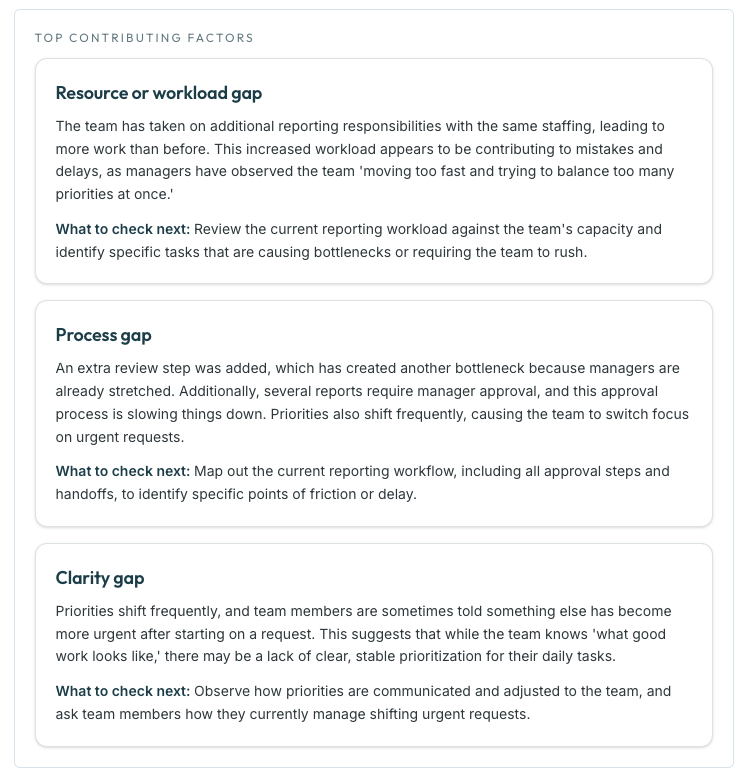
The diagnostic creates a practical report that helps leaders organize the issue, identify likely contributing factors, and prepare for a more focused conversation.
It does not replace HR guidance, legal advice, or your organization’s policies. It helps you think more clearly before choosing the next step.
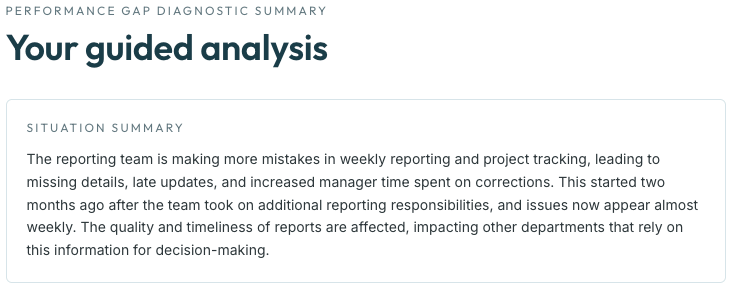
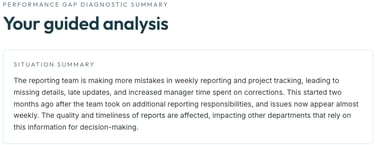
A helpful summary of the situation based on your input and perspective.
See which gaps may be contributing to the concern and what to check next.
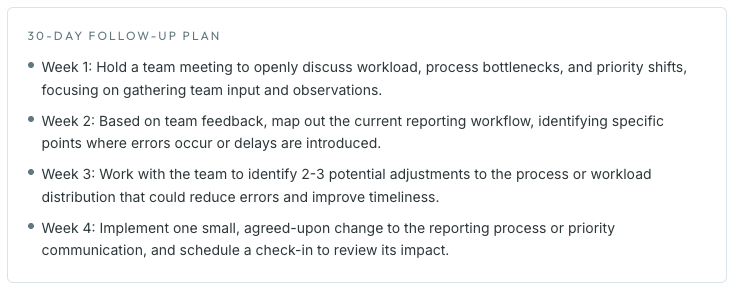
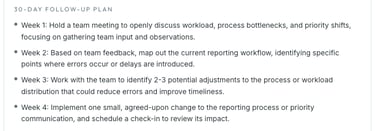
Turn the insight into a short, practical action plan.
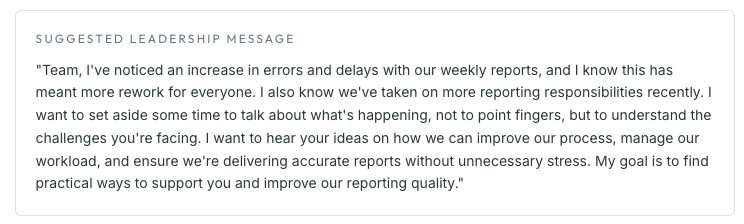
Get language you can adapt for a thoughtful conversation.
Who this tool is for.
This tool is designed for people who need to understand a performance concern before deciding what to do next.
It can be useful when the issue is visible, but the cause is not clear yet. A missed expectation may look like a skill problem at first. It may also be connected to unclear priorities, weak handoffs, delayed feedback, process friction, workload pressure, or inconsistent leadership follow-through.
The goal is to slow down, look at the situation more carefully, and identify the most useful place to start.
Leaders and managers addressing repeated missed expectations
HR partners helping leaders think through performance concerns
L&D professionals deciding whether training is the right solution
Team leaders seeing rework, missed handoffs, or inconsistent follow-through
Operations and customer experience leaders trying to understand performance friction
New managers preparing for a coaching or clarity conversation








How to use your results.
After completing the diagnostic, review your summary and look for the first area that deserves attention.
You do not need to solve everything at once. Start with one pattern, one conversation, or one practical change.
The result is meant to help you think more clearly before acting. It can help you prepare for a better conversation, clarify expectations, review a process, or identify where additional support may be needed.
Use the summary as a starting point for leadership reflection and planning.
Clarify one expectation
Observe the work before giving more feedback
Document a key process or handoff
Ask what is making the work harder than expected
Turn general feedback into specific examples
Review workload, priorities, or tools
Agree on one change to try over the next 30 days





Why performance gaps are often misread.
Performance problems are not always caused by a lack of skill.
Sometimes the issue is unclear expectations. Sometimes the person knows what to do, but feedback has been too general or too delayed. Sometimes the process is creating friction. Sometimes workload, staffing, or tools are affecting quality. Sometimes leaders have set expectations, but have not reinforced them consistently.
A skill gap may need training. A clarity gap may need better expectations. A feedback gap may need a more direct conversation. A process gap may need workflow changes. A workload gap may need a capacity review.
When leaders misread the gap, they often choose the wrong fix.
The Performance Gap Diagnostic Tool helps leaders pause long enough to ask a better question:
What is really getting in the way of the performance we need?
What the diagnostic reviews.
Skill or practice
Does the person need more training, practice, observation, or guided repetition?
Clarity
Are expectations, priorities, ownership, or “what good looks like” clear enough?
Communication
Are handoffs, updates, response times, or ownership boundaries breaking down?
Feedback
Has feedback been specific, timely, and connected to the full pattern?
Process
Are workflow steps, approvals, tools, or handoffs creating friction?
Resources or workload
Are capacity, staffing, workload, systems, or tools affecting performance?
Motivation or engagement
Could ownership, commitment, energy, or connection to the work need to be explored?
Leadership follow-through
Have expectations been reinforced consistently enough over time?
When to use this tool.
The Performance Gap Diagnostic Tool can be useful when:
A team member keeps missing follow-ups, deadlines, or updates
Work quality has declined and the reason is not clear
A team is creating more rework than usual
Communication or handoffs are breaking down
Expectations may be assumed but not clearly documented
Feedback has been general instead of specific
Workload, staffing, tools, or process friction may be affecting results
A leader wants to prepare for a more useful coaching conversation
HR or L&D needs to help a manager think through the issue before recommending training
This tool can also be used before a leadership coaching conversation, team discussion, performance support plan, process review, or training needs conversation.
Related support from Elevating Everyone.
If your diagnostic points to a broader leadership, communication, culture, or team performance challenge, Elevating Everyone can help you turn insight into action.
Support may include leadership development, team communication workshops, facilitated conversations, employee experience support, Elevating Insight, action planning, and practical follow-up support.
The work is designed to help leaders improve clarity, communication, accountability, and the conditions that help people perform well.
Helpful related pages:
Frequently Asked Questions
Is the Performance Gap Diagnostic Tool free?
Yes. The Performance Gap Diagnostic Tool is free to use.
Do I need to provide an email address?
Yes. An email address is required so the tool can generate and send your customized diagnostic summary.
How long does it take?
Most people can complete the diagnostic in about 8 to 12 minutes.
Who should use it?
The tool is useful for leaders, managers, HR partners, L&D professionals, business owners, and anyone responsible for helping people or teams improve performance.
Is this a performance review tool?
No. This is not a performance review, disciplinary tool, or HR compliance tool. It is a leadership reflection tool designed to help you think through what may be contributing to a performance concern.
Does the tool tell me what action to take with an employee?
No. The tool helps you identify likely contributing factors and suggests a practical next step. Employment decisions should follow your organization’s policies and appropriate professional guidance.
Can I use this with a team issue?
Yes. The tool can be used for individual or team performance concerns. The more specific your input is, the more useful the summary will be.
What should I do after receiving the report?
Start with one practical next step. That might be clarifying expectations, observing the work, giving more specific feedback, reviewing a process, or discussing workload and priorities.
Want help turning insight into action?
If your diagnostic points to a broader leadership, communication, culture, or performance challenge, Elevating Everyone can help you build practical solutions that fit the way your organization actually works.
Use the free tool to clarify the concern. Then, when you are ready, let’s talk about what the next step could look like.
Elevating Everyone
Stay Connected
doug.ward@elevatingeveryone.com
843-259-2055
© 2026. All rights reserved.
Elevate Everywhere Enterprises, LLC.