
Your Team Took a Workplace Assessment. Now What?
Learn how to turn workplace assessment results into better communication, stronger trust, and practical team habits without labeling your people.
LEADERSHIP AND COMMUNICATIONELEVATING INSIGHTEMPLOYEE EXPERIENCE AND CULTURE
5/21/20268 min read
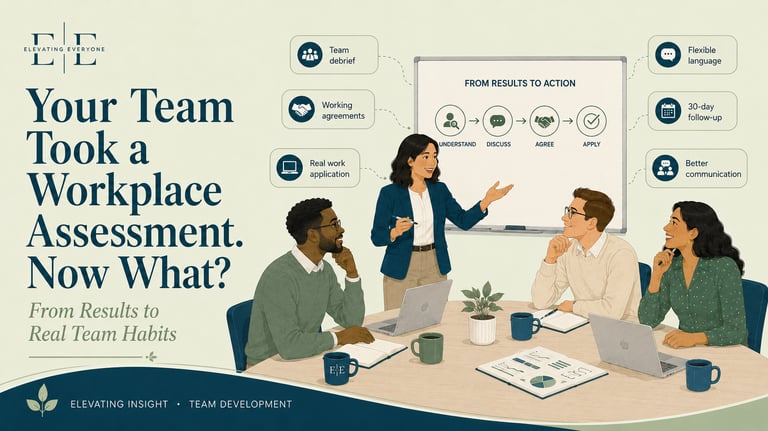
Updated July 2026: This article has been expanded with practical guidance, examples, and manager-focused steps for turning workplace assessment results into action.
Your Team Took a Workplace Assessment. Now What?
A workplace assessment can create a useful moment for a team.
People pause long enough to think about how they work, how they communicate, and how others may experience them. In a healthy setting, the results can open the door to conversations that may not happen during normal day-to-day work.
That moment has value.
It is also only the beginning.
The real impact of a workplace assessment comes after the results are delivered. A report can create awareness, but awareness alone does not change how a team operates.
The value comes when leaders and team members use the insight to build better habits, clarify expectations, and improve the way they work together.
Too often, teams complete an assessment, have one interesting discussion, and then move on.
The language fades. The reports sit in inboxes. The team may remember the activity, but very little changes in how meetings are run, how decisions are made, or how tension is handled.
A workplace assessment should not be treated as a one-time event.
It should be used as a practical starting point for stronger communication, better self-awareness, and more intentional teamwork.
This is also where Elevating Insight is designed to be different. The assessment is not treated as the outcome. It is used as the starting point for better communication, stronger trust, and practical team habits.
Start with the right purpose
Before using assessment results with a team, leaders need to be clear about the purpose.
People will engage differently depending on how they believe the information will be used.
If team members think the results are being used to label them, evaluate them, or explain their behavior away, they may become guarded. If they understand the results are being used for development, they are more likely to reflect honestly and participate in the conversation.
The purpose should be simple.
A workplace assessment helps people better understand how they tend to work, communicate, decide, and respond under pressure. It should create a shared language for discussing differences without making those differences personal.
The assessment should not be used to decide who is right or wrong. It should not be used to place people into fixed categories. It should not become a shortcut for explaining every behavior on the team.
Used well, it helps people notice patterns.
It gives the team a way to talk about those patterns with more clarity and less defensiveness.
A leader might frame the conversation this way:
“We are using this to better understand ourselves and each other. The purpose is better communication, stronger collaboration, and more effective teamwork. This is a development tool, not a performance review.”
That kind of clarity helps set the tone. It also protects trust, which is essential for any meaningful assessment conversation.
Debrief the team before focusing on individuals
One of the most important choices in an assessment process is how the results are introduced.
Leaders may be tempted to move quickly into individual profiles. That can work in some settings, but it can also make people defensive.
A better starting point is the team pattern.
When the conversation begins with the team, people can look at shared dynamics before they focus on individual tendencies. This helps reduce comparison and creates a more constructive discussion.
A team-level debrief might explore questions such as:
Where does this team tend to move quickly?
Where does this team tend to slow down?
Where do we need more clarity before moving forward?
Where do we create friction without meaning to?
What do we expect from each other but rarely say out loud?
These questions keep the focus on how the team works together. They also help people see that most workplace friction does not come from bad intent. It often comes from different expectations.
One person may want to move quickly and solve the problem. Another may want more information before deciding. One person may process ideas out loud. Another may need time to think before responding. One person may value direct conversation. Another may be more cautious when tension rises.
Without a shared language, those differences can feel personal. With a shared language, the team can discuss them more productively.
These differences often show up through workplace communication styles, especially when pace, detail, feedback, and urgency are involved.
Keep the language flexible
Assessment language should help people reflect. It should not make them feel boxed in. Even a useful framework can become limiting if the language becomes too rigid.
A person may have a strong tendency toward action and results, but that does not mean they cannot listen. A person may value stability and trust, but that does not mean they resist change. A person may prefer careful analysis, but that does not mean they are negative. A person may bring energy and connection, but that does not mean they lack focus.
People are more complex than any single result.
The best assessment conversations leave room for that complexity. They use language that invites reflection rather than creating a final answer about someone.
Helpful phrases include:
“You may tend to...”
“This may show up when...”
“Under pressure, this could look like...”
“A possible watch-out might be...”
“Does this feel accurate to you?”
That type of language keeps the conversation open.
It allows people to confirm, clarify, or challenge what they see in the results. It also reinforces that the assessment is a lens, not a label.
If your team has used DiSC or another style-based tool before, you may also find this helpful: Beyond DiSC: A Modern Way to Understand How Your Team Actually Works.
Turn insight into working agreements
Awareness becomes more useful when it leads to clear agreements.
After a team debrief, leaders should help the group identify a few practical ways to work better together. These agreements do not need to be complicated. They are usually more effective when they are simple, specific, and easy to apply.
For example, a team may realize that meetings create frustration because people come into them with different expectations. Some people expect discussion. Others expect decisions. Some want background information in advance. Others are comfortable thinking through the issue live.
That insight can become a meeting agreement.
The team might decide that every meeting invitation should clarify whether the meeting is for discussion, decision, planning, or information sharing. That small change can reduce frustration and help people prepare in a way that fits the purpose of the meeting.
The same approach can apply to communication.
A team may decide which topics need to be handled live, which updates should be written, and which messages require a faster response.
These agreements remove guesswork.
Decision-making is another important area.
Some teams move too quickly and create rework. Others gather more information than they need and lose momentum. Assessment results can help teams discuss how they balance speed, input, and clarity.
Feedback and conflict also benefit from clear agreements.
Teams can decide how they will raise concerns, how they will challenge ideas respectfully, and how they will revisit conversations when tension remains unresolved. This is where assessment results become practical.
The team moves from “That sounds like me” to “Here is how we will work better together.”
Where Elevating Insight fits
Elevating Insight was built for this step.
The assessment helps people understand workplace behavioral tendencies. The debrief helps the team connect those tendencies to real work. That includes how people communicate, make decisions, respond under pressure, give feedback, and create friction without meaning to.
The purpose is not to hand people a label. The purpose is to help the team use insight to work better together. That means the conversation should move beyond individual profiles.
A team should leave with practical answers.
How do we communicate when urgency increases?
How do we handle disagreement?
How do we give feedback?
How do we clarify ownership?
How do we make better decisions?
How do we support different working styles without excusing poor habits?
This is the difference between completing an assessment and using one.
The assessment starts the conversation.
The follow-through creates the value.
Use the results during real work
The assessment should not live only in a report or workshop conversation. It becomes more valuable when the team uses the language during normal work.
A leader might reference the assessment when a meeting gets stuck. They might use it when a decision keeps circling. They might bring it into a conversation when communication has broken down or when team members seem to be talking past each other.
For example, a team may be debating whether to move forward with a decision. Some people feel ready to act. Others feel the plan still has gaps. Without a shared language, that moment can become frustrating.
With the assessment language, a leader might say:
“We may be seeing different needs around pace and clarity. Some of us are ready to move. Others need more confidence in the details. Let’s name what each group needs so we can make a better decision.”
That kind of statement changes the tone. It reduces blame and brings the conversation back to the work. It also gives people a way to explain what they need without sounding difficult.
This is one of the most important benefits of a workplace assessment. It helps teams talk about differences before those differences turn into conflict. If the same issues keep showing up after meetings, the team may be dealing with broader team communication problems.
Avoid the most common mistakes
Workplace assessments can support healthy team development.
They can also create problems when used poorly.
Treating results like labels
When people become labels, curiosity disappears. Team members may start assuming what someone will think, how they will respond, or what they can handle. That limits trust and reduces the value of the conversation.
Using results as excuses
A tendency may explain why something feels natural.
It should not excuse behavior that hurts the team.
Someone who prefers speed still needs to bring others along. Someone who needs time to process still needs to engage. Someone who values harmony still needs to speak honestly. Someone who focuses on precision still needs to recognize when the team has enough information to move forward.
Self-awareness should increase ownership.
Skipping the debrief
Sending people their results without a guided conversation limits the impact. People need time to interpret what the results mean. They also need help connecting the insight to real work.
Treating the assessment as a one-time activity
A single conversation may spark awareness. Sustained use creates the real value. Leaders should revisit the language during team meetings, planning sessions, and moments of friction.
Damaging trust
People should understand how results will be used, who will see them, and what will remain private. If trust is damaged, the assessment becomes something people endure instead of something they use.
A simple 30-day follow-up plan
A workplace assessment does not need a complicated implementation plan. A simple 30-day follow-up can help the team turn insight into action.
Before choosing a follow-up habit, the Team Communication Health Check can help identify where communication is clear and where friction may be building.
Week 1: Hold the team debrief
Focus on shared patterns, team strengths, and possible friction points.
Keep the tone practical and respectful.
Week 2: Choose one working agreement
The team might focus on meetings, communication, decision-making, feedback, or conflict.
Choose one useful change.
Do not try to fix every issue at once.
Week 3: Apply the agreement during real work
Reference it in meetings.
Use it when decisions are being made.
Bring it into conversations when expectations are unclear.
Week 4: Revisit the agreement
Ask what worked, what felt forced, and what needs to change.
Teams are more likely to keep using a habit when they help shape it.
Small follow-up steps can make a difference. They show the team that the assessment was not just an activity. It was part of a larger commitment to working better together.
The real value comes after the results
A workplace assessment can open an important door for a team.
It can help people see themselves more clearly. It can help coworkers understand each other with more empathy. It can give leaders a practical language for coaching, communication, and team development.
But the assessment itself does not create lasting change. The change comes from the conversations that follow. It comes from the agreements the team makes. It comes from the leader who uses the language when the work gets messy.
It comes from the team that pauses long enough to ask:
“What is really happening here, and how can we work through it better?”
When teams use assessment results with care, they gain more than insight. They gain a practical way to improve how they communicate, make decisions, and handle pressure together.
Related resources
Ready to turn assessment results into action?
A workplace assessment should create more than awareness. Elevating Insight helps teams use behavioral insight to improve communication, collaboration, feedback, and follow-through.
Explore Elevating Insight or learn more about team communication consulting from Elevating Everyone.
Elevating Everyone
Stay Connected
doug.ward@elevatingeveryone.com
843-259-2055
© 2026. All rights reserved.
Elevate Everywhere Enterprises, LLC.