
How to Improve Team Communication: A Practical Guide for Managers
A practical guide for managers who want to improve team communication, reduce confusion, strengthen trust, and help people work together with more clarity.
LEADERSHIP AND COMMUNICATION
6/30/20267 min read
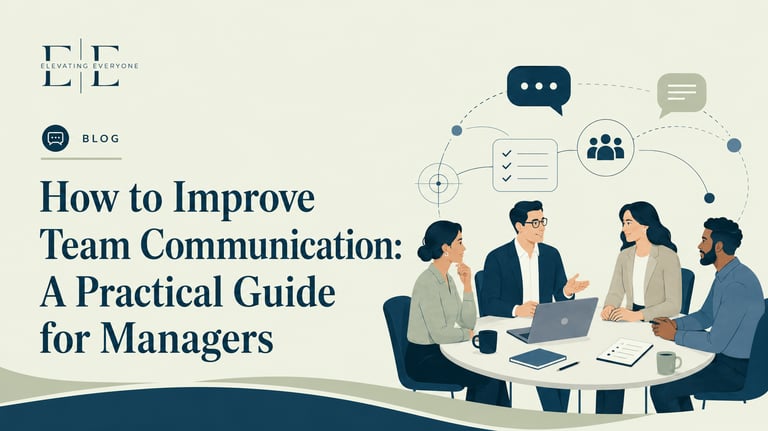
How to Improve Team Communication: A Practical Guide for Managers
Team communication affects almost everything a manager is responsible for.
It shapes how clearly people understand priorities, how quickly decisions get made, how well handoffs happen, how much trust exists on the team, and whether people follow through after a conversation ends.
When communication is working, teams move with more confidence. People know what matters. They understand who owns what. They know where to ask questions, how to raise concerns, and what needs to happen next.
When communication is weak, work gets heavier. People repeat conversations, miss details, make assumptions, duplicate effort, or wait too long for answers. Managers spend more time clarifying, correcting, and reminding.
Improving team communication does not require a complicated system. It requires practical habits that help the right information move clearly, consistently, and at the right time.
Start by defining what needs to be clear
Many communication problems begin with unclear expectations.
A manager may believe a message was obvious. A team member may leave the same conversation with a different understanding. Another person may not know whether they own the next step. Someone else may assume the decision is still open.
Clarity is the foundation of team communication.
Managers can strengthen clarity by making a few things explicit:
What matters most right now
Who owns each decision or action item
What needs to happen next
When follow-up is expected
How updates should be shared
Where people should go for accurate information
What should be escalated
What does not need immediate attention
Teams do not need more communication for the sake of it. They need useful communication that reduces confusion and helps people act.
A good question for managers is:
What are people still having to guess?
That question often reveals where communication needs to improve.
Make ownership visible
Unclear ownership creates unnecessary friction.
A meeting may end with agreement, but no clear owner. A customer issue may move between people without anyone knowing who is responsible for the next update. A project may stall because everyone thought someone else was handling the follow-up.
Managers can improve team communication by making ownership visible.
After important conversations, confirm:
Who owns the next step
What the expected outcome is
When it is due
Who needs to be informed
What support is needed
What should happen if the work gets blocked
This does not need to be formal or heavy. It can be as simple as ending a meeting with a quick recap:
Here is what we decided. Here is who owns each item. Here is when we will check back.
That small habit prevents a lot of avoidable confusion.
Build better meeting habits
Meetings are one of the most visible signs of a team’s communication health.
A good meeting creates clarity, alignment, decisions, and action. A weak meeting adds time without improving the work.
Managers should look at meetings as communication tools, not calendar events.
Before holding a meeting, ask:
What decision needs to be made?
What information needs to be shared?
Who actually needs to be included?
What should people know before the meeting?
What should be different when the meeting ends?
Many meetings become frustrating because the purpose is unclear. People attend without knowing whether they are there to decide, discuss, listen, solve, or update.
A simple meeting structure can help:
Start with the purpose.
Name the decision or outcome needed.
Keep the conversation focused.
Confirm owners and next steps.
Close with what will happen after the meeting.
Improving meetings is one of the fastest ways to improve team communication because meetings often create the downstream work everyone else has to live with.
Balance live communication and written communication
Teams need both conversation and documentation.
Live conversation helps people discuss, clarify, challenge ideas, and build connection. Written communication helps people remember, reference, and stay aligned after the conversation ends.
Problems happen when teams rely too heavily on one side.
Too many live conversations can create meeting overload and leave people without a clear record of decisions. Too much written communication can create confusion when people interpret messages differently or miss important context.
Managers should help teams decide what belongs where.
Use live conversation for:
Sensitive topics
Problem-solving
Conflict or tension
Complex decisions
Coaching and feedback
Work that needs discussion or judgment
Use written communication for:
Decisions
Action items
Process updates
Meeting notes
Reference information
Status updates
Changes people may need to revisit later
A strong communication rhythm gives people fewer places to search and fewer opportunities to miss important information.
Create psychological safety through consistent behavior
People communicate more honestly when they trust how their manager and team will respond.
If employees are punished for raising concerns, they stop raising them. If questions are treated as interruptions, people stop asking. If mistakes are met with blame, people hide problems until they become larger.
Managers influence communication through their reactions.
When someone raises a concern, the manager’s response teaches the team whether honesty is safe. When someone asks a question, the response teaches the team whether clarity is welcome. When someone disagrees respectfully, the response teaches the team whether different perspectives are valued.
Psychological safety is built through consistent behavior.
Managers can support it by:
Thanking people for raising concerns
Asking follow-up questions before reacting
Separating the person from the problem
Inviting quieter voices into the discussion
Acknowledging when something was unclear
Admitting when they do not have the answer yet
Closing the loop after feedback is shared
Teams communicate better when people believe they can speak honestly without creating unnecessary risk for themselves.
Improve feedback before it becomes formal
Feedback should not only happen during performance reviews or after something goes wrong.
Strong teams build feedback into normal work.
That does not mean constant criticism. It means people know how to discuss what is working, what is not working, and what needs to change before issues grow.
Managers can make feedback more useful by keeping it specific and connected to the work.
Instead of saying:
You need to communicate better.
Say:
When the project timeline changed, the team did not know until the day before the deadline. Next time, let the group know as soon as a timeline shifts so people can adjust their work.
Useful feedback explains the behavior, the impact, and the adjustment needed.
Managers should also ask for feedback from the team. A simple question can open the door:
What is one thing I could communicate more clearly?
That question shows the team that communication improvement is shared work, not only something employees are expected to fix.
Pay attention to communication styles
People communicate differently.
Some people are direct and move quickly. Others need more context before responding. Some want to talk through ideas. Others prefer time to think before they contribute. Some people focus on relationships and tone. Others focus on details, risks, and next steps.
These differences can strengthen a team when people understand them. They can create friction when people misread them.
A direct person may be seen as impatient. A detailed person may be seen as slowing things down. A quieter person may be seen as disengaged. A highly collaborative person may be seen as pulling people into too many conversations.
Managers can improve team communication by helping people understand how they tend to communicate and what others may need from them.
This does not require labeling people or putting them into boxes. It means creating better awareness.
Managers can ask:
How do you prefer to receive important updates?
When do you need more context?
What type of communication helps you do your best work?
Where do misunderstandings usually happen?
What do you wish people understood about your communication style?
Better style awareness helps teams reduce assumptions and build more effective working relationships.
Reduce communication clutter
Sometimes communication problems are caused by too little information. Other times, they are caused by too much information in too many places.
Messages may be spread across email, chat, meetings, project tools, hallway conversations, shared documents, and individual follow-ups. People may not know which channel matters most. They may miss important updates because everything feels urgent.
Managers should help teams reduce communication clutter.
That starts with setting simple channel expectations.
For example:
Use chat for quick questions and simple coordination.
Use email for formal updates and external communication.
Use the project tool for tasks, owners, and deadlines.
Use meetings for decisions, discussion, and problem-solving.
Use shared documents for reference materials.
The exact system matters less than the shared understanding.
When people know where to communicate and where to find information, work becomes easier to follow.
Close the loop
Follow-through is one of the most important communication habits a manager can build.
A team can have a good conversation, make a good decision, and still lose momentum if no one closes the loop.
Closing the loop means confirming what happened after the conversation.
It may include:
Sharing the decision
Confirming next steps
Updating the team on progress
Explaining why something changed
Letting people know feedback was heard
Reporting what action was taken
Naming what will happen next
This habit builds trust because people see that communication leads somewhere.
When leaders do not close the loop, people may stop offering input. They may assume decisions were made elsewhere. They may question whether their concerns mattered.
A manager does not need to have every answer immediately. But they should keep people informed enough to maintain confidence in the process.
A practical way to improve team communication
Managers can start with a simple review of the team’s current communication habits.
Ask the team:
Where are we clear?
Where are we creating confusion?
Which meetings are helping?
Which meetings are not helping?
Where do handoffs break down?
What information is hard to find?
Where do we need better follow-through?
What communication habit would make the biggest difference right now?
The goal is not to fix everything at once. The goal is to choose one communication habit that will reduce friction and improve the way work gets done.
A team might decide to improve meeting recaps. Another team might clarify communication channels. Another might create a better process for handoffs or decisions. Another might build more direct feedback into regular conversations.
Small changes can have a large impact when they are specific and consistent.
Managers set the communication standard
Team communication improves when managers model the habits they expect.
If a manager wants clarity, they need to be clear. If they want follow-through, they need to follow through. If they want honest feedback, they need to respond well when people share it. If they want better meetings, they need to run meetings with purpose.
The manager’s behavior becomes the signal.
People watch what leaders repeat, what they ignore, what they reward, and what they allow.
Improving team communication is one of the most practical ways a manager can improve performance. It reduces confusion, strengthens trust, supports accountability, and helps people spend more time doing the work instead of trying to interpret the work.
Strong communication does not happen by accident.
It is built through habits that make work clearer, decisions easier to follow, and people more confident in how they contribute.
A useful starting point
If you want a quick way to assess your team’s current communication habits, start with the Team Communication Health Check.
It can help you identify where your team is already communicating well and where clarity, trust, feedback, meetings, or follow-through may need more attention.
For deeper support, Elevating Everyone works with leaders and teams to improve communication, collaboration, employee experience, and the routines that help work get done more effectively.
Elevating Everyone
Stay Connected
doug.ward@elevatingeveryone.com
843-259-2055
© 2026. All rights reserved.
Elevate Everywhere Enterprises, LLC.