
The 4 Workplace Communication Styles and How to Work With Each
Learn the four workplace communication styles and how managers can reduce friction, improve feedback, and help teams work together more effectively.
LEADERSHIP AND COMMUNICATIONEMPLOYEE EXPERIENCE AND CULTUREELEVATING INSIGHT
7/3/20267 min read
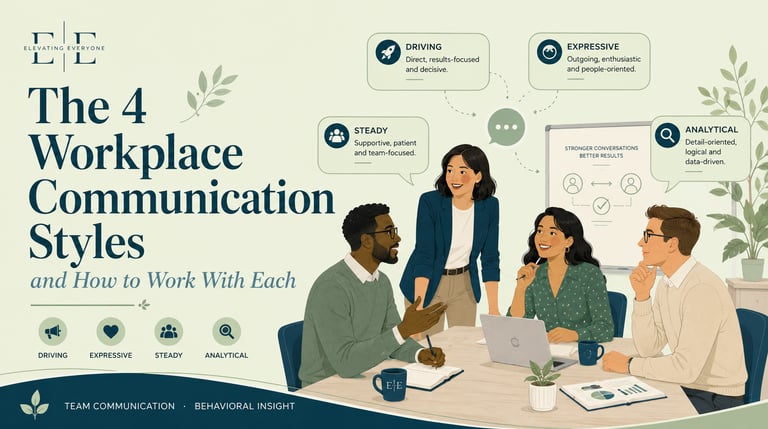
The 4 Workplace Communication Styles and How to Work With Each
Communication at work has become harder to manage.
Teams use more channels, move faster, and carry more information than ever. Grammarly’s 2025 workplace productivity research estimated that poor communication costs businesses $9,284 per employee each year. Microsoft also found that highly interrupted employees receive work pings every two minutes during core work hours. Gallup’s engagement research connects stronger employee engagement with better collaboration and stronger customer outcomes.
Those findings point to a simple issue.
Communication is not only about the message. It is also about how people receive, process, and respond to that message.
Every team has different communication styles. Some people want the headline first. Some need time to think. Some talk through ideas out loud. Some want the details before making a decision.
When leaders understand those differences, they can reduce friction. They can also make feedback, meetings, collaboration, and conflict easier to navigate.
A communication style is not a personality label. It is a pattern. It reflects how someone tends to share information, respond to pressure, make decisions, and engage with others.
Here are four common workplace communication styles.
1. The Driving Communication Style
Driving communicators are direct, focused, and action-oriented.
They usually want the point quickly. They value clarity, ownership, and progress. They may get frustrated when conversations feel slow, vague, or overly detailed.
In meetings, they often push for decisions. In projects, they want roles and next steps clearly defined. In conflict, they may move quickly toward resolution.
What Driving communicators often bring
Driving communicators help teams move.
They can cut through confusion and create momentum. They are often comfortable making decisions with limited information. They can be especially helpful when a team is stuck, unclear, or avoiding action.
They usually ask questions like:
What is the decision?
Who owns this?
What is the timeline?
What are we doing next?
Where friction can happen
Their directness can feel sharp to others.
A Driving communicator may think they are being efficient. Others may experience the same message as impatient or dismissive.
They can also move past important context too quickly. This may create rework later.
How to work with a Driving communicator
Lead with the main point.
Give them the recommendation, decision, or risk first. Then provide supporting details.
Be clear about ownership. Avoid long setup when a direct answer is available.
Try this:
“Here is the recommendation. Here are the two reasons. Here is the decision needed today.”
2. The Expressive Communication Style
Expressive communicators are energetic, verbal, and idea-oriented.
They often process thoughts through conversation. They may enjoy brainstorming, storytelling, and connecting ideas across people or projects.
In meetings, they can bring energy. In group settings, they often help others engage. In change, they may help the team see possibilities.
What Expressive communicators often bring
Expressive communicators help teams connect.
They often bring creativity, enthusiasm, and relational energy. They can make conversations feel more open and collaborative.
They usually ask questions like:
What are the possibilities?
Who needs to be involved?
How will this land with people?
What could this become?
Where friction can happen
Their ideas can move faster than the team can process.
Others may feel the conversation is jumping around. A team may also confuse early brainstorming with a final commitment.
Expressive communicators may need help narrowing ideas into clear next steps.
How to work with an Expressive communicator
Make room for ideas, then create structure.
Let the conversation breathe. Then summarize the decision, owner, and timeline.
Try this:
“These are strong ideas. Let’s choose the top two and decide what happens next.”
3. The Steady Communication Style
Steady communicators are thoughtful, supportive, and relationship-aware.
They often value calm, trust, and consistency. They may prefer time to process before responding. They usually pay close attention to how decisions affect people.
In meetings, they may not speak first. In conflict, they may try to reduce tension. In change, they may look for stability and reassurance.
What Steady communicators often bring
Steady communicators help teams stay grounded.
They often notice morale, trust, and team dynamics. They may sense concerns before others name them.
They usually ask questions like:
How will this affect the team?
Have we heard from everyone?
What support will people need?
Are we moving too quickly?
Where friction can happen
Their patience can be mistaken for agreement.
A Steady communicator may stay quiet to keep peace. Others may assume they have no concerns.
They may also avoid direct disagreement until tension builds.
How to work with a Steady communicator
Invite their perspective directly.
Give them time to think. Avoid putting them on the spot without context.
Try this:
“I would value your read on how this may affect the team. Take some time and send me your thoughts.”
4. The Analytical Communication Style
Analytical communicators are precise, structured, and detail-oriented.
They often want facts, context, and logic before deciding. They may be careful with language because accuracy is important to them.
In meetings, they may ask clarifying questions. In projects, they often identify risks. In conflict, they may focus on facts more than feelings.
What Analytical communicators often bring
Analytical communicators help teams think clearly.
They can prevent rushed decisions. They often spot gaps, risks, and assumptions others miss.
They usually ask questions like:
What data supports this?
What are the risks?
What are the options?
How will we measure success?
Where friction can happen
Their questions can feel like resistance.
An Analytical communicator may be trying to improve the decision. Others may hear hesitation or criticism.
They may also need more time before committing.
How to work with an Analytical communicator
Provide context before asking for agreement.
Share the facts, assumptions, risks, and decision criteria. Give them time to review when possible.
Try this:
“Here is the data we have. Here are the assumptions. I would like your review before we finalize.”
Most team friction comes from style collisions
Many communication problems are not caused by bad intent.
They happen when people use different communication patterns without realizing it.
A Driving communicator may want speed.
An Analytical communicator may want proof.
An Expressive communicator may want discussion.
A Steady communicator may want trust and stability.
None of those needs are wrong.
The issue comes when each person assumes their preferred style is the standard everyone else should use.
That assumption creates avoidable friction.
A manager might say:
“We already discussed this.”
A team member may think:
“We talked about it, but we never clarified the decision.”
Another employee might say:
“No one told me this was urgent.”
The leader may think:
“I said it in the meeting.”
Workplace communication improves when teams stop relying on assumption.
How managers can adapt to each style
Strong communication does not require leaders to become someone else.
It requires leaders to adjust the delivery.
When speaking to a Driving communicator
Be brief, clear, and action-focused.
Use:
clear recommendations
ownership
deadlines
decision points
Avoid:
long background before the point
unclear next steps
vague requests
When speaking to an Expressive communicator
Create room for conversation and ideas.
Use:
brainstorming
discussion
connection to people
visible enthusiasm
Avoid:
shutting down ideas too early
moving straight to task without context
confusing energy with lack of focus
When speaking to a Steady communicator
Build trust and invite input.
Use:
calm tone
clear expectations
time to process
direct invitation to share concerns
Avoid:
sudden changes without context
public pressure
assuming silence means agreement
When speaking to an Analytical communicator
Bring facts and structure.
Use:
data
examples
logic
clear criteria
Avoid:
unsupported claims
rushed decisions
vague explanations
Communication styles become more visible under pressure
Most people can adjust when things are calm.
Pressure makes style differences sharper.
A Driving communicator may become more forceful.
An Expressive communicator may talk faster or expand the conversation.
A Steady communicator may withdraw to avoid tension.
An Analytical communicator may ask more questions before moving forward.
Leaders should watch for those patterns.
Pressure does not create the style. It reveals the default.
This is useful information.
It helps leaders know when to slow down, clarify, check understanding, or bring people back together.
How to use communication styles without boxing people in
A communication style should start a conversation.
It should not become a permanent label.
People are more complex than one style. They may communicate differently based on the audience, the task, the stress level, or the stakes involved.
The best use of communication styles is practical.
Use them to ask better questions:
How do you prefer to receive feedback?
What information helps you make decisions?
What causes communication frustration for you?
When do you need time to process?
What helps you speak up in meetings?
What makes a conversation feel productive?
Those questions create better team habits.
They also reduce the guesswork that causes many communication breakdowns.
A simple team exercise
Use this exercise in a team meeting.
Ask each person to answer four questions:
What helps me communicate clearly?
What causes frustration for me in team communication?
What do I need when receiving feedback?
What should others know about working with me?
Then discuss common themes.
Look for patterns across the team.
You may find that some people need more written follow-up. Others may want shorter meetings. Some may need clearer ownership. Others may need more time before responding.
The value comes from making hidden preferences visible.
Communication styles should lead to better habits
Understanding styles is useful only when behavior changes.
A team should be able to turn insight into agreements.
For example:
We will end meetings with decisions and owners.
We will separate brainstorming from final decisions.
We will share key updates in writing.
We will give people time to prepare for major discussions.
We will clarify urgency instead of assuming it.
We will ask for concerns before closing decisions.
These habits help different styles work together.
They also make communication less dependent on one person’s instincts.
Start with your own communication style
If you lead a team, begin with yourself.
Ask:
Do I overuse my preferred style?
Do I mistake different styles for resistance?
Do I communicate urgency clearly?
Do I give enough context?
Do I leave space for quieter voices?
Do I summarize decisions and next steps?
Leaders set the communication pattern.
When leaders adapt, teams usually follow.
For a quick starting point, take the Workplace Communication Style Quiz. It can help you identify your natural communication tendencies and see where friction may show up.
If your team needs help turning communication insight into better habits, explore team communication consulting from Elevating Everyone.
Communication styles become more useful when teams turn insight into shared habits. The Team Communication Health Check can help identify where communication is clear and where friction may be building.
Final thought
Better communication starts with awareness.
Teams work better when people understand how others process information, respond to pressure, and make decisions.
The four workplace communication styles give managers a practical language for that work.
They help teams move from frustration to clarity.
They also help leaders build the kind of communication habits that support trust, performance, and follow-through.
For teams that want a deeper view of how people communicate, collaborate, and respond under pressure, Elevating Insight provides a more complete team development experience.
Elevating Everyone
Stay Connected
doug.ward@elevatingeveryone.com
843-259-2055
© 2026. All rights reserved.
Elevate Everywhere Enterprises, LLC.