
Beyond the Box: Why Today's Teams Need More Than a Behavioral Type
Behavioral assessments can build awareness, but teams need more than labels. Learn how Elevating Insight helps teams understand workplace tendencies and turn insight into better communication, trust, and collaboration.
ELEVATING INSIGHTEMPLOYEE EXPERIENCE AND CULTURELEADERSHIP AND COMMUNICATION
4/16/20268 min read
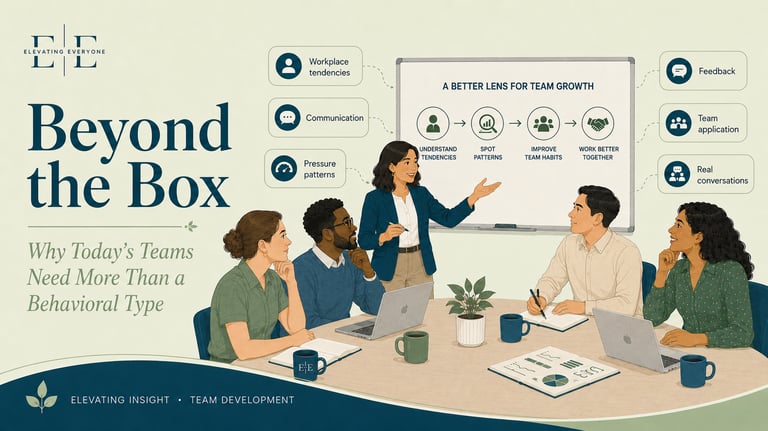
Updated July 2026: This article has been refreshed to better reflect the Elevating Insight framework and how teams can use workplace tendencies in real work.
Beyond the Box: Why Today’s Teams Need More Than a Behavioral Type
Behavioral assessments can help teams. They can create language. They can build self-awareness. They can help people understand why others communicate, decide, and respond differently.
That has value.
Many leaders have seen a good assessment open up a useful conversation. People recognize themselves. Coworkers start to understand each other. A team finds a way to discuss differences without making those differences personal.
But there is a risk.
A helpful tool can become too small for the complexity of real work. When people are reduced to a type, color, letter, or label, the conversation can stop too early.
Someone becomes “the direct one.”
Someone else becomes “the quiet one.”
Another person becomes “the detail person.”
Another becomes “the people person.”
Those shortcuts may feel useful at first. Over time, they can limit how people see themselves and each other. Today’s teams need more than a box. They need a practical way to understand how people work, communicate, collaborate, respond under pressure, and contribute to the team.
That is the idea behind Elevating Insight.
It is designed as a lens, not a label.
Why behavioral types became popular
Simple frameworks became popular because they solved a real problem. Workplaces needed an easier way to talk about behavior. Without a shared language, people often personalize differences.
A fast-moving person may see a careful teammate as slow.
A detailed person may see a quick decision-maker as careless.
A relational person may see direct feedback as harsh.
A direct person may see relational caution as avoidance.
Those interpretations can create tension.
A behavioral framework helps people pause and reconsider.
Maybe the other person is not being difficult.
Maybe they are working from a different set of needs.
Maybe they communicate differently.
Maybe they process risk, urgency, or trust in a different way.
That shift can be powerful. It helps people replace judgment with curiosity. For that reason, behavioral assessments will continue to have a place in leadership development, coaching, and team building. The issue is not whether assessments help. The issue is whether the insight goes far enough.
Where labels start to limit the conversation
A behavioral label can create understanding.
It can also become a shortcut.
A person might say:
“That is just how I am.”
A manager might say:
“She is always going to be that way.”
A team member might assume:
“He will not want to be involved in this.”
Those statements may sound harmless. They can still create problems. A style should explain a tendency. It should not define a person. People are more flexible than a single result. They also behave differently depending on the situation, relationship, pressure, and expectations around them.
A person may be direct in a crisis but patient in coaching.
A person may be analytical with strategy but relational with customers.
A person may prefer stability but still lead well through change.
A person may bring energy to a team but still need quiet time to think.
That complexity gets lost when the label becomes the story. Good assessment work should expand the conversation. It should not narrow it.
What a workplace tendency means
Elevating Insight uses the idea of workplace tendencies. A tendency is not a fixed identity. It is a pattern. It reflects how someone may naturally approach work, communication, decisions, pressure, and relationships.
That distinction is important.
A type can sound permanent.
A tendency leaves room for context, growth, and choice.
A workplace tendency helps people ask better questions.
How do I usually communicate?
How do I respond when pressure increases?
What do I need from others to do my best work?
Where might I create friction without meaning to?
What strengths do I bring to the team?
What should I watch for when I am stressed?
How can others work with me more effectively?
These questions are more useful than asking people to memorize a label. They help move the team from identification to application.
The four Elevating Insight tendencies
Elevating Insight looks at four workplace tendencies. Each tendency reflects a different way people may show up at work.
Driving
Driving reflects action, urgency, ownership, and results.
People with a strong Driving tendency may move quickly. They often want clarity, accountability, and progress.
They may ask:
What is the decision?
Who owns this?
What needs to happen next?
How do we move this forward?
This tendency can help a team gain momentum.
Under pressure, it can also become too forceful or impatient.
Expressive
Expressive reflects energy, connection, influence, and ideas.
People with a strong Expressive tendency may enjoy conversation, brainstorming, and engaging others.
They may ask:
Who needs to be involved?
How will this land with people?
What are the possibilities?
How can we create energy around this?
This tendency can help a team connect and generate ideas.
Under pressure, it can also move too quickly or create too many directions.
Steady
Steady reflects trust, support, patience, and stability.
People with a strong Steady tendency may pay close attention to people, relationships, and team climate.
They may ask:
How will this affect the team?
Have we heard from everyone?
What support will people need?
Are we moving too fast?
This tendency can help a team stay grounded.
Under pressure, it can also avoid tension or delay direct feedback.
Analytical
Analytical reflects precision, structure, logic, and depth.
People with a strong Analytical tendency may want facts, context, and clear reasoning before moving forward.
They may ask:
What data supports this?
What are the risks?
What are the options?
How will we measure success?
This tendency can help a team think clearly.
Under pressure, it can also slow progress or overfocus on what is missing.
Why the blend matters more than the box
The real insight is not found in one tendency. It is found in the combination.
People are not only Driving, Expressive, Steady, or Analytical. Most people carry some mix of all four.
One person may be highly results-oriented and still deeply relational.
Another may value stability but also bring strong analytical discipline.
Another may be expressive in group settings but more cautious under pressure.
Another may prefer data but still move quickly when trust is high.
The blend creates the story. It helps explain why two people with similar outward behavior may need different support. It also helps explain why a person may show up differently across situations. This is one reason Elevating Insight is built around tendencies instead of boxes.
The focus is not “what are you?”
The focus is “how do you operate?”
That is a better question for real teams.
How this helps with team communication
Most team issues show up through communication first.
A decision is discussed but not clarified.
A meeting creates conversation but no ownership.
A concern is raised too late.
Feedback gets softened until it loses meaning.
People use different channels and assume everyone is aligned.
Behavioral insight helps teams understand why these patterns happen.
A Driving tendency may want the headline first.
An Analytical tendency may want more detail before deciding.
An Expressive tendency may want discussion and connection.
A Steady tendency may want trust, calm, and time to process.
None of those needs are wrong. The issue comes when people assume their preferred way is the standard. That assumption creates friction. Understanding workplace communication styles gives teams a better way to discuss those differences. It also helps leaders adapt their communication without losing clarity.
How this helps with feedback and conflict
Feedback often breaks down because people do not experience it the same way.
Some people want direct feedback quickly.
Some need context before they can receive it well.
Some need to know the relationship is still solid.
Some need clear examples and specific next steps.
A leader who understands those differences can give feedback more effectively. That does not mean avoiding hard conversations. It means choosing language that helps the person hear the message and act on it.
Conflict works the same way.
A person with a strong Driving tendency may move quickly into resolution.
A person with a strong Steady tendency may try to reduce tension.
A person with a strong Analytical tendency may focus on facts.
A person with a strong Expressive tendency may want to talk through impact and meaning.
Those patterns can either help the team or frustrate it. The difference is whether the team can name what is happening. When teams understand these tendencies, conflict becomes less personal. It becomes a conversation about needs, expectations, and behaviors.
How this helps under pressure
Pressure reveals patterns. When work is calm, most people can adjust. When deadlines tighten, customers escalate, roles shift, or change accelerates, people usually lean harder into familiar tendencies.
The direct person may become more forceful.
The relational person may avoid difficult conversations.
The analytical person may ask for more information.
The expressive person may generate more ideas or move faster.
Those responses are not automatically bad. They can become problems when the team does not recognize them. Elevating Insight helps teams talk about pressure responses before they turn into frustration.
A leader can ask:
What do we each need when urgency increases?
Where do we tend to overcorrect?
How do we keep communication clear under pressure?
What does each person need to stay engaged and effective?
What habits help us recover after tension rises?
Those questions create better team awareness. They also create better team agreements.
From insight to working agreements
The value of any assessment comes after the results. A team should be able to turn insight into practical agreements.
For example:
We will clarify the purpose of each meeting.
We will separate brainstorming from decision-making.
We will document decisions and owners.
We will clarify urgency in written requests.
We will invite concerns before decisions close.
We will give feedback close to the behavior.
We will avoid using style language as an excuse.
We will revisit team agreements when pressure increases.
These agreements are simple. They are also powerful when leaders use them consistently. For more on turning assessment results into team habits, read Your Team Took a Workplace Assessment. Now What?.
Where Elevating Insight fits
Elevating Insight helps teams use behavioral awareness in a practical way. The assessment creates insight into workplace tendencies. The debrief helps teams connect that insight to communication, trust, decision-making, feedback, and collaboration. The work is designed to help people understand themselves without being boxed in. It also helps teams have better conversations about how work actually happens.
That includes:
how people prefer to communicate
how they respond under pressure
where they may be misunderstood
how they approach pace and detail
what feedback helps them grow
what support helps them contribute
where the team needs better agreements
This is why Elevating Insight fits naturally with team communication and leadership development work. It gives teams language. Then it helps them use that language during real work.
How this is different from a traditional type conversation
Traditional type conversations often focus on identification.
People learn their type.
They compare results.
They discuss strengths and watch-outs.
They may leave with a few useful takeaways.
Elevating Insight is designed to go further.
It focuses on how tendencies interact. It asks how those patterns show up in meetings, decisions, conflict, communication, and pressure. It also emphasizes what the team should do next. This is the key difference. The assessment is not the end of the experience.
It is the start of a better team conversation.
If your team has used DiSC or another traditional assessment before, the article Beyond DiSC: A Modern Way to Understand How Your Team Actually Works explains the difference in more detail.
A better way to use behavioral insight
Behavioral insight should help people grow.
It should help managers coach.
It should help teams communicate.
It should help employees understand each other.
It should help leaders notice friction before it becomes conflict.
It should never be used to box someone in.
A helpful assessment gives people language. A strong development process helps people apply it. That is the shift today’s teams need.
Not another label.
A better lens.
Related resources
Ready to move beyond the box?
People are more complex than a behavioral label. Teams are more complex than a type chart. Elevating Insight helps teams understand workplace tendencies and turn that insight into better communication, stronger trust, and practical team habits.
Explore Elevating Insight or learn more about team communication consulting from Elevating Everyone.
Elevating Everyone
Stay Connected
doug.ward@elevatingeveryone.com
843-259-2055
© 2026. All rights reserved.
Elevate Everywhere Enterprises, LLC.