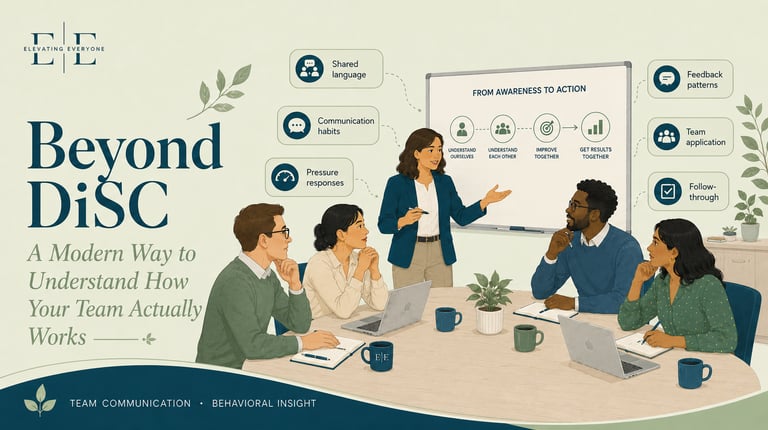
Beyond DiSC: A Modern Way to Understand How Your Team Actually Works
DiSC can introduce helpful behavioral language, but modern teams often need deeper insight into communication, collaboration, pressure, and team habits.
LEADERSHIP AND COMMUNICATIONEMPLOYEE EXPERIENCE AND CULTUREELEVATING INSIGHT
7/4/20267 min read
Beyond DiSC: A Modern Way to Understand How Your Team Actually Works
Many teams have completed a workplace assessment.
They remember the letters, colors, charts, or labels. For a while, the language shows up in meetings. People reference their style. Managers use the report during team discussions.
Then normal work returns.
Deadlines tighten. Meetings get busy. Communication habits drift back into place. Feedback still feels uneven. Tension still shows up in familiar places.
This does not mean the assessment had no value.
It may mean the assessment created awareness, but did not create enough application.
Tools like DiSC can help teams build a shared language around behavioral tendencies. Everything DiSC describes its model as measuring a person’s preferences and tendencies across four styles: Dominance, influence, Steadiness, and Conscientiousness.
That shared language can be useful.
But a shared language is only the starting point. Teams also need a practical way to turn insight into better communication, clearer expectations, stronger feedback, and improved follow-through.
That is where many assessment experiences fall short.
What DiSC does well
DiSC is popular for a reason.
It is simple enough for people to understand quickly. It gives teams a neutral way to talk about differences. It can help employees see why one person wants speed while another wants more detail.
That can reduce unnecessary judgment.
A direct team member may stop seeing a more cautious colleague as slow.
A detail-oriented employee may stop seeing a faster colleague as careless.
A manager may realize the same message lands differently across the team.
That kind of awareness has value. For teams new to behavioral work, DiSC can be a useful introduction. It can help people begin a better conversation.
When DiSC may be enough
DiSC may be enough when the need is simple.
For example, a team may want:
a basic introduction to behavioral styles
a shared vocabulary for communication differences
a lighter team-building experience
a way to improve self-awareness
a common framework that many people already recognize
In those situations, DiSC can serve the purpose well. The challenge comes when the team’s issue is deeper than awareness. A team may already know people have different styles. They may still struggle to work together.
When DiSC may not be enough
DiSC may not be enough when the team needs to address how work actually happens.
The real issue may not be style awareness.
It may be unclear ownership.
It may be weak follow-through.
It may be avoided conflict.
It may be vague feedback.
It may be inconsistent communication.
It may be pressure-driven behavior.
It may be a leadership team that talks often but does not align.
In those situations, a style label can start the discussion. It will not carry the full weight of the work. A team needs to understand the behaviors behind the friction. It also needs practical agreements for what will change after the assessment.
Where style labels can fall short
Labels are useful when they create understanding.
They become limiting when they replace deeper discussion.
A person may say:
“That is just my style.”
Or:
“She is a high D.”
Or:
“He is such a C.”
Those comments can sound harmless. Over time, they can narrow the conversation.
A style should explain a tendency. It should not excuse behavior.
A direct communicator still has to listen.
A careful communicator still has to move work forward.
A relational communicator still has to address conflict.
An idea-oriented communicator still has to create follow-through.
Assessment work should help people take ownership.
It should not give anyone a permanent script.
The team needs more than individual insight
Many workplace assessments focus heavily on individual profiles.
That can help.
But teams do not succeed or struggle only because of individual styles. They struggle because of patterns between people.
A team may have poor meeting discipline.
A team may avoid direct disagreement.
A team may fail to document decisions.
A team may let the loudest voices drive discussion.
A team may confuse conversation with alignment.
A team may use too many channels with no source of truth.
Those are team patterns.
A personal report may identify tendencies. It may not show how the team system works.
A stronger process asks better questions.
How do we communicate under pressure?
Where do handoffs break down?
Who tends to get heard quickly?
Who gets missed?
What do we avoid discussing?
How do we handle disagreement?
Where do we need clearer habits?
Those questions move the work from profile review to team improvement.
What teams need after the profile
A strong assessment experience should not end with the report. The report should create the conversation. The conversation should create practical agreements.
The team should leave with clearer answers to questions like:
How will we handle disagreement?
How will we share updates?
How will we clarify urgency?
How will we give feedback?
How will we close meetings?
How will we make decisions?
How will we adjust under pressure?
How will we prevent style differences from becoming friction?
Without those agreements, the assessment may be remembered but not used. People may enjoy the session. They may still return to the same habits.
What modern teams need from assessment work
Modern teams need applied insight. They need more than a label, chart, or profile summary. They need a way to connect individual tendencies to daily work.
That includes:
communication habits
collaboration patterns
pressure responses
feedback expectations
trust signals
meeting norms
decision-making habits
manager coaching
follow-through
The best assessment work becomes part of how the team operates. It should influence how people meet, listen, disagree, decide, and recover from mistakes. It should help the team work better after the session ends.
How Elevating Insight goes further
Elevating Insight was built for the applied layer. It starts with workplace behavioral tendencies, but the process is designed around team use. The focus is not simply helping people know their style.
The focus is helping the team understand how people communicate, collaborate, respond under pressure, and work together.
That includes practical questions.
How does this person prefer to receive information?
Where might this person be misunderstood?
What happens when pressure increases?
How does this person approach pace, detail, or urgency?
What kind of feedback is most useful?
What support helps this person contribute well?
What does the team need to adjust?
The assessment provides the starting point. The real value comes from the debrief, discussion, and follow-through.
Explore Elevating Insight for more information about the assessment experience.
Why the difference matters for team communication
Most team issues show up through communication.
People miss context.
Updates are unclear.
Decisions are not documented.
Feedback comes too late.
Meetings create discussion without clarity.
Concerns move into side conversations.
Those issues are rarely solved by labels alone. They require better habits. For example, a team may learn that some members prefer direct communication. Others need more context. That insight is useful.
The next step is more important.
The team needs to decide how it will communicate when speed and detail both matter.
It may need agreements like:
We will name decisions clearly.
We will document ownership after meetings.
We will clarify urgency in requests.
We will invite concerns before decisions close.
We will separate brainstorming from commitment.
We will give feedback close to the behavior.
That is the bridge from insight to performance.
For more on this topic, see The 4 Workplace Communication Styles.
When a team needs Elevating Insight
Elevating Insight is a strong fit when a team needs more than style awareness.
It may be the right fit when:
communication keeps breaking down
team members avoid direct feedback
meetings lack clear decisions
leaders struggle to adapt their communication
conflict is polite but unresolved
people work hard but misunderstand each other
pressure changes how people show up
the team needs practical agreements after the assessment
This is especially useful for teams that have already done style work. They may not need another introduction to behavior. They may need a deeper conversation about how work happens.
When the team issue is bigger than the assessment
Sometimes the assessment reveals a larger pattern.
The issue may include:
low trust
unclear roles
weak feedback habits
inconsistent leadership expectations
cross-functional confusion
decision delays
poor meeting follow-through
unresolved tension
In those cases, the team may need more than a debrief. They may need facilitated discussion, manager coaching, and practical communication agreements. The Team Communication Health Check can help identify where communication may be creating friction.
For teams ready to address those patterns directly, team communication consulting can help turn insight into stronger habits.
Questions to ask before choosing a team assessment
Before choosing any workplace assessment, leaders should ask a few practical questions.
What problem are we trying to solve?
A team should not use an assessment just because it sounds interesting.
Start with the real issue.
Examples include:
communication is unclear
conflict is being avoided
meetings lack follow-through
leaders need better coaching tools
silos are creating friction
onboarding is inconsistent
trust has been strained
the team is growing quickly
A clear problem leads to a better assessment experience.
Do we need awareness or application?
This is the key question.
If the team mainly needs a simple introduction to style differences, DiSC may be enough. If the team needs to change communication habits, feedback patterns, or collaboration routines, the process needs to go further.
The assessment should match the level of need.
How will the results be used?
A report is not the outcome.
Ask how the results will support:
manager coaching
team norms
communication habits
leadership development
conflict resolution
meeting practices
follow-up actions
If the results do not connect to work, the impact will likely fade.
Will the process include a real team conversation?
Individual reports are helpful. But teams need shared discussion. They need space to compare patterns, name friction, and create agreements. A strong debrief helps people move from private insight to shared action.
Will the language help or limit people?
Assessment language should create understanding. It should not box people in. The best tools help people discuss tendencies while still encouraging growth. Avoid using any assessment as a permanent label.
What happens after the workshop?
This may be the most important question.
Ask:
What follow-up will happen?
Who owns the next steps?
How will managers use the insight?
How will the team revisit agreements?
How will progress be measured?
If nothing happens after the session, the value may fade quickly.
Final thought
DiSC can help people understand themselves and others. That has real value.
But many teams need more than a familiar framework. They need a process that connects behavioral insight to how work actually gets done. Elevating Insight was designed for that next step. It helps teams move from style awareness to practical conversations about communication, pressure, feedback, trust, and follow-through.
A label can start the conversation.
The real progress comes from what the team does differently next.
Elevating Everyone
Stay Connected
doug.ward@elevatingeveryone.com
843-259-2055
© 2026. All rights reserved.
Elevate Everywhere Enterprises, LLC.