
10 Leadership Principles for Remote and Hybrid Teams
Explore 10 practical leadership principles for remote and hybrid teams, including communication, visibility, trust, engagement, flexibility, and team identity.
REMOTE AND HYBRID WORKLEADERSHIP AND COMMUNICATIONEMPLOYEE EXPERIENCE AND CULTURE
7/5/20268 min read
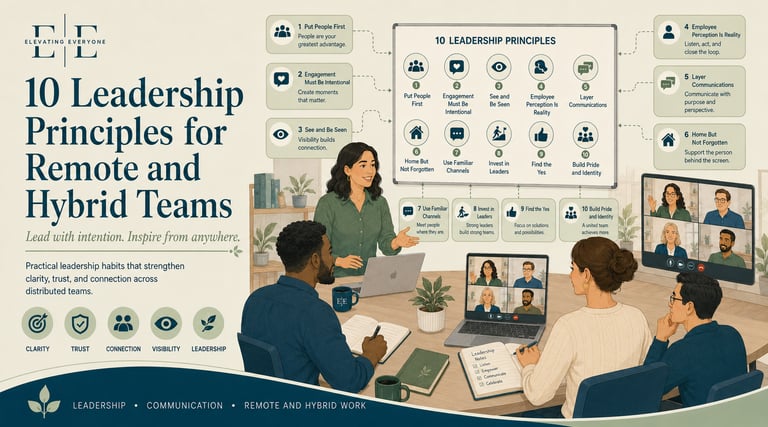
10 Leadership Principles for Remote and Hybrid Teams
Remote and hybrid work have changed the way teams communicate, connect, and perform.
The tools keep evolving. Video platforms improve. Chat tools expand. Project systems become more sophisticated. AI is now part of the daily workflow for many employees.
Still, the leadership fundamentals remain surprisingly consistent.
People need clarity. They need connection. They need trust. They need context. They need leaders who are visible, consistent, and intentional.
Remote and hybrid work expose weak leadership habits faster than office-based work often does. A vague message can create more confusion. A missed check-in can turn into disconnection. A poorly run meeting can leave half the team out of the real conversation.
Strong remote and hybrid leadership requires practical habits that travel across tools, locations, and work models.
Here are ten leadership principles that can help leaders build clearer, stronger, and more connected distributed teams.
For a one-page version of this framework, download 10 Leadership Principles for Remote and Hybrid Teams.
1. Put People First
Remote and hybrid work still depend on human connection.
Leaders can easily get pulled into the mechanics of the model. Which days are office days? Which platform should the team use? How many meetings are too many? How should work be tracked?
Those questions are useful, but people experience remote and hybrid work through trust, support, communication, and belonging.
Putting people first means leaders pay attention to the employee experience behind the work. They notice when someone is drifting. They ask better questions when performance changes. They understand that flexibility, focus, and connection affect how people show up.
Practical ways to put people first include:
Hold consistent one-on-ones.
Ask employees what is helping or hurting their work.
Watch for changes in participation, tone, or energy.
Recognize progress, not just final outcomes.
Make space for employees to raise concerns early.
Support employees through change with clear information and follow-through.
Putting people first does not mean lowering expectations. It means creating the conditions for people to do good work with clarity and confidence.
2. Engagement Must Be Intentional
Engagement does not happen automatically in distributed teams.
In an office, some connection happens through proximity. People run into each other. They hear informal updates. They read the room. They notice shifts in energy.
Remote and hybrid teams lose some of those informal signals.
Leaders have to create connection more deliberately.
Intentional engagement may include:
regular team check-ins
meaningful one-on-ones
shared team rituals
visible recognition
thoughtful onboarding
inclusive meetings
coaching conversations
clear communication rhythms
The best engagement habits are simple and consistent. A short check-in with a clear purpose often creates more value than a crowded meeting with no direction.
Leaders should also define what engagement looks like in the work. Participation is not always loud. Commitment is not always visible through constant messaging. Strong engagement may show up through ownership, follow-through, problem-solving, and thoughtful contribution.
A remote or hybrid leader should know how each team member tends to engage and what helps them stay connected.
For more on individual work patterns, see Find Your Remote Work Style.
3. See and Be Seen
Remote and hybrid employees need leadership presence.
Presence does not mean hovering. It means leaders are visible, accessible, and engaged enough for employees to feel connected to direction, priorities, and support.
When leaders disappear, employees fill the gaps themselves. They may make assumptions about priorities, performance, or organizational change. They may also stop raising questions because they are unsure when or how to engage.
Strong leadership visibility includes:
communicating priorities clearly
showing up consistently in team rhythms
being available for questions
following through on commitments
checking in without micromanaging
explaining decisions that affect the team
recognizing work across locations
Employees also need to be seen.
Remote employees can do strong work and still become less visible than employees who are physically present. Hybrid teams can create unintentional gaps in recognition, opportunity, and access.
Leaders should look for ways to see the work without relying only on office presence.
Useful practices include:
shared project updates
documented wins
regular coaching conversations
team dashboards
visible ownership of major work
recognition across locations
fair access to stretch assignments
Seeing and being seen helps employees feel connected to the work and to the organization.
4. Employee Perception Is Reality
Leaders often judge remote and hybrid work by the design of the policy.
Employees judge it by the experience.
A policy may look fair on paper and still feel uneven in practice. A communication plan may seem clear to leadership and still leave employees confused. A hybrid schedule may appear balanced, while employees experience it as costly, disruptive, or poorly connected to the work.
Employee perception shapes trust, energy, and performance.
Leaders do not have to agree with every perception, but they should pay attention to what those perceptions reveal.
Helpful questions include:
Do employees understand why certain expectations exist?
Do remote employees feel included in decisions?
Do hybrid employees understand how office time should be used?
Do employees believe flexibility is applied fairly?
Do people feel trusted to do the work?
Do employees know where to go for clarity?
Do onsite employees receive more informal access to leaders?
Perception often points to communication gaps, unclear expectations, inconsistent manager behavior, or weak follow-through.
Leaders should treat employee perception as useful information. It helps identify where the operating model may be working in theory but falling short in practice.
For more on building a stronger model, see Hybrid Work is an Operating Model, Not a Schedule.
5. Layer Communications
Remote and hybrid teams need more deliberate communication habits.
One message in one place is rarely enough for important work. People may be in different locations, working different schedules, using different tools, or entering the conversation with different context.
Layered communication helps important information reach people with clarity and consistency.
A practical communication system defines how each channel should be used:
Chat for quick coordination and simple clarifications.
Email for broader updates and formal communication.
Meetings for discussion, decisions, coaching, and problem-solving.
Project tools for ownership, deadlines, status, and blockers.
Shared documents for decisions, process notes, and durable context.
Knowledge bases for repeatable information and resources.
Layered communication also helps employees know where to look. Without clear channel norms, people waste time searching through chat threads, emails, meeting notes, and scattered documents.
Leaders should also define when communication needs to move from written messages to live discussion.
A few signs may indicate a live conversation is needed:
The thread is getting longer without resolution.
Tone is becoming hard to read.
Multiple people are interpreting the issue differently.
A decision needs tradeoff discussion.
The issue involves feedback, conflict, or sensitive context.
Remote and hybrid communication works best when leaders reduce guessing.
For a deeper look at this topic, see Remote Team Communication: How to Reduce Confusion and Keep Work Moving.
6. Home But Not Forgotten
Remote employees should not have to work harder to stay visible, included, or considered for opportunity.
One risk of remote and hybrid work is the quiet gap between presence and access. Employees who are onsite may receive more informal coaching, more casual context, and more relationship-building opportunities. Remote employees may receive the formal update but miss the side conversation that shaped the decision.
Leaders need to watch for this.
Employees working from home still need:
visibility into priorities
access to leaders
development conversations
performance feedback
recognition
stretch opportunities
team connection
career support
timely context
The phrase “out of sight, out of mind” becomes a leadership risk in distributed teams.
Leaders can reduce that risk through consistent habits.
Examples include:
Rotate meeting times when possible.
Include remote employees in informal updates.
Document decisions made after meetings.
Give remote employees visible ownership of meaningful work.
Schedule development conversations, not just task check-ins.
Recognize contributions across all work locations.
Audit who receives coaching, access, and opportunity.
Remote employees should not feel like secondary participants in the culture.
For related thinking, see The Missing First Rung.
7. Use Familiar Channels
Remote and hybrid teams already have enough friction.
Leaders should avoid adding unnecessary complexity to communication. New tools may be useful, but too many tools can scatter work and confuse expectations.
The best communication channel is often the one people already use well.
This principle is especially important during change. When leaders introduce a new process, policy, or expectation, they should meet people where work already happens whenever possible.
Before adding another platform or workflow, ask:
Where does the team already communicate?
Where does work already get tracked?
Which tools create the least friction?
What information needs to be easy to find later?
Will this tool improve clarity or add another place to check?
Who may need support using the channel well?
Using familiar channels does not mean avoiding improvement. It means leaders should be thoughtful about adoption.
A tool only helps when people understand how it fits into the work.
If a team needs a new platform, leaders should explain:
why the change is happening
what problem the tool solves
when to use it
when not to use it
where information should live
how success will be measured
Remote and hybrid teams need fewer communication dead ends. Familiar channels can help work move more smoothly.
8. Invest in Leaders
Remote and hybrid work require stronger manager habits.
Managers have to communicate clearly, coach consistently, build trust, run better meetings, monitor performance without hovering, and create connection across locations.
Many managers were never trained to do this well.
Organizations often announce a remote or hybrid model and assume managers will adapt. Some will. Others will rely on office-based habits that do not translate cleanly.
Leadership development should be part of any remote or hybrid strategy.
Managers need support in areas such as:
communication rhythm
meeting design
one-on-one conversations
employee development
performance expectations
feedback and coaching
documentation habits
trust-building
inclusive leadership
change communication
Inconsistent manager habits create inconsistent employee experiences.
One remote employee may feel informed, trusted, and supported. Another may feel disconnected and unsure, even under the same company policy. The difference often sits with the manager.
Investing in leaders improves the model for everyone.
For support with remote and hybrid leadership development, see Remote and Hybrid Leadership.
9. Find the Yes
Remote and hybrid leadership often requires flexibility.
Leaders will face requests, constraints, exceptions, and new situations that do not fit neatly into the policy. The easy answer may be no. The better first step is to look for a responsible yes.
Finding the yes means leaders explore practical options before closing the door.
This does not mean every request should be approved. It means leaders should look for a path that supports the employee, the team, and the work.
Useful questions include:
What problem is the employee trying to solve?
What does the work require?
What flexibility is reasonable?
What would create risk for the team?
What precedent are we setting?
Can we test this for a defined period?
What would need to be true for this to work?
Finding the yes also builds trust. Employees are more likely to accept boundaries when they believe leaders considered the request with fairness and care.
Flexibility works best when expectations are clear.
Leaders should explain the decision, the reasoning, and any conditions attached to the agreement. This helps employees understand the difference between flexibility and inconsistency.
Remote and hybrid teams need leaders who can balance judgment, fairness, and practicality.
10. Build Pride and Identity
Distributed teams still need a shared sense of identity.
People need to feel part of something larger than their individual tasks. Remote and hybrid work can make this harder because employees may have fewer shared moments, fewer informal conversations, and less visible connection to the broader organization.
Leaders help build pride through meaning, recognition, clarity, and shared language.
Practical ways to strengthen team identity include:
Connect daily work to the larger mission.
Share customer or employee impact stories.
Celebrate progress and improvement.
Name the team’s standards and values.
Recognize collaboration, not just individual output.
Create rituals that reinforce belonging.
Make wins visible across locations.
Help employees understand how their work supports the business.
Pride grows when people understand the value of their contribution.
A team with strong identity does not depend entirely on location for connection. People know what they are part of. They understand what good work looks like. They can see how their effort contributes to something meaningful.
Remote and hybrid leaders should reinforce that connection often.
A Practical Reflection for Leaders
Use these questions to assess how well your remote or hybrid leadership habits are working.
People and Connection
Do employees feel seen, supported, and included?
Are leaders checking in consistently?
Are quiet employees still connected to the team?
Are remote employees receiving the same context as onsite employees?
Communication
Are communication channels clearly defined?
Do people know where decisions live?
Are important messages shared in more than one appropriate way?
Are urgent messages clearly labeled?
Visibility and Performance
Can leaders see work progress without hovering?
Are expectations clear across locations?
Are employees recognized fairly?
Are remote employees visible for growth opportunities?
Leadership Habits
Are managers equipped to lead distributed teams?
Are one-on-ones useful and consistent?
Are meetings designed for onsite and remote participants?
Are leaders explaining decisions with enough context?
Flexibility and Identity
Are leaders looking for practical options before defaulting to no?
Are flexibility decisions explained clearly?
Does the team feel connected to a shared purpose?
Are wins, standards, and values reinforced across locations?
A few unclear answers can show where the team needs attention first.
Final Thought
Remote and hybrid work keep changing, but the core leadership work remains familiar.
People need clarity, trust, connection, visibility, and support. They need leaders who communicate well, follow through, and design work with intention.
The tools may change again. The expectations around work may keep shifting. Teams may continue to move across office, home, and hybrid settings.
Leadership principles travel.
When leaders put people first, communicate with discipline, invest in managers, and build shared identity, remote and hybrid teams can work with more confidence and less friction.
The work becomes easier to lead because the principles are clear.
Elevating Everyone
Stay Connected
doug.ward@elevatingeveryone.com
843-259-2055
© 2026. All rights reserved.
Elevate Everywhere Enterprises, LLC.