
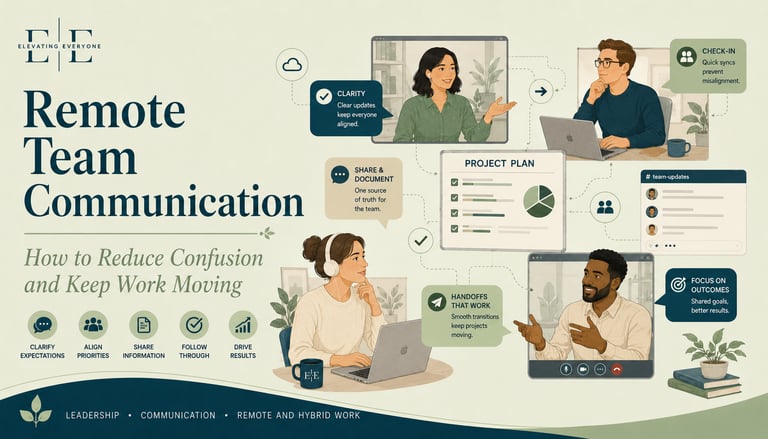
Remote Team Communication: How to Reduce Confusion and Keep Work Moving
Learn how leaders can improve remote team communication, reduce confusion, strengthen visibility, and keep distributed teams moving with clarity.
REMOTE AND HYBRID WORKLEADERSHIP AND COMMUNICATIONEMPLOYEE EXPERIENCE AND CULTURE
7/5/20269 min read
Remote Team Communication: How to Reduce Confusion and Keep Work Moving
Remote and hybrid communication should do more than keep people updated.
It should help people understand the work, see the priorities, make decisions, and move forward without guessing.
In an office, weak communication often gets patched through proximity. Someone asks a quick question. A manager notices confusion. A teammate overhears context and fills a gap before the issue grows.
Remote and hybrid teams do not have the same informal safety net. Work moves across locations, tools, schedules, meetings, and message threads. Context can get separated from decisions. Decisions can get separated from ownership. Ownership can get separated from follow-through.
Strong remote team communication gives people a shared way to work. It reduces rework, protects focus, strengthens trust, and helps distributed teams stay connected to the larger purpose behind the work.
For leaders, the work starts with building practical communication habits before confusion becomes part of the team’s rhythm.
Why Remote Communication Breaks Down
Most remote communication problems begin with small gaps.
A single gap may not cause major damage. The problem grows when those gaps repeat across the team.
Common examples include:
A decision gets made in a meeting, but no one documents it.
A message gets posted in chat, but the audience is unclear.
A task gets assigned, but ownership is assumed instead of confirmed.
A teammate misses context because they were not in the right conversation.
A leader thinks communication happened because the topic was mentioned once.
A project moves forward, but the “why” behind the work never gets explained.
A handoff happens without enough detail for the next person to act confidently.
These moments create friction. People spend more time clarifying, correcting, waiting, and rechecking. The work may still get done, but it takes more energy than it should.
Remote and hybrid teams need a stronger communication system because the work is distributed. People may not be online at the same time. They may rely on different tools. They may also have different expectations about response time, meeting behavior, documentation, and decision-making.
When expectations are not defined, teams build their own habits.
Some people over-message because they want to stay visible.
Some stay quiet because they do not want to interrupt.
Some move forward without alignment because they think speed is expected.
Some wait too long because they are unsure who owns the next step.
Some use meetings for everything because no other communication rhythm exists.
Better communication gives people a shared operating system for the work.
Build Communication Around the Work, Not the Tool
Many remote communication conversations start with tools.
Should the team use email, chat, Teams, Slack, project boards, shared documents, video calls, or something else?
The better first question is simpler: what type of communication does the work require?
Different communication needs require different formats.
Quick coordination may belong in chat.
Formal updates may belong in email.
Complex decisions may need a live discussion.
Project ownership should live in the project tool.
Durable context should live in a shared document.
Coaching and sensitive feedback should usually happen in conversation.
Tools are useful when the team knows how to use them. Without shared norms, tools create more noise.
A strong remote communication system answers a few basic questions:
Where do we make decisions?
Where do we document decisions?
Where do we track ownership?
Where do we ask quick questions?
Where do we store long-term context?
Which issues require a meeting?
Which updates should not become meetings?
These questions help leaders move from scattered communication to intentional communication.
For broader support with team communication habits, see team communication training.
Start With Decision Clarity
A remote team can recover from a missed update. It struggles when decisions become blurry.
Updates, discussions, recommendations, and decisions are different. Teams need to know which one is happening.
Without clarity, people leave the same conversation with different interpretations. One person thinks a decision was made. Another thinks the topic remains open. A third person thinks they own the next step. Someone else assumes the leader will follow up.
Rework often starts there.
Leaders can reduce confusion by closing important conversations with a simple decision check.
Use these questions before ending a meeting or message thread:
What was decided?
Who owns the next step?
What is the deadline?
Who needs to know?
Where will this be documented?
What should stop, start, or change because of this decision?
This does not require a complicated process. It requires consistency.
A simple decision note can also help:
Decision:
Reason:
Owner:
Deadline:
People impacted:
Follow-up location:
Remote teams should not need to guess whether a decision has been made. If decisions often disappear into meetings, chat threads, or side conversations, the communication system needs more discipline.
Layer Communication Without Creating Noise
Remote and hybrid teams need layered communication.
Layered communication does not mean repeating every message everywhere. It means matching the message to the right channel and giving people more than one way to receive important context.
A practical channel map might look like this:
Chat: quick coordination, simple questions, immediate clarifications.
Email: broader updates, formal communication, leadership messages.
Meetings: discussion, decisions, problem-solving, relationship building.
Project tools: ownership, deadlines, status, blockers.
Shared documents: durable context, process notes, decision history.
Knowledge base: repeatable information, procedures, templates.
The team should understand which channel serves which purpose. Otherwise, people waste time searching across tools and trying to determine which message carries authority.
Leaders should also be careful with urgency. When every channel feels urgent, people stay on alert. Focus drops. Stress rises. The quality of work suffers.
Layered communication works best when the team knows:
where to look
where to respond
where decisions live
where urgent issues go
where long-term context should be stored
This principle connects directly to 10 Leadership Principles for Remote and Hybrid Teams. Download the 10 Leadership Principles guide here.
Make Work Visible Without Hovering
Remote teams need visibility. People should be able to see priorities, ownership, progress, blockers, and decisions without asking for a special update every time.
Visibility should help people coordinate, not make them feel watched.
Remote leadership often swings between two poor habits. Some leaders disappear and assume people will figure everything out. Others overcorrect with constant check-ins, status requests, and meetings.
A better approach uses clear systems.
A useful visibility system shows:
top priorities for the week
who owns each major item
current progress
blocked work
recent decisions
key risks
upcoming deadlines
handoffs between people or teams
This can happen through shared project boards, weekly priority updates, meeting notes, decision logs, team dashboards, or documented handoffs.
The format can stay simple. The discipline behind it carries the value.
When work is visible, leaders can support the team without hovering. Team members can also see how their work connects to others. Visibility helps leaders notice overload, blockers, and disconnection before problems become larger.
Define Response Expectations
Remote communication can become stressful when response expectations are unclear.
Some people treat chat like a live conversation. Others treat it like email. Some respond immediately. Others batch messages between focused work. Some leaders send late-night notes with no urgent intent, while employees read those notes as pressure.
Assumptions create friction.
Leaders can prevent much of this by naming response expectations directly.
Clarify:
What requires an immediate response?
What can wait until the next business day?
When should people use chat instead of email?
When should an issue move from written messages to live discussion?
How should urgent items be labeled?
What are acceptable response expectations during focus time?
How should people communicate when they are unavailable?
Teams also need permission to protect focus.
Remote work often increases written communication. If everyone responds to every message immediately, deeper work suffers. A healthy rhythm gives people access to one another without creating constant interruption.
One useful practice is to define response tiers:
Urgent: needs attention now and should be clearly labeled.
Same day: needs a response before the day ends.
Next business day: important but not immediate.
Reference only: no response required unless there is a concern.
This kind of clarity reduces anxiety and helps people choose the right communication behavior.
Use Meetings With More Discipline
Remote teams often depend on meetings because meetings create shared context. Poor meetings create shared confusion.
Every recurring meeting should earn its place.
Leaders should be clear about why each meeting exists. Different meetings serve different purposes.
Decision meetings should end with clear choices and owners.
Coordination meetings should align work and surface blockers.
Problem-solving meetings should define the issue and identify options.
Connection meetings should strengthen trust and team awareness.
Information-sharing meetings should be reviewed carefully because many can become written updates.
Before scheduling a meeting, leaders can ask:
What outcome do we need?
Who needs to be involved?
What should be shared in advance?
What decision or next step should come from the meeting?
Could this be handled better in writing?
Good remote meetings also account for different communication styles.
Some people think best out loud. Others need time to process. Some speak quickly. Others may contribute more clearly in writing after reflection.
Leaders can improve participation by:
sending context before the meeting
using a clear agenda
naming the desired outcome
inviting written input
asking quieter participants for perspective
summarizing decisions before closing
documenting owners and deadlines
Meeting discipline protects time and improves follow-through.
For a related lens, see The 4 Workplace Communication Styles and How to Work With Each.
Protect Context
Context is one of the first things remote teams lose.
People may know their own task, but not the reason behind it. They may know what changed, but not why. They may hear the decision, but not the tradeoff behind it.
This creates shallow alignment. People can follow instructions, but they struggle to make strong decisions when conditions change.
Leaders can protect context by explaining the thinking behind priorities.
Useful context includes:
why the work is important
what problem the team is solving
what changed and why
what tradeoffs were considered
what success should look like
what risks need attention
what decision has already been made
what information is still unknown
Context does not require a long explanation every time. A few extra sentences can prevent hours of confusion later.
Remote and hybrid teams often make decisions without immediate access to leaders. More context gives people the confidence to act instead of waiting.
Watch for Silence
Silence is easy to miss in remote teams.
In person, a leader may notice body language, side comments, or frustration after a meeting. In remote work, silence can look like agreement.
A quiet employee may be focused. They may also be confused, disengaged, overwhelmed, or hesitant to speak up.
Leaders should pay attention to participation patterns.
Helpful questions include:
Who has stopped contributing?
Who used to ask questions but no longer does?
Who seems less visible in meetings or message threads?
Who may be missing context?
Who may need a different way to contribute?
Who may be overloaded but not saying so?
A few practical habits can help:
Ask specific questions instead of broad ones.
Invite written input before meetings.
Follow up with people who have gone quiet.
Use one-on-ones to test understanding.
Create space for concerns before decisions are final.
Watch for changes in tone, pace, and participation.
Remote teams need leaders who notice when communication patterns shift. A drop in communication can signal confusion, fatigue, disengagement, or lack of trust.
Early attention prevents small issues from becoming cultural patterns.
Build Stronger Handoffs
Handoffs are where remote communication often gets messy.
Work moves from one person to another, but the receiving person lacks context. The task may be assigned, but expectations remain incomplete.
A strong handoff should answer:
What needs to happen?
Why does it need to happen?
What has already been done?
What decisions have already been made?
What information is still missing?
Who else is involved?
What does complete look like?
Where should the next update go?
This is especially important across time zones, departments, shifts, and hybrid schedules.
A handoff should not require the next person to reconstruct the work from scattered messages. Clear handoffs save time and reduce frustration between teams.
When handoffs fail, people often blame each other. In many cases, the process created the problem.
Leaders should look for recurring handoff failures. Those failures often point to unclear ownership, missing documentation, weak systems, or assumptions about who knows what.
Connect Communication to Trust
Remote communication affects more than information flow. It shapes how people experience the team.
People build trust when expectations are clear, decisions are explained, and follow-through is consistent. Trust weakens when people feel left out, surprised, ignored, or uncertain about where they stand.
Leaders should view communication as part of the employee experience.
Strong questions to ask include:
Do people feel informed?
Do people feel included?
Do people understand priorities?
Do people know how decisions get made?
Do people know where to find information?
Do people feel safe raising concerns?
Do remote employees receive the same context as onsite employees?
Do hybrid employees feel connected when they are not physically present?
These questions reveal more than communication quality. They reveal how work feels from the employee’s side.
Remote and hybrid teams need intentional connection because belonging does not happen as easily through proximity. Communication is one of the main ways leaders create that connection.
For a broader look at remote and hybrid leadership, visit Remote and Hybrid Leadership.
A Simple Remote Communication Check
Leaders can use this checklist to assess where communication may be breaking down.
Ask these questions honestly:
Are priorities clear for the week?
Do people know where decisions are documented?
Are meetings producing clear next steps?
Are communication channels used consistently?
Do employees understand response expectations?
Are handoffs creating confusion?
Are remote employees getting the same context as onsite employees?
Are quiet team members still engaged?
Is important information easy to find later?
Do people know when to move from written messages to live discussion?
Are leaders visible without hovering?
Are urgent messages clearly labeled?
Are decisions easy to trace after the fact?
Are employees comfortable asking for clarification?
Are communication habits helping the team move faster, or creating more work?
If several answers are unclear, start with the area creating the most friction.
Do not try to fix everything at once. Choose one communication habit, make it visible, and reinforce it for a few weeks. Then move to the next.
For a quick diagnostic, use Team Communication Health Check.
Final Thought
Remote and hybrid teams can be clear, connected, and productive. Strong communication habits make that possible.
Leaders set the tone through clarity, consistency, and follow-through. They decide where decisions live, how context gets shared, how meetings are used, and how people stay connected to the work.
When teams know where to find information, how to raise questions, and how decisions get made, work moves with less friction.
Remote team communication becomes a leadership advantage when people understand both the task and the context behind it.
Elevating Everyone
Stay Connected
doug.ward@elevatingeveryone.com
843-259-2055
© 2026. All rights reserved.
Elevate Everywhere Enterprises, LLC.