
Hybrid Work Is an Operating Model, Not a Schedule
Hybrid work requires more than office days. Learn how leaders can build communication, visibility, meeting, documentation, and management habits that help hybrid teams work better.
REMOTE AND HYBRID WORKLEADERSHIP AND COMMUNICATIONEMPLOYEE EXPERIENCE AND CULTURE
7/5/20267 min read
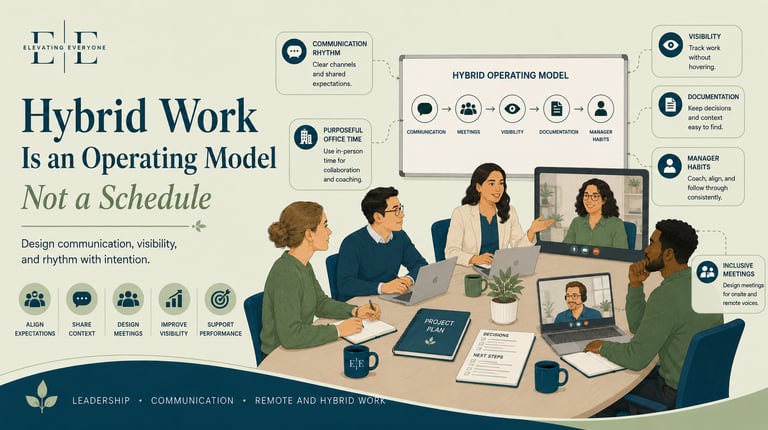
Hybrid Work Is an Operating Model, Not a Schedule
Many organizations treat hybrid work like a calendar decision.
Two days in the office.
Three days remote.
Anchor days on Tuesday and Wednesday.
Team discretion with manager approval.
The schedule gets most of the attention because it is visible. It is also easier to debate than the deeper work underneath it.
A hybrid schedule may tell people where to work. It does not automatically tell them how to communicate, make decisions, build trust, share context, run meetings, develop employees, or keep work moving across locations.
This is where many hybrid work models start to break down.
Hybrid work requires an operating model. Leaders need to define how work happens when some people are together, some are remote, and everyone needs access to the same clarity.
The strongest hybrid teams do more than choose office days. They build habits, systems, and leadership routines that help people work well wherever they are.
The Schedule Is Only One Decision
The schedule is still important.
People need to know when they are expected onsite, when flexibility exists, and how team norms apply. A confusing schedule creates frustration quickly.
Schedule clarity should answer questions like:
Which days are office days?
Are office days team-wide or role-specific?
What happens when someone has a conflict?
Are meetings designed around the office schedule?
How are remote employees included on office-heavy days?
What work is best done onsite?
What work is best done remotely?
Those questions are useful, but they only cover the surface.
A hybrid schedule can create the illusion of structure while deeper operating issues remain unresolved. Leaders may bring people into the office and still struggle with unclear ownership, weak communication, poor handoffs, and uneven access to information.
A better question comes next: how should this team operate when work is no longer tied to one shared place?
Hybrid Work Changes the Flow of Information
In an office-based model, information often moves through proximity. People hear context before and after meetings. They notice who is struggling. They catch side conversations. They ask quick questions without scheduling time.
Hybrid work changes that flow.
Some people hear hallway context. Others only hear the formal version. Some employees receive information in real time. Others receive it after decisions have already started to move. Some people are visible because they are physically present. Others have to work harder to be included.
Uneven information creates uneven performance.
Leaders need to design communication with more discipline. Important context should not depend on who happened to be in the room.
Hybrid teams need clear habits around:
where decisions are documented
how updates are shared
which meetings require remote access
how office conversations get captured
where project ownership lives
how urgent items are escalated
how remote employees receive the same context as onsite employees
This connects directly to Remote Team Communication: How to Reduce Confusion and Keep Work Moving.
A strong hybrid operating model protects information from getting trapped in location-based conversations.
Office Time Should Have a Purpose
Office days work better when people understand why they exist.
Some teams need office time for collaboration, planning, complex problem-solving, coaching, training, or relationship building. Other teams may use office time for customer sessions, operational reviews, onboarding, or cross-functional alignment.
The issue comes when office days become performative.
People commute, sit on video calls, answer emails, and leave wondering what the office day accomplished. Over time, that experience damages trust. Employees may not object to in-person work itself. They object to wasted time, unclear purpose, and policies that ignore how the work actually happens.
Leaders can make office time more useful by defining its role.
Office time may be best used for:
team planning
relationship building
onboarding and coaching
problem-solving sessions
customer or stakeholder discussions
cross-functional coordination
culture-building moments
leadership visibility and support
Remote time may be better for:
focused work
writing and analysis
individual follow-through
asynchronous collaboration
preparation before meetings
deep project work
administrative tasks
This does not need to become rigid. The point is to make work design more intentional.
When office time has a clear purpose, employees are more likely to see value in being there.
Hybrid Meetings Need Better Design
Hybrid meetings often expose weak operating habits.
A meeting where half the room is onsite and half the group is remote can create an uneven experience fast. People in the room may talk over remote participants. Side comments may not be heard. Whiteboard work may be difficult to see. Decisions may happen after the meeting ends.
Hybrid meetings require more facilitation discipline.
Leaders should decide how hybrid meetings will work before the team develops bad habits.
Useful practices include:
Share the agenda before the meeting.
Make the meeting link available even when several people are onsite.
Assign someone to watch the chat and remote participation.
Repeat questions or side comments for everyone.
Use shared digital notes instead of relying only on the room.
Capture decisions, owners, and deadlines before closing.
Avoid continuing the real meeting after remote participants leave.
Hybrid meetings should give every participant a fair chance to contribute.
This does not mean every meeting needs to be perfectly polished. It means the leader pays attention to access, participation, and follow-through.
For teams with mixed communication preferences, The 4 Workplace Communication Styles and How to Work With Each can provide a useful lens.
Visibility Should Not Depend on Being Seen in the Office
Hybrid work can create a quiet visibility gap.
People who are onsite more often may appear more engaged, more available, or more committed. Remote employees may produce strong work while still being less visible to leaders and peers.
This can affect development, recognition, assignments, promotions, and trust.
Leaders need to separate visibility from physical presence.
Strong hybrid visibility comes from work clarity, contribution, communication, and outcomes. Leaders should know what people are working on, where they are making progress, where they need support, and how they are contributing to the team.
Practical visibility habits include:
weekly priority updates
shared project boards
regular one-on-ones
documented wins and blockers
clear ownership of major work
consistent coaching conversations
team rituals that include remote employees
recognition that reaches beyond the office
Presence can help connection, but it should not become the only signal leaders use.
A hybrid operating model gives leaders better ways to see the work and support the people doing it.
Culture Needs More Than Office Attendance
Some leaders connect culture almost entirely to in-person time.
In-person interaction can strengthen relationships. It can help people build familiarity, trust, and connection. Those benefits are real.
Culture, however, is shaped by daily experience.
People experience culture through how decisions get made, how leaders communicate, how conflict is handled, how priorities are set, how mistakes are treated, and how consistently people follow through.
A team can spend three days a week together and still have a weak culture.
A distributed team can build a strong culture when leadership habits are clear, communication is healthy, and people feel connected to the work and to one another.
Hybrid culture needs intentional routines.
Those routines may include:
consistent team check-ins
manager one-on-ones
clear communication norms
inclusive meeting practices
shared decision-making habits
recognition across locations
intentional onboarding
leadership visibility
development conversations
Culture grows through repetition. Hybrid teams need repeated habits that reinforce clarity, trust, and connection across locations.
For a related resource, see 10 Leadership Principles for Remote and Hybrid Team. Download the guide here.
Managers Need Stronger Operating Habits
Hybrid work puts more pressure on managers.
Managers have to communicate clearly, track work without hovering, build trust across locations, run better meetings, coach people consistently, and notice when employees are drifting.
These skills are not always developed before a hybrid model is launched.
Organizations often announce the schedule before preparing managers to lead the model.
That creates uneven employee experiences. One team may have a manager who communicates well and uses hybrid work thoughtfully. Another team may have a manager who relies on office attendance as the main measure of engagement.
Hybrid work becomes inconsistent when manager habits are inconsistent.
Managers need clear expectations around:
communication rhythm
meeting standards
performance expectations
coaching cadence
documentation practices
team connection
employee development
escalation paths
flexibility boundaries
This is one reason hybrid work should be treated as an operating model. The manager role becomes a key part of the system.
For leadership support, see Remote and Hybrid Leadership.
Hybrid Work Requires Better Documentation
Documentation often feels like extra work until the team needs information and cannot find it.
Hybrid teams need practical documentation because people may not share the same conversations, schedules, or locations. Good documentation reduces repeated questions and keeps context available after meetings end.
Useful documentation does not need to be complicated.
Start with the basics:
decisions
owners
deadlines
project status
process changes
meeting notes
team norms
escalation paths
key resources
customer or stakeholder commitments
The best documentation is easy to find, easy to maintain, and connected to how work already happens.
Documentation also helps new employees ramp faster. It gives remote employees stronger access to context. It reduces dependency on the person who “just knows” how something works.
In hybrid teams, shared knowledge needs a home.
Hybrid Work Should Be Evaluated
A hybrid model should not run on assumptions forever.
Leaders need to evaluate whether the model is helping the team perform, communicate, collaborate, and develop people effectively.
A simple evaluation rhythm can help.
Review these questions quarterly:
Are priorities clear across locations?
Are office days being used well?
Are remote employees receiving the same context?
Are meetings effective for both onsite and remote participants?
Are handoffs working across schedules and locations?
Are managers coaching consistently?
Are employees clear on response expectations?
Are development opportunities visible to remote and hybrid employees?
Are customers or internal partners experiencing delays due to communication gaps?
Are people using the right tools for the right work?
This review should include both performance data and employee experience.
Useful signals may include:
project delays
missed handoffs
meeting load
employee feedback
turnover risk
customer friction
manager feedback
engagement data
productivity trends
participation patterns
Hybrid work should improve how work gets done. If the model creates confusion, the operating habits need attention.
For individual reflection, the Remote Work Style Quiz can help employees think through how they work best across remote, hybrid, and office settings.
A Practical Hybrid Operating Model Checklist
Use this checklist to assess whether your hybrid model has enough structure.
Schedule and Purpose
Do employees understand when and why they are expected onsite?
Are office days tied to work that benefits from being together?
Are remote days protected for focused work where appropriate?
Are exceptions handled consistently?
Communication
Are channels clearly defined?
Are decisions documented?
Are urgent messages labeled?
Are remote employees getting the same context as onsite employees?
Are communication norms understood by the team?
Meetings
Do hybrid meetings include remote participants effectively?
Are agendas and desired outcomes clear?
Are decisions and owners captured?
Are recurring meetings reviewed for usefulness?
Visibility and Performance
Can leaders see progress without constant check-ins?
Are expectations clear?
Are employees evaluated based on contribution and results?
Are remote employees visible for recognition and opportunity?
Development and Belonging
Do remote and hybrid employees receive coaching?
Are growth opportunities distributed fairly?
Are new employees onboarded with enough structure?
Are team connection habits intentional?
Tools and Documentation
Does the team know where information lives?
Are project tools used consistently?
Are process changes documented?
Can a new employee find the context they need?
A hybrid model does not need to be perfect. It needs to be clear enough for people to work with confidence.
Final Thought
Hybrid work requires more than a schedule.
The schedule gives people a starting point. The operating model gives people a way to work.
Leaders shape that model through communication habits, meeting discipline, visibility systems, documentation, manager expectations, and intentional connection.
When those pieces are clear, hybrid work becomes easier to lead and easier to experience.
Teams spend less time guessing. Managers spend less time chasing updates. Employees have better access to context, support, and opportunity.
Hybrid work performs best when leaders design the work, not just the calendar.
Elevating Everyone
Stay Connected
doug.ward@elevatingeveryone.com
843-259-2055
© 2026. All rights reserved.
Elevate Everywhere Enterprises, LLC.