
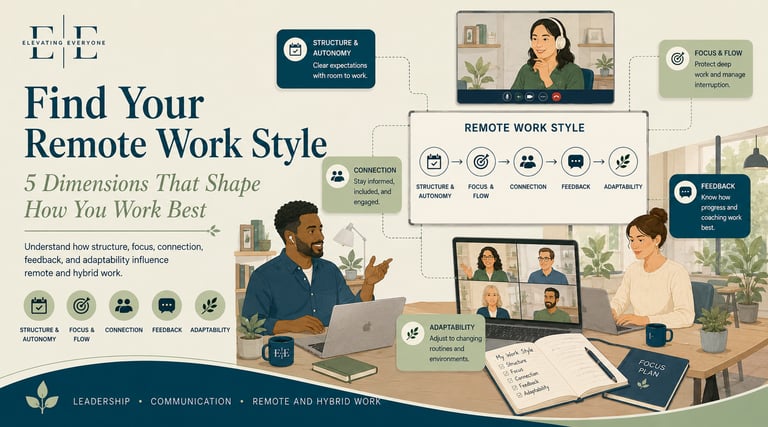
Find Your Remote Work Style: 5 Dimensions That Shape How You Work Best
Discover five remote work style dimensions that shape focus, communication, connection, feedback, and performance across remote and hybrid teams.
REMOTE AND HYBRID WORKLEADERSHIP AND COMMUNICATIONEMPLOYEE EXPERIENCE AND CULTURE
7/5/20268 min read
Find Your Remote Work Style: 5 Dimensions That Shape How You Work Best
Remote and hybrid work affect people differently.
Some employees do their best work with quiet focus, flexible blocks of time, and limited interruption. Others need more interaction, faster feedback, and regular connection to stay engaged.
Some people thrive with autonomy. Others feel more confident when expectations are visible and structured.
None of these patterns are wrong. They are different ways people work.
This is where remote work style becomes useful. When employees understand how they work best, they can make better choices about communication, focus, structure, and collaboration. When leaders understand those patterns across a team, they can design better work habits instead of relying on one-size-fits-all assumptions.
Remote and hybrid work improve when people understand both the work and the conditions that help them do it well.
For a quick reflection tool, see the Remote Work Style Quiz.
Why Remote Work Feels Different for Different People
Remote work is often discussed as if everyone experiences it the same way.
They do not.
One person may feel energized by fewer interruptions. Another may feel disconnected by the end of the week. One employee may love the freedom to plan their day. Another may struggle when the workday has too little structure.
These differences show up in practical ways:
how people manage focus
how quickly they respond to messages
how they prefer to receive feedback
how much social connection they need
how they organize their day
how they handle ambiguity
how they ask for help
how visible they feel to leaders and peers
Remote and hybrid work make these patterns more obvious because employees have more responsibility for managing their environment, energy, communication, and time.
Leaders should pay attention to those differences. The same remote work policy can create very different employee experiences.
A strong employee may struggle in remote work because the support system around them changed. Another employee may become more productive because they finally have space for deeper work.
Understanding work style helps leaders avoid surface-level conclusions.
Work Style Is Not a Personality Label
A work style should be used as a practical lens.
It helps people understand preferences, risks, and working conditions. It should not be used to box people in or excuse poor habits.
For example, someone who prefers independent work still needs to communicate clearly. Someone who values connection still needs focused time. Someone who likes structure still needs to adapt when priorities shift.
Work style gives people language. It does not remove accountability.
Useful work style conversations sound like this:
Here is how I focus best.
Here is where I may need more clarity.
Here is how I prefer to receive feedback.
Here is what helps me stay connected to the team.
Here is what can cause friction for me in remote or hybrid work.
Here is what I am working on improving.
This kind of conversation helps employees take ownership of their habits. It also helps leaders coach with more precision.
For a broader workplace lens, see The 4 Workplace Communication Styles and How to Work With Each.
Dimension 1: Structure and Autonomy
The first remote work dimension is structure.
Some employees work well with broad direction and freedom to shape the path. Others need more visible expectations, milestones, and check-ins.
Remote work can make this difference more noticeable.
An employee with a high need for autonomy may become frustrated when every task requires approval. They may prefer clear outcomes, then space to work. Another employee may feel lost when expectations are too open-ended. They may need more checkpoints to make sure they are moving in the right direction.
Leaders should look for signs that structure is either too loose or too restrictive.
Signs the structure may be too loose:
employees wait because next steps are unclear
people interpret priorities differently
deadlines shift without explanation
work gets redone because expectations were assumed
employees ask repeated clarification questions
Signs the structure may be too restrictive:
employees feel micromanaged
decision-making slows down
people stop taking initiative
managers become approval bottlenecks
capable employees disengage from unnecessary oversight
The best remote work structure gives people clarity without removing ownership.
A useful leadership question is:
How much structure does this person need to do the work with confidence?
The answer may vary by employee, role, project, and level of experience.
Dimension 2: Focus and Interruption
Remote work can improve focus. It can also create constant digital interruption.
Some employees need long blocks of quiet time to do their best work. Others operate well with more interaction, quick exchanges, and collaborative problem-solving.
Digital tools can blur the line between access and interruption.
A chat notification may feel small to the sender. For the receiver, it may break focus during complex work. A meeting may seem helpful to one person and disruptive to another. A quick call may solve a problem fast, but it can also interrupt someone’s best thinking time.
Employees should understand their own focus patterns.
Helpful questions include:
When do I do my best focused work?
Which types of interruptions slow me down most?
What kind of work requires protected time?
When do quick messages help me move faster?
When should I ask for a live conversation instead of sending more messages?
Leaders can support better focus by creating communication norms.
Examples include:
define when chat should be used
label urgent items clearly
protect focus blocks where possible
reduce unnecessary recurring meetings
use written updates for simple information sharing
group non-urgent questions when practical
Remote work does not automatically create focus. Leaders and employees have to protect it.
For more on communication rhythm, see Remote Team Communication: How to Reduce Confusion and Keep Work Moving.
Dimension 3: Connection and Belonging
Some employees feel connected through the work itself. Others need more regular interaction to feel part of the team.
Remote and hybrid work can strain belonging because people lose some of the informal touchpoints that happen naturally in shared spaces.
A team member may no longer hear casual updates. They may miss side conversations. They may not see the small moments of recognition or support that help people feel included.
Connection does not require constant meetings. It does require intention.
Leaders can strengthen connection through:
consistent one-on-ones
team check-ins with a clear purpose
thoughtful onboarding
visible recognition
inclusive meeting habits
shared team rituals
informal connection points
follow-up after major decisions or changes
Employees also need to know how they prefer to connect.
Some people value social time. Others prefer connection tied to meaningful work. Some appreciate quick check-ins. Others need deeper conversations less often.
A useful reflection question is:
What type of connection helps me feel informed, included, and engaged?
Leaders should avoid assuming silence equals comfort. Some remote employees may stay quiet even when they feel disconnected.
Connection is easier to support when leaders pay attention to patterns.
Dimension 4: Feedback and Visibility
Remote employees often have to be more intentional about visibility.
Good work can become less visible when people are not physically present. Leaders may not see the effort behind the output. Peers may not notice progress unless it is shared. Employees may begin to wonder whether their work is understood or valued.
Feedback also changes in remote and hybrid environments.
Some employees want frequent feedback to stay aligned. Others prefer more independence, with feedback at key milestones. Some need direct coaching. Others respond better when they have time to review written input first.
A strong remote work style includes understanding how feedback helps you perform.
Employees can ask themselves:
How often do I need feedback to stay aligned?
Do I prefer feedback live, written, or both?
Do I ask for input early enough?
Do I make my progress visible without over-reporting?
Do I know how my work connects to the larger priorities?
Leaders can improve feedback and visibility by using simple habits:
schedule regular one-on-ones
define what progress should look like
ask employees where they need support
recognize contributions in visible ways
document key wins and development needs
coach consistently across onsite and remote employees
Visibility should not depend on who is in the office most often.
Strong hybrid teams create better ways to see work, support employees, and develop talent across locations.
For related support, see Remote and Hybrid Leadership.
Dimension 5: Adaptability and Work Environment
Remote and hybrid work require employees to manage more of their own environment.
The work setting, daily routine, communication flow, distractions, home responsibilities, and technology setup all affect performance.
Some employees adapt quickly when conditions change. Others need more time, planning, or support. Some can shift between office, home, and travel without much friction. Others perform best with a stable routine.
Adaptability is easier when people know what helps them reset.
Useful questions include:
What kind of environment helps me do my best work?
What distractions affect me most?
How well do I transition between home and office days?
What routines help me start and end the workday?
What support do I need when priorities change quickly?
What drains my energy in remote or hybrid work?
Leaders should understand how environment affects the team, especially when making decisions about office days, meeting schedules, collaboration expectations, and response norms.
This is also where return-to-office decisions can create hidden friction. A policy change may affect commuting time, energy, family routines, focus time, and cost.
For a practical reflection on employee cost, see the Return-to-Office Cost Calculator.
How Leaders Can Use Remote Work Style Without Overcomplicating It
Remote work style should lead to better conversations, not more complexity.
Leaders can use work style insights in practical ways:
Match communication methods to the work.
Clarify expectations for response time and availability.
Design meetings with different participation styles in mind.
Balance focus time with collaboration time.
Make employee visibility less dependent on location.
Coach employees based on how they work best.
Identify where remote or hybrid friction is slowing the team down.
Work style conversations can fit naturally into existing leadership routines.
Use them during:
onboarding
one-on-ones
team resets
project kickoffs
hybrid schedule planning
manager coaching
employee development conversations
communication improvement work
The best use of work style is practical. It should help people understand themselves, understand each other, and work with fewer assumptions.
A Simple Remote Work Style Reflection
Use this reflection to identify patterns in how you work best.
Structure
Do I prefer broad direction or detailed expectations?
Where do I need more clarity to move with confidence?
Where do I perform best with more autonomy?
Focus
What type of work requires uninterrupted time?
Which interruptions affect my performance most?
How can I protect focus without becoming unavailable?
Connection
What helps me feel included and informed?
How often do I need meaningful interaction with my team?
What kind of connection feels useful rather than forced?
Feedback
How do I prefer to receive feedback?
Do I ask for feedback early enough?
How do I make progress visible to my leader and team?
Environment
Where do I do my best work?
What routines help me stay consistent?
What makes remote or hybrid work harder than it needs to be?
This reflection can also work as a team conversation. Each person can share a few patterns, risks, and preferences. The discussion often reveals simple adjustments that improve how people work together.
For a more guided version, take the Remote Work Style Quiz.
Practical Team Questions
Leaders can use these questions to apply remote work style across a team:
Which team members need more structure to perform confidently?
Who may need more autonomy to stay engaged?
Where are interruptions hurting focused work?
Which employees may be feeling disconnected?
Are remote employees getting consistent feedback?
Are office-based employees receiving more informal coaching?
Are meetings designed for different participation styles?
Are response expectations clear?
Are we recognizing strong work across locations?
Are work style differences creating avoidable friction?
These questions can help leaders see patterns before they become performance issues.
Remote work style is especially useful when a team is experiencing confusion, uneven engagement, missed handoffs, meeting fatigue, or tension around hybrid expectations.
Final Thought
Remote and hybrid work are easier to lead when people understand how they work best.
Employees gain language for their preferences, risks, and needs. Leaders gain insight into how to support focus, connection, communication, visibility, and development across the team.
A remote work style is not a fixed identity. It is a practical way to understand working conditions and make better choices.
When people understand their own patterns and the patterns of their teammates, they can reduce friction, communicate more clearly, and build stronger habits together.
The work still requires leadership. It also becomes easier when leaders stop assuming one remote experience fits everyone.
Elevating Everyone
Stay Connected
doug.ward@elevatingeveryone.com
843-259-2055
© 2026. All rights reserved.
Elevate Everywhere Enterprises, LLC.