The Missing First Rung: Why Remote and Hybrid Work Require a Better Career Development Model
Remote and hybrid work can succeed, but only when organizations build stronger systems for onboarding, mentoring, feedback, visibility, and career development.
REMOTE AND HYBRID WORKEMPLOYEE EXPERIENCE AND CULTURE
6/30/20267 min read
The Missing First Rung: Why Remote and Hybrid Work Require a Better Career Development Model
A recent analysis from the Federal Reserve Bank of New York should get the attention of leaders.
The New York Fed’s Liberty Street Economics blog published an article titled “Remote Work Leaves Younger Workers Sidelined.” The analysis suggests remote work may explain 64% of the recent increase in unemployment among young college graduates between 2017–2019 and 2022–2024. The authors argue that distributed work can make it harder for managers to train, mentor, and develop new employees.
That finding is worth noting.
But the larger issue reaches beyond young college graduates.
Remote and hybrid work did not create every career development problem. They exposed problems that were already there.
Many organizations relied on proximity to develop people. New employees learned by sitting near experienced peers. Future leaders were noticed in meetings. Coaching happened in hallway conversations. New managers picked up habits by watching stronger leaders work.
Those moments were valuable. They were also inconsistent.
They depended on access, location, timing, confidence, and relationships.
Remote and hybrid work changed the environment. It reduced many informal learning moments and made the gaps easier to see.
The question is no longer whether remote work can succeed. It can.
A Stanford-led study found that employees working from home two days per week were just as productive and just as likely to be promoted as fully office-based peers. The study also found lower quit rates among hybrid workers.
The better question is this:
Do organizations have a career development model strong enough for the way work happens now?
The first-rung problem
Early-career employees often need more than task instructions.
They need context.
They need to hear how experienced employees think through problems. They need feedback while work is still fresh. They need help understanding priorities, relationships, customers, culture, and communication norms.
They also need repetition.
A new employee does not build confidence from one onboarding call. Confidence comes from repeated exposure, guided practice, and timely correction.
In an office setting, some of that happened naturally. A new employee could overhear a customer call. They could watch a leader navigate conflict. They could ask a quick question after a meeting. They could see how people responded when something went wrong.
Remote work can still provide these learning moments.
But they rarely happen by accident.
That is where many organizations struggle.
They moved work to distributed environments without redesigning development. They adopted new tools, new schedules, and new meeting habits. But many kept the same loose approach to career growth.
That creates risk.
New employees may perform tasks without understanding the broader business. New managers may run meetings without learning how to coach. High-potential employees may deliver solid work but remain invisible. Internal candidates may be overlooked because they have fewer informal relationships.
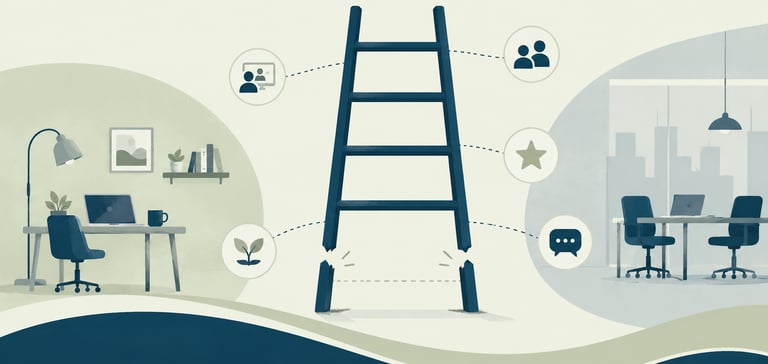
The result is a thinner career ladder.
For early-career employees, the first rung may be harder to reach.
For organizations, the leadership pipeline may weaken.
This issue affects more than new graduates
It would be a mistake to treat this as only a Gen Z issue.
Every role transition creates a development need.
A promoted supervisor is new again. A high performer moving into a stretch assignment is new again. A technical expert becoming a people leader is new again. An employee moving into a cross-functional role is new again.
Each of these moments requires learning, feedback, context, and support.
If those systems are weak, remote and hybrid work can amplify the problem.
Succession planning is also affected.
Leaders often say they want deeper internal benches. They want to promote from within. They want employees to see a future inside the organization.
Those goals require more than talent reviews.
They require visibility into who is ready, who is growing, and who needs exposure. They also require honest conversations about opportunity.
In a hybrid environment, visibility can become uneven.
Employees who spend more time near senior leaders may receive more informal coaching. Employees who speak up quickly may get noticed faster. Employees who already understand the culture may navigate it better.
That does not always mean they are more capable.
It may mean they are more visible.
Organizations need more discipline here.
Performance counts. Access to opportunity counts too.
A strong career development model should help leaders see both.
Engagement and manager capacity
This issue is also connected to employee engagement.
Gallup’s 2026 State of the Global Workplace report found global employee engagement fell to 20%. Gallup also reported that manager engagement declined from 27% to 22%.
Managers carry much of the development experience.
They set expectations. They coach performance. They translate strategy. They create feedback loops. They identify readiness. They influence whether employees feel seen, challenged, and supported.
If managers are disengaged, overloaded, or undertrained, development suffers.
Remote and hybrid work raise the bar for manager skill. They require more intentional communication, stronger follow-up, better meeting design, and clarity around when to use chat, email, phone, video, or in-person time.
They also require managers to separate status updates from development conversations.
A status meeting is not a development conversation.
A project update may tell a manager what happened. It may not reveal what the employee learned, where they are struggling, or what support they need next.
That distinction is critical.
Employees can be busy and still not be growing.
The Remote Career Development Model
Remote and hybrid teams need a practical model.
It does not need to be complicated. But it does need to be intentional.
A strong model should include five components.
1. Structured onboarding
Remote onboarding cannot rely on a checklist and a welcome call.
It needs a clear learning path.
That path should include role expectations, systems training, stakeholder introductions, customer context, communication norms, and early success measures.
A useful structure is a 30, 60, and 90-day plan.
The first 30 days should focus on learning the role and building relationships. The next 30 should focus on guided contribution. The third 30 should focus on stronger ownership and feedback.
Leaders should also build shadowing into the process.
New employees need to watch experienced employees work. They need to see how decisions are made. They need to hear how customer issues are handled. They need access to examples of strong work.
Remote teams can do this through recorded walkthroughs, live shadowing, shared call reviews, peer learning sessions, and structured debriefs.
Consistency is key.
Onboarding should not depend on which manager someone gets.
2. Mentorship with purpose
Mentorship is often too vague.
Many organizations assign a mentor and hope the relationship becomes useful. That is not a system. It is a good intention.
Remote and hybrid teams need clearer mentorship lanes.
A role mentor helps the employee perform the current job.
A culture mentor helps the employee understand how the organization works.
A career mentor helps the employee think about future growth.
One person may not be able to serve all three needs.
That is especially true in complex organizations.
A new employee may need one person for systems and processes. They may need another person to explain decision-making norms. They may need a different leader to help them explore long-term career paths.
Mentorship should also have a rhythm.
The relationship should include expectations, meeting frequency, discussion topics, and an endpoint. Without structure, mentorship often fades when work gets busy.
3. Manager-led development rhythm
Managers need a repeatable cadence.
A healthy rhythm might include four types of conversations.
Weekly check-ins should focus on priorities, blockers, and near-term support.
Monthly development conversations should focus on learning, feedback, skill-building, and confidence.
Quarterly career conversations should focus on goals, interests, readiness, and future opportunities.
Talent reviews should focus on growth, succession, exposure, and development actions.
Each conversation serves a different purpose.
When organizations skip this structure, everything gets compressed into task updates. That leaves little room for coaching.
This is one of the biggest risks in distributed work.
Remote teams can communicate constantly and still avoid meaningful development.
The manager’s role is to create space for both performance and growth.
4. Visibility and opportunity mapping
Remote employees can do strong work and still remain unseen.
Leaders should be intentional about visibility.
That does not mean forcing everyone into more meetings. It means designing fair access to opportunity.
Organizations can rotate presentation opportunities. They can assign project leadership intentionally. They can document stretch assignments. They can track who receives exposure to senior leaders. They can review whether remote employees are included in key initiatives.
This is especially important for succession planning.
A succession plan should not only identify who is ready now. It should also identify who needs exposure, coaching, and experience to become ready later.
That requires leaders to look beyond the most visible employees.
It also requires managers to advocate for talent in a structured way.
In hybrid work, opportunity should be tracked as carefully as performance.
5. Skill-building for distributed work
Remote and hybrid work require stronger communication skills.
Employees need to know how to ask better questions. They need to share concise updates. They need to manage up. They need to navigate conflict without creating unnecessary escalation. They need to build trust without constant proximity.
Managers need these skills too.
They need to coach through ambiguity. They need to read weak signals. They need to notice disengagement earlier. They need to create clarity without micromanaging.
These are not minor skills.
They are core leadership skills in modern work.
Organizations should teach them directly.
That may include manager training, communication workshops, peer coaching, meeting norms, feedback practice, and behavioral assessments.
The goal is not to add more activity.
The goal is to make development more visible, consistent, and sustainable.
What leaders should do now
Leaders do not need to overhaul everything at once.
They can start with a focused review.
First, audit the onboarding experience.
Look at the first 90 days for new employees. Identify where learning depends on chance. Then build structure around those moments.
Second, separate performance conversations from development conversations.
Both are essential, but they serve different purposes.
Third, define mentorship roles.
Do not simply ask someone to “be a mentor.” Clarify what kind of support the employee needs.
Fourth, review opportunity distribution.
Look at who gets stretch assignments, project visibility, leadership exposure, and coaching time.
Fifth, train managers for distributed leadership.
Managers need support. They are being asked to lead through flexibility, technology, disengagement, and constant change.
Sixth, connect career development to succession planning.
Development should align with future business needs and prepare people for the roles the organization will need next.
The real leadership challenge
Remote and hybrid work are often discussed as workplace policies.
That framing is too narrow.
They are operating models.
They shape how people communicate, learn, connect, build trust, and grow.
A flexible work model without a career development model creates risk. It may work well for experienced employees who already know how to navigate the organization. It may work less well for employees who need access, coaching, and context.
That includes early-career employees.
It also includes future managers, internal successors, and high-potential employees who have not yet been fully seen.
The answer is not a simple return-to-office mandate.
The answer is better design.
Organizations need onboarding systems that create real learning. They need mentorship that has purpose. They need managers who can coach in distributed environments. They need fair access to opportunity. They need career pathways that do not depend on proximity.
Remote and hybrid work can support flexibility, retention, and access to talent.
But flexibility alone is not a development strategy.
The organizations that win will be the ones that build the missing first rung.
Elevating Everyone
Stay Connected
doug.ward@elevatingeveryone.com
843-259-2055
© 2026. All rights reserved.
Elevate Everywhere Enterprises, LLC.