
Why Remote Employees Get Overlooked for Growth Opportunities
Remote employees can miss informal coaching, visibility, mentoring, and stretch assignments. Learn how leaders can create equitable growth paths across remote and hybrid teams.
REMOTE AND HYBRID WORKLEADERSHIP AND COMMUNICATIONEMPLOYEE EXPERIENCE AND CULTURE
7/5/20269 min read
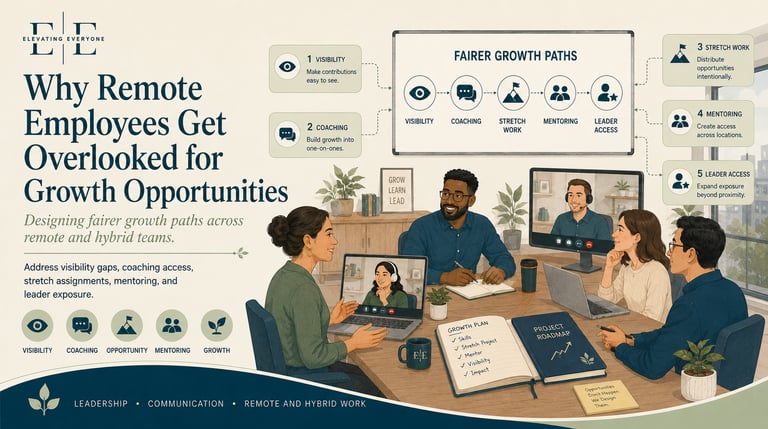
Why Remote Employees Get Overlooked for Growth Opportunities
Remote employees are not usually overlooked because leaders intend to leave them behind.
They are often overlooked because many development habits were built around proximity.
In traditional office settings, growth opportunities often happen through informal access. A leader notices someone asking good questions. A manager invites an employee into a conversation. A senior teammate offers coaching after a meeting. Someone gets pulled into a project because they were nearby when the need came up.
Those moments can help people grow.
They can also create uneven opportunity when the workplace becomes remote or hybrid.
Remote employees may be doing strong work, but they can miss out on informal coaching, visibility, stretch assignments, mentoring, and relationship-based opportunities. Over time, those missed moments can affect career growth, confidence, and retention.
Leaders need to design growth more intentionally across locations.
For a broader look at distributed team leadership, see Remote and Hybrid Leadership.
Proximity Bias Can Quietly Shape Opportunity
Proximity bias happens when people who are physically present receive more attention, trust, access, or opportunity than people who are less visible.
Most leaders would not describe themselves as biased toward onsite employees. The bias often shows up in small, ordinary decisions.
A manager needs someone for a quick assignment and asks the person nearby.
A leader talks through an issue with the employee who stopped by after a meeting.
A senior leader remembers the person who regularly appears in the office.
A stretch opportunity goes to someone who was part of an informal conversation.
None of these moments may feel unfair by themselves. Over time, they can create a pattern.
Remote employees may still receive assignments, updates, and performance reviews. They may not receive the same informal exposure, advocacy, or development conversation.
Leaders should watch for signs of proximity bias:
Onsite employees get more informal coaching.
Remote employees receive fewer stretch assignments.
Office conversations influence decisions before remote employees are included.
Leaders describe onsite employees as more engaged without clear evidence.
Remote employees have fewer relationships with senior leaders.
Recognition happens more often for work leaders see in person.
Career conversations happen inconsistently across locations.
The fix starts with awareness, but awareness alone will not be enough. Leaders need systems that make opportunity visible and fair.
Informal Coaching Does Not Travel Automatically
Coaching often happens in small moments.
A manager offers quick feedback after a customer call. A leader gives context after a meeting. A senior employee explains why a decision landed a certain way. A peer shares a shortcut that makes the work easier.
In remote and hybrid teams, those coaching moments can disappear unless leaders build new habits.
Remote employees may still get formal feedback. They may not get the casual explanation that helps them understand the business more deeply.
Informal coaching helps employees learn:
how leaders think
what good judgment looks like
how decisions are made
which risks matter most
how to handle sensitive situations
how to communicate with different stakeholders
what skills they need for the next level
When remote employees miss this coaching, their growth may slow even when their performance stays strong.
Managers can create more consistent coaching by making small development moments part of the regular rhythm.
Practical habits include:
Add five minutes of coaching to one-on-ones.
Explain the reason behind important decisions.
Invite remote employees to observe key conversations when appropriate.
Debrief complex work after it is complete.
Share examples of strong judgment.
Ask employees what skills they want to build.
Give feedback close to the work, not only during review cycles.
Remote employees should not have to wait for a formal development conversation to receive useful coaching.
For a related article on early career development in remote and hybrid settings, see The Missing First Rung.
Stretch Assignments Need a Clearer Process
Stretch assignments are one of the most important ways employees grow.
They give people exposure, confidence, new skills, and a chance to demonstrate readiness for more responsibility.
In remote and hybrid teams, stretch assignments can become too dependent on visibility and timing.
A manager may think of the employee they saw most recently. A leader may select someone who has been part of more informal conversations. A project may move quickly, and the opportunity goes to the person easiest to reach.
Remote employees can be overlooked even when they are capable and interested.
Leaders can reduce this risk by creating a clearer process for identifying growth opportunities.
A strong process answers:
What stretch work is coming up?
Who is ready for more exposure?
Who has expressed interest in growth?
Who needs a chance to build confidence?
Who has not received a meaningful opportunity recently?
What support would help the person succeed?
How will the assignment be visible and recognized?
Managers should also talk with employees about the type of growth they want.
Not every employee wants the same opportunity. Some want people leadership. Some want technical depth. Some want cross-functional exposure. Some want to solve harder problems without managing others.
Growth conversations should be specific enough to guide real decisions.
Visibility Should Be Designed, Not Assumed
Remote employees often face a visibility challenge.
They may produce strong work, support the team, solve problems, and serve customers well. Yet their contributions may be less visible because leaders do not see the daily effort behind the outcomes.
Visibility should not depend on who happens to be in the office.
Leaders need practical ways to see work across locations.
Useful visibility habits include:
shared project updates
documented wins and blockers
regular one-on-one conversations
team dashboards
visible ownership of key work
leadership reviews of project contribution
recognition across remote, hybrid, and onsite employees
clear discussion of progress during team meetings
Employees also have a role to play. Remote employees may need to communicate progress more intentionally without feeling like they are constantly proving themselves.
Leaders can make this easier by defining what good visibility looks like.
For example:
Share weekly priorities.
Note key decisions and progress.
Raise blockers early.
Document completed work.
Connect updates to business outcomes.
Ask for feedback before major milestones.
A healthy visibility system helps leaders support employees fairly. It also prevents remote employees from becoming invisible until something goes wrong.
For more on communication systems, see Remote Team Communication.
One-on-Ones Become More Important
One-on-ones are important in any team. In remote and hybrid teams, they carry more weight.
They may be the primary place where employees receive coaching, ask questions, share concerns, discuss development, and get access to their leader’s thinking.
A weak one-on-one becomes a missed opportunity. A strong one-on-one can help close the distance created by remote work.
Too often, one-on-ones become task reviews.
Task updates have value, but development requires more than status.
A strong remote one-on-one should include space for:
current priorities
blockers
feedback
coaching
career interests
confidence level
workload
visibility
development opportunities
questions the employee may not raise in a group setting
Managers do not need a complex agenda every week. They need consistency and intention.
Useful questions include:
What work feels most important right now?
Where do you need more context?
What is creating friction?
What kind of work would you like more exposure to?
Where do you want to grow next?
What feedback would be most useful right now?
Who would it help you to learn from?
What opportunity would stretch you in a good way?
These conversations help managers understand more than output. They help managers understand the employee’s interests, confidence, and readiness for growth.
Mentoring Requires More Structure
Mentoring can happen naturally in an office. People meet through proximity, repeated interaction, and informal conversation.
Remote employees may have fewer casual ways to build those relationships.
This can affect career growth, especially for newer employees, early-career professionals, or employees entering a new function.
Leaders should not leave mentoring entirely to chance.
A simple mentoring structure can help remote and hybrid employees build broader relationships.
Options include:
peer mentors for new hires
monthly development conversations with a senior teammate
project-based mentoring
cross-functional shadowing
leadership office hours
small group learning sessions
role-based communities of practice
skill-focused mentoring circles
Mentoring does not need to become a large program. It can begin with a few intentional connections.
The important shift is simple: employees should not need physical proximity to gain access to learning relationships.
Managers can support this by asking:
Who does this employee need more exposure to?
What relationships would help them grow?
Who could help them understand the business better?
Where could they observe stronger examples of the skill they want to build?
Remote employees benefit when leaders help open doors.
Use Better Insight to Support Growth
Remote employees can be overlooked when leaders only see output and miss the person behind the work.
Structured insight can help.
A workplace assessment, used responsibly, can give leaders a better understanding of how employees communicate, what motivates them, how they approach work, and where they may want to grow. It can also give employees better language to describe what they need from their leader.
The value comes from creating better conversations.
One employee may want more stretch assignments but may not advocate loudly for them. Another may be energized by solving complex problems. Another may need clearer expectations before stepping into something new. Another may want more visibility but feel uncertain about how to ask for it.
Leaders can use these insights to ask better development questions:
What kind of growth are you most interested in?
What type of work gives you energy?
Where would you like more exposure?
What kind of support helps you take on something new?
What would make the next opportunity feel realistic?
How do you prefer to receive coaching or feedback?
What might cause you to hold back from pursuing an opportunity?
Tools like Elevating Insight can help leaders and teams turn these conversations into practical development habits.
This works best when assessments are used as a lens, not a label. People should leave the conversation feeling better understood, not boxed in.
Remote Employees Need Access to Leaders
Growth often depends on access.
Employees learn from leaders through direct conversations, project exposure, feedback, decision-making context, and informal observation.
Remote employees may have fewer moments with leaders outside their direct manager.
This can limit how well senior leaders understand their capabilities. It can also limit how well employees understand the broader business.
Leaders can create more equitable access without overcomplicating the process.
Examples include:
invite remote employees to present project updates
rotate who leads portions of team meetings
create skip-level conversations with purpose
include remote employees in cross-functional work
offer virtual office hours
make leadership Q&A sessions accessible
ask managers to identify employees ready for more exposure
recognize remote contributions in broader forums
Access should not only go to the loudest employees or the most visible employees.
Managers play an important role here. They should advocate for remote employees and make sure their work is seen by the right people.
Managers Should Audit Growth Opportunities
Fair growth requires regular review.
Leaders should occasionally step back and look at who is receiving opportunity, coaching, visibility, and sponsorship.
A simple audit can reveal patterns that are easy to miss in daily work.
Review questions might include:
Who received stretch assignments in the last quarter?
Who presented to senior leaders?
Who received meaningful coaching?
Who had development conversations?
Who was recognized publicly?
Who joined cross-functional projects?
Who received mentoring or sponsorship?
Who was considered for promotion or expanded responsibility?
Are remote employees represented fairly in those opportunities?
Are hybrid employees receiving more access when they are onsite?
This review should not become a compliance exercise. It should help leaders see whether growth is being distributed intentionally.
If opportunity is concentrated among onsite employees, the system needs adjustment.
Build Equitable Growth Paths
Remote and hybrid teams need clearer growth paths because informal access is less reliable.
Employees should understand how growth happens, what skills are needed, and how opportunities are identified.
An equitable growth path includes:
clear role expectations
regular development conversations
visible stretch opportunities
documented skills needed for advancement
access to mentoring
consistent feedback
fair recognition
exposure to leaders and cross-functional work
manager accountability for employee development
Leaders should also be careful with assumptions.
A remote employee who is quiet may still want to grow. An employee who values flexibility may still want advancement. An employee who does strong independent work may still need coaching, visibility, and opportunity.
Growth should be discussed directly, not assumed based on location, personality, or schedule.
For a related perspective on individual work patterns, see Find Your Remote Work Style.
A Practical Checklist for Leaders
Use this checklist to assess whether remote employees have fair access to growth.
Visibility
Do remote employees have ways to make progress visible?
Are their contributions recognized in team and leadership settings?
Are leaders seeing outcomes, not just office presence?
Are remote employees included in important conversations?
Coaching
Are one-on-ones consistent and useful?
Do remote employees receive feedback close to the work?
Are managers explaining context and decision-making?
Are coaching conversations focused on growth, not only tasks?
Opportunity
Are stretch assignments distributed intentionally?
Are remote employees considered for visible projects?
Do managers know what kind of growth each employee wants?
Are remote employees getting chances to build new skills?
Access
Do remote employees have access to senior leaders?
Are mentoring relationships available across locations?
Are remote employees included in cross-functional work?
Are informal opportunities being replaced with intentional access?
Fairness
Are flexibility and development treated separately?
Are managers watching for proximity bias?
Are growth opportunities reviewed across the team?
Are employees evaluated based on contribution and readiness?
If several answers are unclear, start with one leadership habit. Improve one-on-ones, document growth interests, review stretch assignments, or create more visible opportunities.
Small improvements can change the experience quickly.
Final Thought
Remote employees are often overlooked because growth systems were built around proximity.
Informal coaching, visibility, mentoring, stretch assignments, and access to leaders do not always travel naturally into remote and hybrid work.
Leaders can close that gap.
They can make development conversations more consistent. They can create fairer access to opportunity. They can use better insight to understand what employees want and how they work best. They can recognize contribution without relying on physical presence.
Remote and hybrid work can support strong employee growth. It requires leaders to design development with the same intention they bring to communication, performance, and team connection.
When growth becomes visible, structured, and fair, remote employees have a better chance to be seen for what they can contribute next.
Elevating Everyone
Stay Connected
doug.ward@elevatingeveryone.com
843-259-2055
© 2026. All rights reserved.
Elevate Everywhere Enterprises, LLC.