
How to Calculate Your Commute Cost Before Returning to the Office
Learn how to calculate commute cost, including mileage, fuel, parking, tolls, meals, care needs, time, and annual return-to-office impact.
REMOTE AND HYBRID WORKEMPLOYEE EXPERIENCE AND CULTURE
7/5/20268 min read
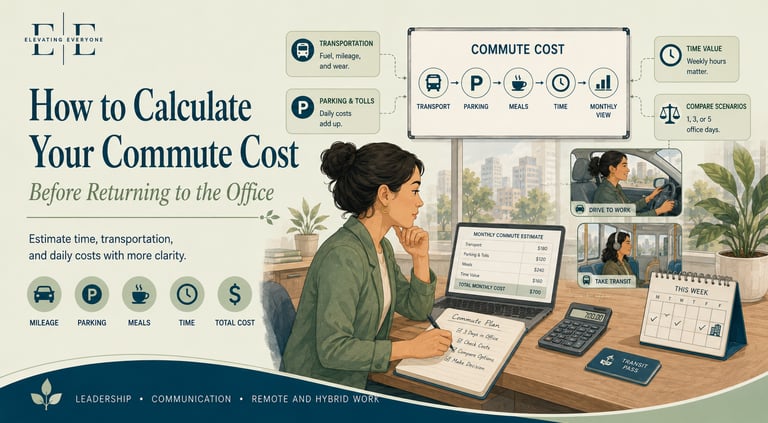
How to Calculate Your Commute Cost Before Returning to the Office
A commute can look small when it is measured one trip at a time.
A few dollars for gas. A parking fee. A quick stop for coffee. Thirty or forty minutes in the car.
Over a week, month, or year, the picture changes.
For employees, commute cost is part of the return-to-office experience. For leaders, understanding that cost can improve how office expectations are designed and communicated.
This article is a practical guide. It walks through how to calculate the personal cost of commuting so employees and leaders can have a more grounded conversation about return-to-office expectations.
For a faster estimate, use the Return-to-Office Calculator.
Start With Your Commute Pattern
The first step is to define the pattern.
A commute cost calculation depends on how often someone travels to the office, how far they travel, and what expenses are tied to each office day.
Start with these questions:
How many days per week will you commute?
How many miles is the round trip?
How long does the round trip usually take?
Do you drive, use public transportation, carpool, walk, bike, or combine options?
Do you pay for parking?
Do you pay tolls?
Do office days change your meal, childcare, or routine costs?
Does the commute affect your workday, energy, or schedule?
Use a normal week as the baseline. If your schedule varies, calculate a low, middle, and high estimate.
For example:
Low estimate: one office day per week
Middle estimate: two or three office days per week
High estimate: four or five office days per week
This helps you see how much the cost changes as office expectations increase.
For a broader view of RTO impact, see The True Cost of Returning to the Office.
Step 1: Calculate Your Transportation Cost
Transportation is usually the easiest cost to estimate.
If you drive, start with round-trip mileage.
Use this formula:
Round-trip miles x office days per week = weekly commute miles
Then estimate your cost per mile.
Many people only think about fuel. Fuel is important, but driving also adds wear and tear, maintenance, tires, depreciation, and mileage to the vehicle.
You can estimate transportation cost in a few ways:
Use your actual fuel cost if you track gas expenses.
Use a personal estimate based on your vehicle’s fuel efficiency.
Use a mileage estimate that includes fuel and wear.
Use your company reimbursement rate if one applies.
Use a conservative flat estimate if you only need a rough number.
A simple version might look like this:
Round-trip commute: 40 miles
Office days: 3 days per week
Weekly commute miles: 120 miles
Estimated cost per mile: $0.40
Weekly transportation cost: $48
This will not be perfect, but it creates a more realistic estimate than fuel alone.
If you use public transportation, calculate:
fare per trip
round-trip fare
number of office days
monthly pass cost if applicable
ride-share or parking needed to reach transit
If you carpool, include your share of fuel, parking, tolls, or vehicle contribution.
Step 2: Add Parking and Tolls
Parking and tolls can turn a moderate commute into a costly one.
These expenses are easy to miss because they may feel routine. Over time, they add up quickly.
Calculate:
parking cost per day
toll cost per round trip
office days per week
weekly total
monthly total
annual total
Example:
Parking: $12 per day
Tolls: $6 per day
Office days: 3 per week
Weekly parking and tolls: $54
A three-day office schedule at that rate adds more than $200 per month before fuel, meals, or time are included.
Leaders should pay attention to these costs, especially in urban markets or locations where parking is limited.
Employees may not talk openly about these expenses, but they often factor them into how the policy feels.
Step 3: Include Meals, Coffee, and Daily Routine Costs
Office days often change spending habits.
Some employees bring lunch from home. Others buy meals because the day starts earlier, the commute is longer, or the office routine creates more convenience spending.
These expenses are personal, but they are still part of the commute calculation.
Possible routine costs include:
coffee or breakfast
lunch
snacks
bottled drinks
after-work meals due to a longer day
clothing or dry cleaning
gym or shower access
convenience purchases tied to commuting
A simple estimate works well.
Ask:
What do I usually spend on an office day?
What would I spend if I worked from home that day?
What is the difference?
Example:
Office day meals and coffee: $18
Work-from-home meals and coffee: $5
Added daily cost: $13
Office days: 3 per week
Weekly routine cost: $39
This category can be flexible. Some employees can control it more than others.
The calculation still helps because it shows how office days change daily spending.
Step 4: Add Childcare, Pet Care, or Household Support
Some costs only appear because the employee is away from home longer.
These can be significant.
Examples include:
before-school care
after-school care
extended daycare hours
babysitting
elder care support
pet walking
pet daycare
household help due to longer office days
Not everyone will have these costs. For employees who do, they can become one of the largest parts of the commute calculation.
A simple way to estimate:
Added care cost per office day
Office days per week
Weekly added care cost
Monthly added care cost
Example:
After-school care: $25 per office day
Office days: 2 per week
Weekly added care cost: $50
Monthly added care cost: about $200
Leaders should be careful with assumptions here. Employees have different family structures, schedules, transportation options, and caregiving responsibilities.
A return-to-office policy may look consistent on paper while creating very different cost levels across the team.
Step 5: Estimate the Value of Commute Time
Time is harder to price, but it should not be ignored.
Commute time affects the employee’s day even when it does not show up as a receipt.
Start by calculating the time:
Round-trip commute time x office days per week = weekly commute time
Example:
Round-trip commute: 90 minutes
Office days: 3 per week
Weekly commute time: 270 minutes
Weekly commute time in hours: 4.5 hours
Then decide how you want to view the value of that time.
You can look at it as:
unpaid time connected to work
personal time lost
family time reduced
focus time displaced
recovery time shortened
flexibility removed from the day
Employees may choose to assign a dollar value to the time. Leaders may choose to view it as an employee experience and energy cost.
Both views are useful.
For some employees, the commute time may be more significant than the out-of-pocket expenses.
A five-hour weekly commute adds up to more than 250 hours per year. That is before parking, fuel, meals, or routine costs are considered.
Step 6: Convert Weekly Cost Into Monthly and Annual Cost
Weekly numbers are useful. Monthly and annual numbers are more revealing.
Use these simple conversions:
Weekly cost x 4.33 = estimated monthly cost
Weekly cost x 52 = estimated annual cost
A weekly cost of $100 may feel manageable in isolation. Over a year, it becomes about $5,200.
A weekly cost of $150 becomes about $7,800 per year.
This is why commute cost should be calculated over time. Return-to-office decisions are usually ongoing, not one-time events.
A monthly or annual view also helps employees compare different work arrangements.
For example:
one office day per week
two office days per week
three office days per week
five office days per week
The Return-To-Office Calculator can help compare these scenarios quickly.
A Simple Commute Cost Example
Here is a basic example for one employee.
Assumptions:
Round-trip commute: 40 miles
Office days: 3 per week
Estimated vehicle cost: $0.40 per mile
Parking: $10 per day
Tolls: $4 per day
Added meals and coffee: $12 per day
Round-trip commute time: 70 minutes
Weekly transportation cost:
40 miles x 3 days = 120 miles
120 miles x $0.40 = $48
Weekly parking and tolls:
Parking: $10 x 3 days = $30
Tolls: $4 x 3 days = $12
Total: $42
Weekly routine cost:
Meals and coffee: $12 x 3 days = $36
Weekly out-of-pocket estimate:
Transportation: $48
Parking and tolls: $42
Meals and coffee: $36
Weekly total: $126
Estimated monthly cost:
$126 x 4.33 = about $546
Estimated annual cost:
$126 x 52 = $6,552
Weekly commute time:
70 minutes x 3 days = 210 minutes
210 minutes = 3.5 hours per week
Annual commute time:
3.5 hours x 52 weeks = 182 hours per year
This example is not extreme. For many employees, the cost could be lower. For others, it could be much higher.
The value comes from seeing the whole picture.
What Leaders Should Take From Commute Cost Data
Commute cost calculations are useful for employees. They are also useful for leaders.
Leaders do not need to ask employees to disclose personal finances. They should understand the types of costs employees may be carrying.
This helps leaders make better decisions about:
office day expectations
meeting design
team anchor days
flexibility guidelines
manager communication
employee listening
retention risk
location strategy
hybrid work design
A cost-aware leader can ask better questions.
For example:
Are office days being used for work that benefits from being together?
Are employees commuting for meetings they could have joined remotely?
Are managers present and available on required office days?
Are employees getting enough value from onsite time?
Are teams using hybrid schedules consistently?
Are employees carrying cost without seeing a clear business reason?
This is where commute cost connects to leadership.
The issue is not only what employees pay. The issue is whether the organization is designing work with enough purpose to justify the cost.
For a deeper leadership perspective, see Hybrid Work is an Operating Model, Not a Schedule.
How Employees Can Use the Calculation
Employees can use commute cost calculations to make better personal decisions.
The calculation can help with:
budgeting
evaluating hybrid schedules
comparing job offers
planning childcare or transportation
discussing flexibility with a manager
understanding the real cost of office days
deciding which expenses need to be managed differently
Employees should avoid using the number as the only factor. Office time may also offer benefits.
Those benefits may include:
stronger relationships
more coaching
faster problem-solving
better access to leaders
clearer collaboration
stronger team connection
better onboarding or learning
A good calculation shows the cost. It does not decide the value by itself.
The value depends on how the office time is used.
For individual work-pattern reflection, see Find Your Remote Work Style.
How to Lower Commute Cost Without Ignoring the Work
Some commute costs can be reduced with small changes.
Employees may consider:
carpooling
using public transportation
adjusting commute times
bringing meals from home
batching errands around office days
choosing lower-cost parking
planning office clothing needs
using pre-tax transportation benefits if available
coordinating childcare around office schedules
Leaders may consider:
aligning office days with collaboration needs
reducing low-value required attendance
giving teams guidance on when office time adds value
avoiding onsite days filled with individual video calls
making manager expectations clear
using office time for coaching, planning, and connection
reviewing office-day effectiveness after implementation
Cost reduction should not fall only on employees. Leaders influence whether office time is useful, efficient, and credible.
A thoughtful hybrid model can reduce wasted commute time and improve the value of in-person work.
A Practical Commute Cost Checklist
Use this checklist to estimate commute cost before returning to the office.
Transportation
How many miles is the round trip?
How many days per week will you commute?
What is your estimated cost per mile?
Do you need to include public transportation, ride-share, or carpool costs?
Are vehicle maintenance and wear part of your estimate?
Parking and Tolls
Do you pay for parking?
Do you pay tolls?
Are parking rates different by day or location?
Are there lower-cost alternatives?
Daily Routine
Will office days increase meal, coffee, or snack spending?
Will you need different clothing or cleaning costs?
Will your schedule create convenience spending?
Care and Household Logistics
Will office days add childcare costs?
Will you need pet care?
Will elder care or household support change?
Will commute timing affect family routines?
Time and Energy
How long is the round trip?
How many hours per week will commuting add?
Where will that time come from?
How does commuting affect focus, rest, or personal routines?
Monthly and Annual Impact
What is the weekly cost?
What is the monthly cost?
What is the annual cost?
How does the cost change with more office days?
Final Thought
Commute cost is more than a gas estimate.
It includes transportation, parking, tolls, meals, care needs, time, energy, and changes to daily routines. Those costs become more meaningful when they are viewed over a month or a year.
Employees benefit from understanding the real number. Leaders benefit from understanding the experience behind the number.
A strong return-to-office conversation should connect cost, purpose, and work design.
When office days create clear value, the commute becomes easier to understand. When office days feel disconnected from the work, the cost becomes harder to accept.
Calculating commute cost gives people a clearer starting point for better decisions.
Elevating Everyone
Stay Connected
doug.ward@elevatingeveryone.com
843-259-2055
© 2026. All rights reserved.
Elevate Everywhere Enterprises, LLC.