
The True Cost of Returning to the Office: What Employees Actually Pay
Return-to-office decisions affect more than location. Learn how commuting, time, cost, energy, flexibility, and trust shape the employee experience.
REMOTE AND HYBRID WORKEMPLOYEE EXPERIENCE AND CULTURE
7/5/20268 min read
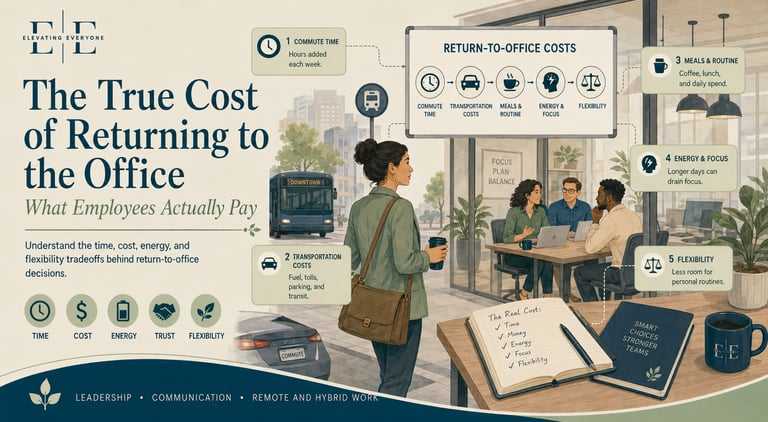
The True Cost of Returning to the Office: What Employees Actually Pay
Return-to-office decisions are often discussed as workplace policy.
How many days should employees come in? Which teams should be onsite? Who gets flexibility? What should count as an exception?
Those questions are important. They also leave out a major part of the employee experience.
Returning to the office creates real costs for employees. Some are financial. Some are practical. Some affect energy, focus, trust, and the way people experience their workday.
Leaders do not need to avoid office expectations. Many teams benefit from in-person collaboration, coaching, onboarding, planning, and connection.
Leaders do need to understand the full cost before changing the policy.
When employees hear a return-to-office announcement, they are not only thinking about workplace culture. They are calculating time, money, logistics, family routines, commute stress, flexibility, and whether the added cost connects to a clear business reason.
A stronger return-to-office conversation starts with a fuller picture.
For a quick estimate, use the Return-to-Office Cost Calculator.
Return-to-Office Costs Are Bigger Than Gas
Many people think about commute cost in simple terms.
Gas. Parking. Maybe tolls.
Those costs count, but they are only part of the picture.
A realistic return-to-office cost includes several categories:
fuel or public transportation
parking
tolls
vehicle wear and tear
increased maintenance
meals and coffee
work clothing
childcare or after-school coverage
pet care
commute time
lost flexibility
stress and energy drain
reduced time for exercise, caregiving, errands, or recovery
Some employees may only feel a few of these costs. Others may feel nearly all of them.
The cost also compounds over time. One office day may feel manageable. Three or four days per week can change a household’s schedule, budget, and daily rhythm.
For leaders, the key is to avoid treating the commute as a minor inconvenience. For many employees, the commute is a real part of the workday.
Time Is Often the Largest Cost
Money gets attention because it is easier to calculate.
Time may be the larger cost.
A 30-minute commute each way adds five hours per week for someone working onsite five days. A 45-minute commute each way adds seven and a half hours per week. An hour each way adds ten hours per week.
For many employees, that time comes from somewhere specific.
It may come from:
family time
exercise
sleep
focused work
caregiving responsibilities
meal preparation
personal appointments
school routines
rest and recovery
Employees may not object to being together. They may object to losing several hours each week without a clear reason.
This is where communication becomes critical.
If leaders ask employees to absorb more time cost, employees need to understand the value of that time. What happens in the office that cannot happen as effectively remotely? What work improves because people are together? Which days need collaboration, coaching, or planning?
When office time has a clear purpose, employees are more likely to see the tradeoff.
For related thinking, see Hybrid Work is an Operating Model, Not a Schedule.
Commuting Changes the Employee’s Workday
The office day starts before an employee arrives.
People prepare differently. They may wake earlier, pack meals, plan clothing, arrange transportation, coordinate childcare, and allow extra time for traffic or parking.
The workday also continues after they leave. Employees may arrive home later, more tired, and with less flexibility for personal responsibilities.
These changes can affect how people experience the work itself.
A longer commute may leave someone less focused by the time they arrive. A difficult evening commute may affect their availability for family or recovery. A schedule that looks simple on paper may create friction in real life.
Leaders should consider how office expectations affect the full day, not only the time inside the building.
Useful questions include:
How long are typical commutes for employees?
Are office days aligned to work that benefits from being together?
Are employees spending office days on video calls with remote colleagues?
Are leaders present and accessible on required office days?
Are meetings, coaching, and collaboration intentionally planned?
Are employees gaining value from the time spent commuting?
If the office day feels like a remote day with a commute attached, employees will notice.
Financial Costs Can Affect Trust
Return-to-office policies can create financial pressure.
For some employees, the additional cost may be small enough to absorb. For others, it may be significant.
A few extra expenses can add up quickly:
$12 for parking
$8 for coffee or breakfast
$15 for lunch
$6 for tolls
$10 to $20 in fuel
extra mileage on the vehicle
additional childcare coverage
A single office day can become expensive. Multiple days per week can become a meaningful budget item.
Leaders should be careful with assumptions. Employees do not all have the same commute, household income, family responsibilities, or transportation options.
Financial strain can also affect how employees interpret the policy.
If the business reason is unclear, employees may see the decision as disconnected from their reality. If the policy is applied inconsistently, frustration can grow. If leaders ignore the cost entirely, trust can weaken.
A transparent explanation does not remove the cost. It can help employees understand the decision.
For practical support, link employees to the Return-to-Office Calculator.
The Commute Affects Energy and Performance
Commutes can create hidden performance costs.
Traffic, delays, crowded public transportation, parking challenges, and longer days can affect mood, focus, and energy. Employees may arrive at the office already feeling behind. They may leave with less energy for responsibilities outside of work.
Over time, this can influence engagement and retention.
Leaders should avoid assuming office attendance automatically improves performance. It may improve some kinds of work. It may also introduce friction for other kinds of work.
Office time tends to be more useful for:
relationship building
onboarding
coaching
complex collaboration
planning
difficult conversations
team problem-solving
customer or stakeholder sessions
cross-functional alignment
Remote time often works well for:
focused individual work
writing
analysis
preparation
follow-through
asynchronous collaboration
administrative work
deep project work
The best return-to-office decisions connect location to the type of work being done.
A commute feels more reasonable when the office day creates value employees can recognize.
RTO Can Affect Employees Differently
Return-to-office policies are rarely experienced evenly.
The same policy may affect employees differently based on commute distance, role, household responsibilities, caregiving needs, disability, transportation access, and financial situation.
A 15-minute commute and a 75-minute commute are not the same experience.
A flexible household and a single-parent household may not experience the same policy the same way.
A role that depends on in-person collaboration may experience office time differently than a role built around independent analysis.
Leaders should evaluate the impact across the workforce, not only the policy design.
Questions worth asking include:
Which employees face the highest commute burden?
Which roles benefit most from in-person work?
Which roles can perform well remotely with strong communication habits?
Where does office time improve customer, team, or business outcomes?
Where does office time create more cost than value?
Are exceptions handled fairly and consistently?
Are managers equipped to apply the policy without creating confusion?
Fair does not always mean identical. Leaders need clear principles for how flexibility is evaluated and communicated.
A Better RTO Conversation Starts With Purpose
Employees are more likely to accept change when the purpose is clear.
“Come in three days per week” is a rule.
“Come in on the days when your team is planning, coaching, solving complex issues, or working through cross-functional decisions” gives people a reason.
Purpose does not guarantee agreement. It improves the quality of the conversation.
Leaders should be able to explain:
why the policy is changing
what business problem the change is intended to solve
which work improves when people are together
how office days should be used
how remote employees will remain included
how the policy will be evaluated
how employee feedback will be heard
what flexibility exists and how it will be handled
A return-to-office decision should connect to work design, not just attendance.
For broader support, see Remote and Hybrid Leadership.
Managers Carry Much of the RTO Experience
Return-to-office decisions may come from senior leadership, but managers shape how employees experience them.
A strong manager can help employees understand expectations, plan office time well, reduce confusion, and maintain trust. A weak or inconsistent manager can turn a clear policy into frustration.
Managers need guidance before policy changes take effect.
They should know:
how to explain the policy
what flexibility they can approve
how to handle exceptions
how to plan meaningful office time
how to include remote employees
how to avoid proximity bias
how to document decisions
how to listen without overpromising
how to escalate concerns
Without manager alignment, employees may receive different messages from different leaders.
This creates confusion fast.
Return-to-office changes require communication discipline, manager preparation, and follow-through.
For a leadership framework, see 10 Leadership Principles for Remote and Hybrid Teams.
Office Days Should Earn the Commute
Employees will judge office days by what happens during them.
If people commute only to sit on video calls, answer email, and work independently, the office requirement will feel disconnected from the work.
Leaders should design office days with intention.
A useful office day may include:
team planning
leader check-ins
coaching conversations
project reviews
customer problem-solving
cross-functional working sessions
onboarding support
relationship building
recognition moments
decision-making sessions
A poor office day often includes:
isolated work with no collaboration
meetings with people who are mostly remote
leaders who are not present
unclear purpose
limited team interaction
no visible connection to business outcomes
Employees do not need every office day to be extraordinary. They need the expectation to make sense.
If the commute is costly, the office experience should create enough value to justify the ask.
Use Cost Awareness Without Turning It Into a Debate
Leaders do not need to calculate every employee’s personal cost before making a decision.
They should understand the types of costs employees may be carrying.
Cost awareness helps leaders communicate with more credibility. It also helps them design better policies.
A few practical options include:
use office days for high-value collaboration
reduce low-value mandatory attendance
align onsite days with leadership presence
allow team-based scheduling where appropriate
give managers clear flexibility guidelines
review whether the policy is improving outcomes
acknowledge employee cost directly
provide tools employees can use to estimate impact
Cost awareness does not mean every request can be approved. It means leaders are making decisions with a fuller understanding of the employee experience.
A Practical RTO Cost Checklist for Leaders
Before changing a return-to-office policy, leaders should ask a few direct questions.
Cost and Time
How much commute time are employees likely to absorb?
What financial costs might increase for employees?
Which employees may be affected most?
Are there location, role, or schedule differences to consider?
Work Design
Which work truly benefits from being onsite?
Which work is better suited for remote focus?
Are office days designed around collaboration, coaching, and decision-making?
Are employees likely to spend office days on calls with remote colleagues?
Communication
Can leaders explain why the change is happening?
Do managers understand how to communicate the policy?
Are flexibility guidelines clear?
Are employee questions being captured and addressed?
Trust and Fairness
Will the policy feel consistent across teams?
Are exceptions handled with clear criteria?
Are remote employees protected from reduced visibility?
Are leaders modeling the expectations they set?
Measurement
How will the organization know whether the change is working?
What employee feedback will be reviewed?
What performance or customer outcomes will be monitored?
When will the policy be revisited?
A return-to-office decision should be reviewed after implementation. Leaders should look for what improved, what became harder, and where the model needs adjustment.
Questions Employees May Be Asking
Leaders should be prepared for the questions employees may not say out loud.
Employees may be wondering:
How much will this cost me each month?
Will the commute improve my work or just add time?
Will leaders be in the office too?
Will remote employees lose opportunity?
Will flexibility still be available when life happens?
Will office days be used well?
Will this policy change again soon?
Does leadership understand how this affects my daily life?
These questions do not make employees resistant. They make them human.
Leaders who address these concerns with honesty will usually build more trust than leaders who avoid the topic.
Final Thought
Returning to the office has real costs.
Some are financial. Some are practical. Some affect time, energy, trust, and the employee experience.
Leaders can still decide that office time is valuable. In many cases, it is. The strongest decisions connect office time to work that benefits from being together.
When leaders understand what employees actually pay, they can make better decisions, communicate with more credibility, and design office days with more purpose.
Return-to-office decisions work best when they are grounded in the realities of the work and the realities of the people doing it.
Elevating Everyone
Stay Connected
doug.ward@elevatingeveryone.com
843-259-2055
© 2026. All rights reserved.
Elevate Everywhere Enterprises, LLC.