
Why Every Customer Interaction Starts Inside the Organization
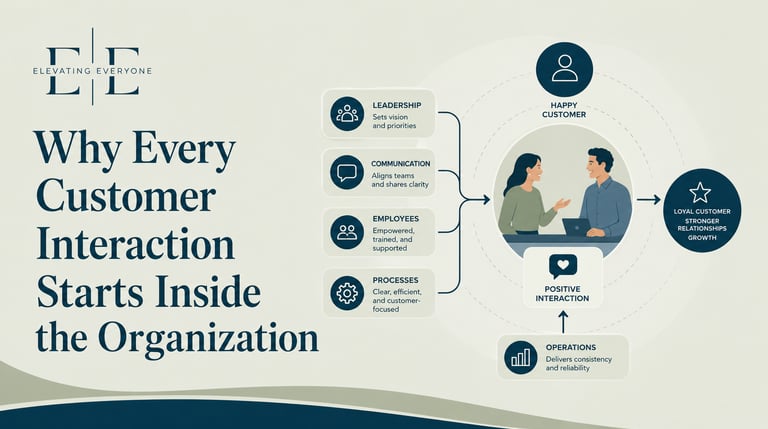
Customer experience is shaped by the people, processes, tools, and leadership routines behind the scenes. Stronger internal alignment creates better customer interactions.
CUSTOMER EXPERIENCE
6/27/20266 min read

Why Every Customer Interaction Starts Inside the Organization
Every customer interaction tells a story.
Sometimes it tells a story of clarity, ownership, and care. Other times it reveals confusion, process gaps, missed handoffs, unclear expectations, or employees who are trying to serve customers inside a system that makes the work harder than it should be.
Customers usually experience the front end of the organization. They talk to the employee, submit the form, read the email, use the product, wait for the update, or call for help. What they feel in that moment is shaped by everything happening behind the scenes.
A customer interaction rarely begins when the customer reaches out. It begins much earlier, in the way the organization communicates, prepares employees, designs processes, uses feedback, and supports the people responsible for delivering the experience.
When customer experience breaks down, the problem is often visible at the point of contact. The cause usually sits deeper inside the organization.
The customer sees the outcome of internal decisions
A customer may never see the meeting where a process was designed. They may never know how a policy was created, how a team was trained, or how information moved from one department to another.
They still feel the result.
If employees do not have clear information, customers receive inconsistent answers. If teams are not aligned, customers get transferred, delayed, or asked to repeat themselves. If technology does not match the workflow, employees spend more time navigating systems than solving problems. If leaders focus only on speed, customers may feel rushed instead of helped.
Internal decisions become external experiences.
This is why customer experience work has to look beyond the surface. A poor interaction may appear to be an employee issue, but the employee may be working with limited training, unclear ownership, outdated tools, or a process that was never designed around the customer’s actual need.
Improving the customer interaction starts with understanding what the organization has made easy or difficult for the employee.
For organizations trying to connect customer feedback, employee readiness, and operational discipline, our Customer Experience Strategy work is designed around practical improvement.
Employees need clarity before they can create clarity
Customers value clear answers. They want to know what is happening, what to expect, who owns the issue, and when it will be resolved.
Employees can only provide that clarity when they have it themselves.
A frontline employee who has to search across multiple systems, ask several people for direction, or guess how to handle an exception is already working from a weaker position. The customer may hear hesitation, receive partial information, or lose confidence in the process.
Strong customer interactions require internal clarity around:
What the employee can decide
When an issue should be escalated
What information should be shared with the customer
How exceptions should be handled
Where accurate information is stored
Who owns the next step
How follow-up should happen
Without that clarity, employees often rely on personal judgment, tribal knowledge, or workarounds. Some may handle the situation well. Others may handle it differently. The customer experience becomes inconsistent because the internal operating model is inconsistent.
Clear expectations help employees serve customers with more confidence.
Process gaps become customer friction
Many customer frustrations are process frustrations.
The customer waits because a handoff is unclear. They call back because the first contact did not resolve the issue. They repeat information because systems do not connect. They receive mixed messages because departments are working from different assumptions.
From the customer’s view, the organization feels difficult. From the employee’s view, the work may feel just as difficult.
This is where customer experience and operational improvement connect.
A customer complaint may point to a process problem. A long resolution time may point to unclear ownership. A high contact rate may point to confusing communication. Repeat calls may reveal that employees are solving symptoms while the root cause remains untouched.
When leaders review customer feedback, they should ask what the feedback reveals about the internal system.
Where is the process breaking down?
Where are customers waiting?
Where are employees using workarounds?
Where are expectations unclear?
Where does ownership become confusing?
Where does the customer have to do more work than necessary?
Each question moves the conversation from reaction to improvement.
Employee experience shapes customer experience
Employees are often asked to deliver excellent customer experiences while working inside environments that drain energy, create confusion, or limit their ability to help.
That tension shows up.
Employees who feel supported are more likely to show patience, ownership, and judgment. Employees who feel overwhelmed, disconnected, or underprepared may struggle to bring the same level of care to each interaction.
This does not mean every customer issue is caused by employee morale. It means employee experience is one of the conditions that shapes service quality.
If employees have clear communication, useful tools, supportive leaders, realistic expectations, and a way to raise problems, they are better equipped to serve customers well.
If employees are constantly navigating confusion, conflicting priorities, outdated systems, or avoidable escalations, customers eventually feel the impact.
Organizations often measure customer satisfaction and employee engagement separately. The work connects. A better employee experience can reduce friction in the customer experience because the people serving customers are better supported in doing the work.
Leadership routines create service consistency
Customer experience depends on what leaders reinforce.
If leaders only review numbers, employees may focus on the metric instead of the customer need. If leaders only react to escalations, the organization may miss patterns that could prevent future problems. If leaders do not create space for employee feedback, valuable insight stays trapped at the frontline.
Strong customer experience requires leadership routines that keep the right conversations active.
Those routines may include:
Reviewing customer feedback for patterns
Listening to frontline employees about recurring issues
Identifying process gaps that create repeat contacts
Clarifying ownership across departments
Coaching employees on judgment, empathy, and resolution
Following up on known friction points
Sharing what changed because of feedback
These routines create consistency. They help teams connect individual interactions to broader business learning.
Without leadership routines, organizations can become dependent on individual effort. A strong employee may create a great interaction despite the system. A less experienced employee may struggle. A customer may receive excellent service one day and a very different experience the next.
Consistency improves when leaders build systems that support the behavior they expect.
Customer feedback should travel back into the business
Customer feedback loses value when it stays in a report.
Surveys, complaints, reviews, call drivers, escalation reasons, and frontline observations can all help leaders understand where the organization is creating friction. The challenge is making sure that insight moves back into the business.
A customer comment about confusing communication may need to reach marketing, operations, training, or product teams. A complaint about repeated follow-up may reveal a handoff issue between departments. A pattern of billing questions may point to unclear language, system limitations, or gaps in customer education.
Feedback should not stop with the team that receives it.
Leaders should ask:
Who needs to hear this?
What pattern is forming?
What internal process may be contributing to this issue?
What can we change to prevent this from happening again?
How will we know if the change worked?
Customer feedback becomes more valuable when it leads to action.
A single complaint may be an isolated issue. A pattern of similar complaints is business intelligence. The organization needs a way to notice, interpret, assign ownership, and act.
The best customer interactions feel easy because the work behind them is disciplined
An excellent customer interaction often feels simple from the outside.
The customer reaches out. The employee understands the issue. The answer is clear. The next step is explained. The follow-up happens when promised. The customer feels heard, respected, and supported.
That kind of experience requires discipline behind the scenes.
It requires clear processes, trained employees, useful tools, good communication, consistent leadership, and a culture that pays attention to both customers and employees.
When those conditions exist, employees can focus more energy on the customer instead of fighting the system.
This is why leaders should study their best customer interactions, not only the broken ones.
What made the interaction work?
Was the employee empowered?
Was the process clear?
Was the information easy to find?
Did the customer know what to expect?
Was follow-up simple?
Did the employee have the right tools?
The best interactions often reveal what the organization should repeat.
A practical place to start
Improving customer interaction does not always require a major transformation. Leaders can start by choosing one recurring point of friction and studying it from both sides.
Pick one issue customers frequently raise.
Then ask:
What does the customer experience?
What does the employee experience?
What information is needed to resolve it?
Where does the process slow down?
Who owns each step?
What communication does the customer receive?
What could be made clearer, simpler, or faster?
This approach moves the organization closer to the source of the issue.
It also shows employees that customer experience work is grounded in the reality of their day-to-day work. That matters. Employees are more likely to engage when they see leaders addressing the barriers that make service harder.
If you want a quick starting point, the Customer Experience Maturity Assessment can help you see where your organization may be strong and where friction may be showing up.
Customer experience starts inside
Every customer interaction is shaped before the customer ever reaches the organization.
It is shaped by leadership choices, process design, employee experience, communication, training, tools, ownership, and follow-through.
When organizations want better customer interactions, they should look inside first.
They should listen to customers. They should listen to employees. They should study the handoffs, routines, systems, and expectations that shape the experience. They should ask where friction is being created and where clarity can be improved.
The customer may only see the interaction.
The organization is responsible for understanding everything that made that interaction possible.
Elevating Everyone
Stay Connected
doug.ward@elevatingeveryone.com
843-259-2055
© 2026. All rights reserved.
Elevate Everywhere Enterprises, LLC.