
The Customer Experience Handoff Gap
Customer experience often breaks down between teams. Learn how leaders can improve handoffs, ownership, context, follow-up, and service consistency.
CUSTOMER EXPERIENCEEMPLOYEE EXPERIENCE AND CULTUREOPERATIONAL IMPROVEMENT
7/20/20269 min read
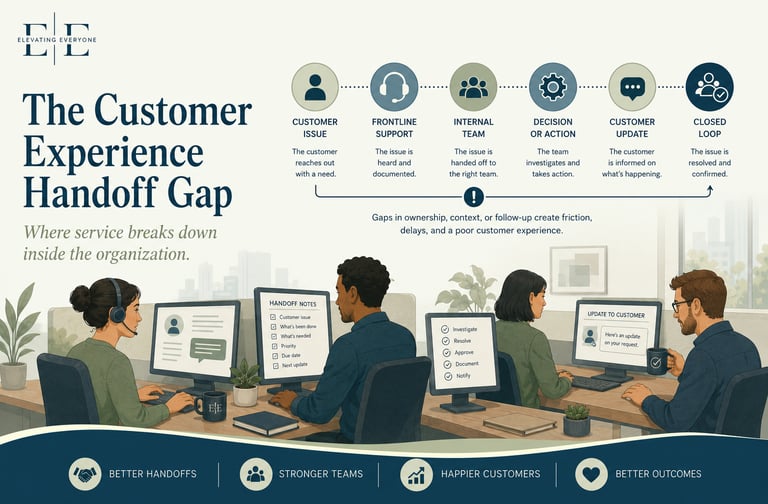

The Customer Experience Handoff Gap: Where Service Breaks Down Inside the Organization
Customer experience often breaks down between teams, not during the first conversation with the customer.
A customer explains the issue clearly. The frontline employee documents what happened. A ticket is created. Another department needs to investigate. A field team, billing team, operations group, finance partner, or manager may need to get involved.
On paper, the process exists.
In practice, the customer waits.
The employee who opened the issue may not know who owns the next step. The next team may receive incomplete context. A decision may be made without a clear update back to the customer. Several people may touch the issue, but no one fully owns the outcome.
This is the customer experience handoff gap.
It is one of the quieter reasons service feels inconsistent, frustrating, or slow. It also explains why a company can have good people, a capable support team, and a ticketing system in place while customers still experience confusion.
For a broader view of how internal conditions shape customer experience, see WHY EVERY CUSTOMER INTERACTION STARTS INSIDE THE ORGANIZATION.
Customer Issues Rarely Stay in One Place
Many customer issues require more than one person to solve.
A billing concern may require account research. A technical issue may require operations support. A service failure may involve scheduling, field work, vendor coordination, or leadership approval. A complaint may require context from sales, customer care, product, finance, or fulfillment.
The customer does not usually care how many teams are involved. They care whether the company understands the problem, owns the next step, and follows through.
Internally, those same issues may cross several boundaries:
customer support to operations
sales to implementation
billing to customer care
field service to dispatch
account management to finance
technical support to engineering
frontline employees to leadership
external vendors to internal teams
Every transition creates risk.
Information can be lost. Ownership can become unclear. Timelines can slip. Updates can stall. Employees can spend more time tracking work than resolving the issue.
Customers experience those internal gaps as poor service.
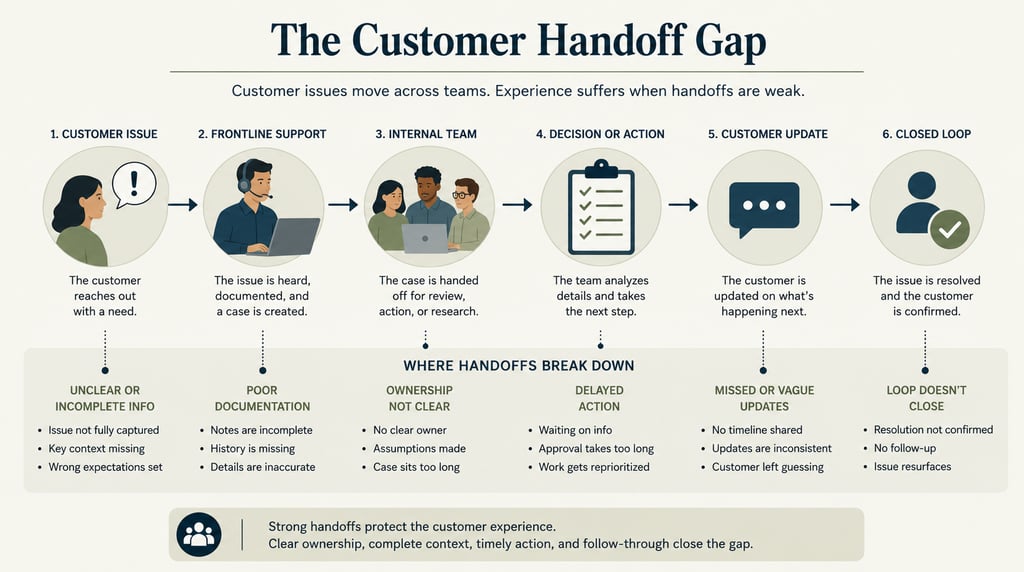

Handoffs Fail When Ownership Is Unclear
A weak handoff often starts with a simple problem: everyone assumes someone else owns the next step.
The support agent may think operations now owns it. Operations may think support will follow up with the customer. The manager may assume the ticketing system will keep the process moving. The customer may assume someone is actively working on the issue because they received a confirmation message.
The result is a gap between activity and accountability.
A handoff should make ownership clear. At a minimum, it should answer:
Who owns the issue now?
What action is needed?
What context should carry forward?
When does the next step need to happen?
Who will update the customer?
How will the loop be closed?
When those questions are not answered, employees create their own assumptions.
Strong customer experience depends on clear internal accountability. A customer should not have to repeat the story because the organization failed to pass it along.
Ticketing Systems Do Not Fix Broken Handoffs
Many organizations believe a ticketing system will solve the handoff problem.
It can help, but only if the process behind it is clear.
A ticketing system can store information, assign work, track status, and create visibility. It cannot decide whether the right context was entered. It cannot repair unclear ownership. It cannot make teams care about the same timeline. It cannot guarantee a meaningful customer update.
Technology helps when it supports a clear operating process.
It creates more frustration when it becomes a place where work disappears.
Common ticketing problems include:
vague ticket titles
incomplete notes
unclear ownership
too many status categories
no standard for customer updates
internal comments that do not explain the issue
reassigned tickets without context
closed tickets before the customer outcome is confirmed
reports that track activity instead of resolution quality
The problem is rarely the tool alone. The deeper issue is how teams use the tool to move work, share context, and close the loop.
For more on this, see Your Ticketing System Isn't the Problem.
Internal Friction Becomes Customer Friction
Customers often feel the friction that employees are managing internally.
If employees cannot find information, customers wait. If teams disagree on ownership, customers receive unclear answers. If policies are confusing, employees hesitate. If internal approvals take too long, customers hear “we are still looking into it.”
The customer may never see the internal process, but they experience its condition.
Internal friction can show up as:
long response times
repeated explanations
conflicting answers
unnecessary transfers
vague updates
missed commitments
unresolved follow-up
delayed credits, repairs, or corrections
employees apologizing without being able to act
These experiences reduce trust because they make the company feel disorganized.
Employees often feel the strain too. They may want to help but lack the authority, information, or cross-functional support needed to resolve the issue.
A better customer experience often starts by removing the friction employees face while trying to serve the customer.
For a related article, see Operational Friction is a Culture Problem.
Handoffs Need Context, Not Just Transfer
A handoff should do more than move work from one queue to another.
It should transfer enough context for the next person to act intelligently.
A strong customer handoff includes:
the customer’s issue in plain language
what the customer has already been told
what has already been tried
what is still unresolved
relevant dates, commitments, or deadlines
emotional context if the customer is frustrated
business impact or urgency
the requested action
who should follow up
when the next update is due
Without this context, the next team may start over. Customers then feel like the company is not listening.
Context is especially important when the issue is sensitive, recurring, expensive, or emotionally charged.
A customer who has contacted the company four times should not be treated like a first-time inquiry. A customer who has been promised a callback should not need to chase the update. A customer who is dealing with a service interruption should not receive a generic response that ignores the urgency.
Good handoffs preserve the story.
Closed Tickets Are Not Always Resolved Issues
Many teams track closure. Fewer teams verify resolution.
A ticket can be closed because a task was completed, an internal step was taken, a note was added, or a team reached the end of its part of the process. The customer may still be waiting for confirmation, correction, explanation, or reassurance.
This creates a dangerous reporting gap.
Internally, the work may appear complete. From the customer’s perspective, the issue may still feel unresolved.
Leaders should pay attention to the difference between:
task completion
ticket closure
customer resolution
customer confidence
These are not the same.
A billing correction may be entered, but the customer may not know it was completed. A service visit may be scheduled, but the customer may not know what to expect. A technical issue may be escalated, but the customer may still need a timeline. A refund may be approved, but the customer may not know when it will appear.
Closed-loop follow-up protects the customer experience.
It also protects the employee experience because fewer customers need to call back, repeat themselves, or escalate.
Leaders Need to See the Whole Journey
Handoff gaps are hard to fix when leaders only look at their own team’s portion of the work.
Customer experience crosses functions. The customer journey does not follow the organizational chart.
A support leader may see response time. An operations leader may see backlog. A billing leader may see adjustments. A field leader may see completed work orders. A finance leader may see approvals. Each view may be accurate, but none of them may show the full customer experience.
Leaders need a shared view of where customers get stuck.
Customer journey mapping can help because it shows how the customer moves through the organization, not only how work is assigned internally.
A useful journey review asks:
Where does the customer first raise the issue?
Which teams touch the issue?
Where does information get repeated?
Where do customers wait without updates?
Where do employees need approval?
Where do handoffs depend on informal relationships?
Where do customers experience conflicting answers?
Where does the loop fail to close?
These questions help leaders find the gaps that normal departmental reporting may miss.
For more on mapping the experience, see Customer Journey Mapping.
Measure the Right Handoff Signals
Teams often measure customer service by volume, response time, and closure rate.
Those metrics are useful, but they may not reveal handoff quality.
A team can respond quickly and still hand off poorly. A ticket can close on time and still leave the customer confused. A department can meet its internal target while the overall customer experience suffers.
Leaders should consider additional signals, such as:
repeat contacts for the same issue
reopened tickets
tickets reassigned multiple times
aging tickets between teams
missed customer update commitments
escalations caused by unclear ownership
issues closed without customer confirmation
complaints mentioning repeated explanations
customer effort after the first contact
time from first contact to actual resolution
These signals help reveal where work is moving without enough clarity.
They also help leaders separate frontline performance from system performance.
For a broader assessment of customer experience effectiveness, see Customer Experience Maturity Assessment.
The Employee Experience Side of Handoffs
Handoff gaps are not only a customer issue. They create employee frustration.
Employees want to resolve problems. Most do not enjoy transferring a customer, reopening a ticket, chasing another team, or apologizing for delays they cannot control.
Poor handoffs can make employees feel:
unsupported
blamed for issues they do not own
stuck between the customer and the process
unclear about authority
frustrated by internal delays
hesitant to make commitments
disconnected from other teams
Over time, this can affect morale and performance.
When leaders fix handoffs, they improve the employee experience too. Employees gain clearer ownership, better information, stronger support, and more confidence in the process.
Customer experience and employee experience are connected through daily work.
For related reading, see Customer Experience vs. Employee Experience.
A Practical Handoff Framework
A simple handoff framework can help teams reduce confusion and improve follow-through.
Use this structure when customer work moves from one person or team to another.
1. Issue
What is the customer trying to resolve?
Write the issue in plain language. Avoid internal shorthand that another team may not understand.
2. Impact
How is this affecting the customer?
Include practical and emotional impact when relevant. A customer waiting on internet service, a billing correction, a missed appointment, or a delayed refund may need a different level of attention than a routine request.
3. History
What has already happened?
Include prior contacts, commitments, attempted fixes, scheduled work, approvals, or previous decisions.
4. Owner
Who owns the next step?
Name the team or person responsible. If ownership is shared, clarify who is responsible for coordination.
5. Action
What needs to happen next?
Be specific. Avoid vague language like “review,” “advise,” or “handle” unless the expected action is clear.
6. Timeline
When does the next step need to happen?
Include the customer expectation, internal deadline, or next update time.
7. Customer Update
Who will communicate with the customer?
Clarify whether the sending team, receiving team, manager, account owner, or automated process will provide the update.
8. Closed Loop
How will everyone know the issue is resolved?
Confirm whether the ticket should close after internal completion, customer confirmation, or a specific final action.
This framework does not need to be complicated. It gives teams a shared way to move work without losing the customer’s story.
Questions Leaders Should Ask
Leaders can use these questions to identify where customer handoffs are breaking down.
Ownership
Where does ownership become unclear?
Which teams receive work without enough context?
Who is responsible for customer follow-up after escalation?
Where do employees rely on informal relationships to get action?
Process
Which handoffs create the most delays?
Where do tickets get reassigned multiple times?
Which issue types generate repeat contacts?
Where does the process depend too much on individual memory?
Communication
What information is often missing from handoffs?
Are customers told what will happen next?
Are internal notes useful to the next team?
Do employees know when and how to update the customer?
Measurement
Are we tracking reopened issues?
Are we tracking repeat contacts for the same problem?
Are we measuring actual resolution, not only closure?
Do leaders review the full journey across teams?
Employee Experience
Where do employees feel stuck?
Which policies create avoidable friction?
Where do employees lack authority to solve common issues?
What support would help frontline employees serve customers better?
These questions help shift the conversation from blame to process improvement.
How to Start Improving Customer Handoffs
Organizations do not need to redesign the entire customer experience at once.
A practical starting point is to choose one high-volume or high-friction issue type and follow it across teams.
For example:
billing correction
service outage
missed appointment
installation delay
refund request
technical escalation
complaint requiring manager review
customer move or account change
Then review the path:
Where does the issue begin?
Who touches it?
What information is needed at each step?
Where does the customer wait?
Where do employees lose visibility?
Where does the loop close or fail to close?
After that review, make one or two improvements.
Possible improvements include:
creating a handoff template
clarifying ownership rules
improving internal notes
adding customer update expectations
reducing unnecessary approvals
defining escalation criteria
training teams on common issue paths
reviewing repeat contacts weekly
creating a shared dashboard for aging handoffs
Small process changes can have a visible impact when they address the right friction point.
For customer experience support, see Customer Experience Strategy.
Final Thought
Customer experience often depends on what happens after the first employee listens.
If the issue requires another team, the quality of the handoff can shape the entire experience. Customers notice when they have to repeat themselves, wait without updates, or chase answers across disconnected parts of the organization.
Leaders can improve the experience by making handoffs clearer, more complete, and easier to own. That means stronger context, cleaner ownership, better timelines, and closed-loop follow-up.
The best service teams are supported by operating habits that help them serve customers well.
When internal teams move work with clarity, customers feel the difference.
Elevating Everyone
Stay Connected
doug.ward@elevatingeveryone.com
843-259-2055
© 2026. All rights reserved.
Elevate Everywhere Enterprises, LLC.