
Team Communication Problems: 7 Signs Yours Is Breaking Down
Learn seven signs of team communication problems and what managers can do to improve clarity, trust, follow-through, and collaboration.
LEADERSHIP AND COMMUNICATIONEMPLOYEE EXPERIENCE AND CULTURE
7/3/20267 min read
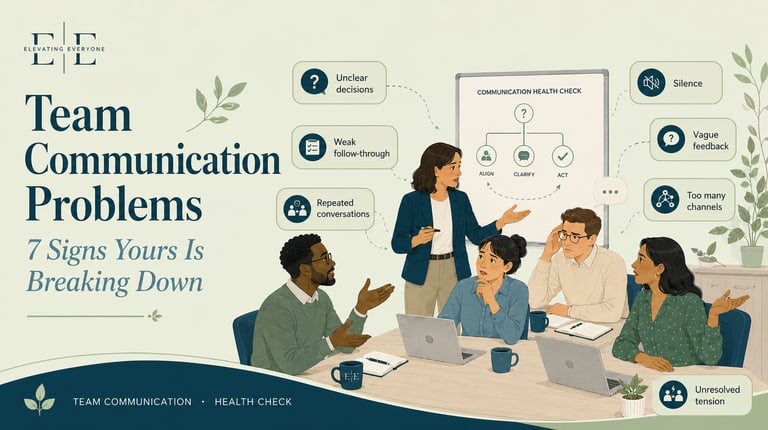
Team Communication Problems: 7 Signs Yours Is Breaking Down
Most team communication problems do not start with one big failure.
They usually start with small misses.
A decision is made, but no one writes it down.
A meeting ends, but ownership stays unclear.
A leader shares an update, but the team hears different versions.
A concern is raised quietly, but never addressed directly.
Over time, those small misses become patterns.
People start filling gaps with assumptions. Meetings get longer. Follow-through gets weaker. Feedback becomes more careful than useful. Leaders feel like they are repeating themselves. Team members feel like expectations keep shifting.
Workplace communication has also become more complex. Grammarly’s 2024 workplace communication report found that all surveyed knowledge workers experienced miscommunication at least weekly. One in four experienced it multiple times a day. The same report linked poor communication to stress, lower productivity, strained relationships, and missed deadlines.
Microsoft’s 2025 Work Trend Index described a more interrupted workday, with some employees receiving pings every two minutes during core work hours. That kind of environment makes clarity harder to maintain.
When team communication breaks down, the issue is rarely one person. It is usually a combination of unclear habits, missing structure, and unspoken expectations.
Here are seven signs your team communication may be breaking down.
1. People leave meetings with different versions of the decision
This is one of the clearest warning signs.
The meeting felt productive. People talked through the topic. A few people nodded. Someone said, “That sounds good.”
Then the follow-up starts.
One person thinks the decision was final.
Another thinks the team agreed to keep exploring.
Someone else thought the work belonged to another department.
A fourth person never understood the deadline.
This usually happens when teams talk around the decision instead of naming it clearly.
A good conversation does not always create a clear agreement.
What to do
End each meeting with three questions:
What decision did we make?
Who owns the next step?
When will it be completed or revisited?
Then send a short written recap.
This does not need to be formal. It just needs to be clear.
A simple recap might say:
We agreed to move forward with Option B. Sarah owns the first draft by Friday. The team will review it on Monday.
That small habit prevents a lot of confusion.
2. Follow-through depends on individual memory
Strong teams do not rely on people remembering everything.
They create visible systems for ownership.
When follow-through depends on memory, tasks slip. Not because people do not care. Often, the work gets lost inside meetings, chat threads, email chains, and side conversations.
A leader may say:
“I thought we already covered that.”
A team member may say:
“I did not know that was mine.”
Both can be true.
The conversation happened. The ownership was still unclear.
What to do
Create one consistent place for action items.
This may be a project board, shared document, ticketing system, task tracker, or meeting notes template.
The tool is less important than the habit.
Every action item should include:
owner
due date
current status
next step
blocker, if one exists
If ownership is unclear, the task is not assigned.
3. Meetings keep repeating the same conversations
Repeated conversations are usually a signal.
Sometimes the team is being thoughtful. More often, something did not get resolved the first time.
The team may be revisiting the same topic because:
the decision was never clear
the right people were not included
concerns were not addressed
the problem was framed too broadly
no one owned the next step
people did not trust the first decision
This creates frustration.
People feel like they are wasting time. Leaders feel like the team cannot move. Team members feel like their concerns are being ignored.
What to do
Separate discussion from decision.
Not every meeting needs to end with a final answer. But every meeting should end with clarity.
Before closing the topic, say:
“Are we deciding today, gathering input, or identifying options?”
Those are different conversations.
If the team is deciding, name the decision.
If the team is gathering input, name how input will be used.
If the team is identifying options, name when the decision will happen.
This keeps the team from confusing movement with progress.
4. Quiet team members stay quiet
Some people think out loud.
Others need time to process.
Some will challenge an idea in the moment. Others will hold back until they understand the full context. Some people stay quiet because they do not feel safe raising concerns.
A quiet team is not always aligned.
Silence may mean agreement. It may also mean hesitation, confusion, fatigue, frustration, or disengagement.
Gallup’s 2026 State of the Global Workplace report found that only 20% of employees worldwide were engaged in 2025. Low engagement often shows up through lower participation, weaker connection, and less ownership.
When people stay quiet, avoid disagreement, or raise concerns only after meetings, the team may also be struggling with psychological safety in the workplace.
What to do
Create more than one way to contribute.
Do not rely only on open discussion in meetings.
Use:
pre-reads before major decisions
written input after the meeting
one-on-one check-ins
anonymous pulse questions when needed
direct invitations to share concerns
Try asking:
“What concern have we not named yet?”
That question often works better than:
“Does anyone have questions?”
The second question is easy to avoid.
The first question gives people permission to be honest.
5. Feedback feels personal, vague, or delayed
Poor feedback habits create communication problems quickly.
Some teams avoid feedback until something breaks. Some leaders give feedback too indirectly. Others give feedback in a way that feels like criticism instead of coaching.
When feedback is vague, people cannot act on it.
Examples include:
“Be more proactive.”
“Improve your communication.”
“Take more ownership.”
“You need to be more collaborative.”
Those statements may be true. They are also incomplete.
The person needs to know what behavior should change.
What to do
Make feedback specific, timely, and behavior-based.
Instead of saying:
“You need to communicate better.”
Say:
“When timelines change, please update the project channel the same day. That helps the team adjust priorities.”
That feedback gives the person a clear action.
Good feedback connects behavior to impact.
It should answer:
What happened?
Why did it create an issue?
What should happen next time?
6. Different communication channels create different realities
This is common in modern teams.
One decision lives in email.
A second version appears in Teams or Slack.
A third version gets mentioned in a meeting.
A fourth version comes through a side conversation.
Soon, people are working from different sources of truth.
This is not always a technology problem. Often, it is a communication discipline problem.
The team has tools. It does not have shared rules.
Some communication breakdowns also come from style differences. Understanding workplace communication styles can help managers adapt how they share expectations, feedback, and decisions.
What to do
Define which channels serve which purpose.
For example:
chat for quick coordination
email for formal external updates
project boards for task ownership
meetings for discussion and decisions
shared documents for reference materials
Then agree on where final decisions live.
This one question helps:
“Where should someone look later to know what we decided?”
If the answer is unclear, the team needs a better system.
7. People are polite, but unresolved tension keeps showing up
Many teams confuse politeness with health.
People are respectful in meetings. They avoid open conflict. They keep conversations moving.
But the same tension keeps returning.
You may notice:
side conversations after meetings
passive agreement during discussions
slow follow-through
repeated clarification requests
frustration hidden behind humor
people escalating around each other
decisions reopened after they seemed final
This usually means the team has an issue it has not addressed directly.
The problem may involve trust, workload, ownership, priorities, decision rights, or leadership expectations.
What to do
Name the pattern without blaming the people.
Try saying:
“We keep returning to this topic. I want to pause and understand what is still unresolved.”
Or:
“It seems like we have agreement in the meeting, but hesitation afterward. What are we not addressing?”
A leader’s tone makes a difference.
The purpose is to surface the real issue, not force agreement.
Team communication problems usually have patterns
A single missed message is normal.
A pattern of missed messages is different.
Look across the seven signs:
unclear decisions
weak follow-through
repeated conversations
quiet team members
vague feedback
scattered channels
unresolved tension
These problems often connect.
For example, unclear decisions create weak follow-through. Weak follow-through creates repeated conversations. Repeated conversations create frustration. Frustration makes feedback harder. Harder feedback creates more silence.
The work starts by identifying the pattern.
A quick way to do that is through the Team Communication Health Check. It gives leaders a practical view of where communication may be helping or hurting the team.
A simple manager checklist
Use this checklist after your next team meeting.
Ask yourself:
Did we name the decision clearly?
Did every action item have one owner?
Did we identify the deadline or next review point?
Did quieter voices have a way to contribute?
Did we separate discussion from decision?
Did we document the source of truth?
Did we surface concerns before closing the topic?
If the answer is “no” to several questions, the team may not need more meetings.
It may need better communication habits.
How leaders can reset team communication
Start small.
Pick one communication habit to improve over the next two weeks.
You might choose:
clearer meeting recaps
written action items
fewer channels for decisions
better feedback language
stronger meeting closeouts
more direct invitations for input
clearer expectations around urgency
Do not try to fix everything at once.
One improved habit can change the way a team works.
The best place to start is usually the point of greatest friction.
If people are confused, start with decisions.
If work is slipping, start with ownership.
If people are quiet, start with input.
If tension is building, start with direct conversation.
If feedback is weak, start with behavior-based coaching.
Final thought
Team communication problems are rarely just communication problems.
They affect trust, speed, accountability, collaboration, and customer experience.
A team can have good people and still struggle with poor communication habits. A leader can have the right message and still miss the mark if the team does not receive it clearly.
The fix usually starts with simple questions.
What did we decide?
Who owns the next step?
Where does the final version live?
What concern have we not named?
What behavior needs to change?
Those questions help teams move from assumption to clarity.
If your team is experiencing repeated communication breakdowns, Elevating Everyone offers team communication consulting to help leaders improve clarity, trust, follow-through, and collaboration.
Elevating Everyone
Stay Connected
doug.ward@elevatingeveryone.com
843-259-2055
© 2026. All rights reserved.
Elevate Everywhere Enterprises, LLC.