
How to Motivate Employees Without Money
Practical ways leaders can improve employee motivation through clarity, recognition, growth, trust, communication, and better work conditions.
EMPLOYEE EXPERIENCE AND CULTURE
7/1/20265 min read
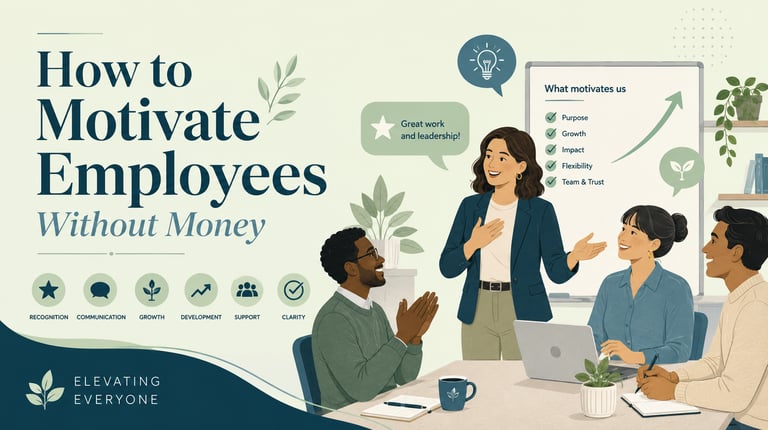
How to Motivate Employees Without Money
Money is part of work. It always will be.
Pay needs to be fair. People need to feel their compensation reflects the value of their work, the demands of the role, and the realities of the market. Leaders should not use “motivation” as a way to avoid conversations about pay, workload, or fairness.
But compensation is only one part of employee motivation.
Many employees lose energy at work even when the pay is acceptable. They become frustrated because expectations are unclear, their effort goes unnoticed, decisions feel disconnected from reality, or the work environment makes it harder to do good work.
That creates an opportunity for leaders.
You may not always control compensation budgets, bonus plans, or companywide benefits. You do have influence over the daily conditions that shape whether people feel focused, trusted, supported, and willing to keep giving their best effort.
Start by understanding what motivates each person
A common mistake leaders make is assuming motivation looks the same for everyone.
One employee may feel energized by public recognition. Another may prefer quiet appreciation. One person may want more autonomy. Another may want clearer direction. Some employees are motivated by learning, others by stability, achievement, purpose, collaboration, or solving difficult problems.
When leaders rely on one approach for everyone, they miss opportunities to connect with people in a more meaningful way.
A simple question can help:
“What helps you do your best work?”
Follow it with:
“What gets in the way?”
Those two questions can open a much better conversation than a generic engagement survey or a one-size-fits-all recognition program.
Employees often know what helps them stay engaged. They may not always volunteer it unless someone asks directly.
Give people clearer expectations
Unclear expectations drain motivation quickly.
People want to know what success looks like. They want to understand priorities, timelines, decision rights, and how their work connects to the bigger picture.
When expectations are vague, employees spend too much energy guessing. They may work hard and still miss the mark because the target was never clear. Over time, that creates frustration and hesitation.
Leaders can improve motivation by making expectations easier to understand.
That includes:
What needs to be done
Why it is important
Who owns the work
What good looks like
When it is due
How decisions will be made
Clear expectations do not limit people. They give people a better foundation for doing strong work.
Recognize effort in specific ways
Recognition is most useful when it is specific.
A quick “great job” is fine, but it does not always tell the employee what was valued. Specific recognition helps people understand which behaviors, decisions, or outcomes were meaningful.
Instead of saying:
“Thanks for your help.”
Try:
“Thank you for stepping in with that customer issue. You stayed calm, asked good questions, and helped us avoid a bigger escalation.”
Instead of:
“Nice work on the report.”
Try:
“The way you organized the data made the decision much easier for the team.”
Specific recognition helps employees feel seen. It also reinforces the kind of work, judgment, and behavior the organization needs more often.
The recognition does not have to be public. It does not have to be dramatic. It needs to be timely and real.
Give employees more ownership where you can
Few things reduce motivation faster than feeling controlled, micromanaged, or constantly second-guessed.
Employees need guidance, but they also need room to think, decide, and contribute. When leaders make every decision or require approval for every small step, employees can become passive. They may stop bringing ideas forward because they assume the answer has already been decided.
Ownership creates energy.
That might mean giving someone responsibility for a project, asking them to recommend a solution, letting them lead a meeting, or trusting them to manage the path once the outcome is clear.
Leaders can ask:
“What part of this do you think you should own?”
“How would you approach it?”
“What decision can you make without waiting for me?”
Small increases in ownership can change how employees experience their work.
Remove unnecessary friction
Sometimes motivation is not the issue. Friction is.
Employees may be willing to do strong work, but the process makes it harder than it should be. They deal with outdated tools, unclear handoffs, competing priorities, repeated rework, slow approvals, or meetings that do not lead to decisions.
Over time, that wears people down.
A leader can support motivation by paying attention to where work gets stuck.
Ask the team:
“What slows you down the most?”
“What do we keep fixing again and again?”
“Where are we creating extra work for ourselves?”
“What could we simplify?”
When leaders remove friction, employees feel the difference. It shows that leadership is paying attention to the real experience of doing the work.
Connect the work to a larger purpose
People do not need every task to feel inspiring. Some work is routine, repetitive, or simply necessary.
Even so, employees benefit from understanding why their work contributes to something larger.
That connection may be customer impact, team success, community value, operational stability, financial performance, or support for colleagues.
Leaders can build this connection into everyday communication.
Instead of only assigning tasks, explain the reason behind them.
Instead of only sharing results, explain what the results mean for customers, employees, or the organization.
Instead of only discussing what needs to improve, acknowledge where the team is making progress.
People are more likely to stay engaged when they can see how their work contributes to something useful.
Create growth without always creating promotion
Not every employee can be promoted at the same time. Not every role has a clear upward path. That does not mean growth has to stop.
Growth can happen through skill-building, exposure, mentoring, project ownership, cross-training, problem-solving, and new responsibilities.
Leaders can ask:
“What skill do you want to build this year?”
“What kind of work would you like more exposure to?”
“What part of your role feels too routine right now?”
“Where do you want to stretch?”
Employees often become more motivated when they see a future path, even if that path is not an immediate promotion.
Growth shows people they are not standing still.
Build trust through follow-through
Motivation suffers when employees stop believing leaders will follow through.
If leaders ask for feedback but never act on it, people become quieter. If leaders make commitments and do not revisit them, employees become skeptical. If priorities keep changing without explanation, people start protecting their energy.
Trust is built through consistency.
That means doing what you said you would do, explaining decisions clearly, admitting when something changed, and closing the loop when employees raise concerns.
Follow-through does not require perfection. It requires visible effort and honest communication.
Employees are more likely to stay engaged when they believe leaders are listening and acting with integrity.
Use a simple tool to start the conversation
Employee motivation is easier to support when leaders understand what actually energizes their people.
The free What Motivates You at Work? quiz from Elevating Everyone gives employees a simple way to reflect on what helps them feel focused, engaged, and productive. It can also help managers have better conversations with team members about work conditions, communication, recognition, and support.
Take the Free What Motivates You at Work? Quiz
Motivation is shaped by the daily experience of work
Leaders do not need a large budget to improve motivation.
They need to understand what drives their people, clarify expectations, recognize strong work, create ownership, remove friction, connect the work to a larger purpose, support growth, and build trust through follow-through.
None of those actions replace fair pay. They do help create a better experience once pay is no longer the only conversation.
Employees are more likely to stay engaged when they feel seen, supported, trusted, and clear on how their work contributes.
That kind of motivation is built through the way leaders show up every day.
Elevating Everyone
Stay Connected
doug.ward@elevatingeveryone.com
843-259-2055
© 2026. All rights reserved.
Elevate Everywhere Enterprises, LLC.