
How to Know If Your Customer Experience Strategy Is Actually Working
A practical guide for leaders to evaluate customer feedback, service consistency, employee readiness, process gaps, and follow-through in their customer experience strategy.
CUSTOMER EXPERIENCEOPERATIONAL IMPROVEMENT
7/1/20266 min read

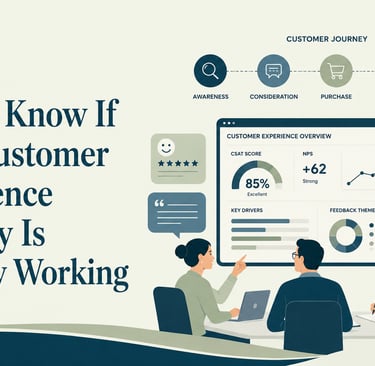
How to Know If Your Customer Experience Strategy Is Actually Working
A customer experience strategy can look strong on paper and still fall short in practice.
The plan may include the right language. The leadership team may agree that customer experience is a priority. The company may track survey scores, review customer comments, and talk about service improvement in meetings.
But customers do not experience strategy documents. They experience the handoff, the response time, the tone of the conversation, the accuracy of the answer, the ease of the process, and the follow-through after something goes wrong.
That is where many organizations find the gap.
They have a customer experience strategy, but they are not always sure whether it is changing the way customers actually feel, behave, or engage with the business.
To understand whether your customer experience strategy is working, you have to look beyond the existence of a plan. You have to look at what is happening across the full customer journey, the employee experience, and the daily operating routines that shape service delivery.
Start with the customer’s actual experience
Customer experience strategy should begin with a simple question:
What is it like to be our customer?
That sounds obvious, but many organizations answer a different question instead. They focus on what they intended to deliver, what the process was designed to do, or what the internal team believes should be happening.
The customer’s experience may tell a different story.
A customer may be able to reach someone quickly, but still feel bounced around. They may receive a technically correct answer that does not solve the full problem. They may complete the transaction, but leave with frustration because the process was harder than expected.
That is why customer feedback needs to be more than a score.
Survey results, reviews, complaints, call recordings, support tickets, cancellations, refunds, escalations, and repeat contacts can all help reveal what customers are actually experiencing. The key is to look for patterns, not isolated comments.
If customers repeatedly mention confusion, delays, inconsistent answers, difficult processes, or lack of follow-up, those are not just service issues. They are signals that the strategy may not be reaching the customer in a meaningful way.
Look for consistency across teams and channels
A strong customer experience strategy should create a more consistent experience.
Customers should not receive a completely different level of support depending on who answers the phone, which location they visit, which department they reach, or which channel they use.
Some variation is natural. People have different communication styles, workloads, and levels of experience. But the core experience should feel dependable.
Leaders should ask:
Are customers getting consistent answers?
Do employees know what good service looks like?
Are policies applied in a similar way across teams?
Do different departments understand their role in the customer journey?
Does the experience change dramatically between phone, email, chat, in-person, or self-service channels?
Inconsistency often points to deeper issues. It may mean training is unclear, processes are not documented, systems do not support the work, or teams are making decisions without shared expectations.
When consistency improves, customers feel more confident. Employees also feel more supported because they are not left guessing how to handle common situations.
Pay attention to repeat contacts and avoidable effort
One of the clearest signs of customer experience friction is repeat contact.
If customers have to reach out multiple times for the same issue, something is breaking down. The cause may be unclear communication, incomplete resolution, poor documentation, weak handoffs, system limitations, or processes that make the customer do too much work.
Repeat contacts are costly for the business and frustrating for the customer.
They also create employee strain. Service teams become busier, wait times grow, escalations increase, and employees spend more time correcting issues that should have been resolved earlier.
Leaders should review where repeat contacts are happening most often.
Are customers calling back because the first answer was incomplete?
Are they checking on the status of something that should have been communicated proactively?
Are they being transferred between departments?
Are they confused by instructions, billing, installation, onboarding, or next steps?
Are internal teams closing the task without confirming the customer’s issue was fully resolved?
A customer experience strategy is working better when customers can move through the process with less effort and fewer avoidable contacts.
Evaluate whether employees are equipped to deliver the experience
Customer experience depends heavily on employee readiness.
Leaders can design a great customer promise, but employees are the ones who have to deliver it when systems are slow, policies are unclear, staffing is tight, customers are upset, or priorities conflict.
A practical customer experience strategy should answer these questions:
Do employees understand the experience we are trying to create?
Do they have the information they need?
Do they know where to find accurate answers?
Do they have enough authority to solve common customer issues?
Are managers coaching toward the right behaviors?
Are frontline employees included when leaders review customer feedback?
If employees are not equipped, the customer experience will be inconsistent. Not because employees do not care, but because the organization has not made the desired experience easy enough to deliver.
Employee experience and customer experience are closely connected. When employees are supported, trained, informed, and trusted, they are in a much better position to serve customers well.
Connect feedback to action
Many organizations collect customer feedback. Fewer organizations use it well.
Feedback should create movement. It should help leaders make decisions, adjust processes, improve communication, support employees, and reduce friction.
A good test is to ask:
What changed because of what customers told us?
If the answer is unclear, the feedback loop may be incomplete.
Customer comments should not sit in a dashboard without ownership. Survey results should not be reviewed once a month and then forgotten. Complaints should not be handled one at a time without asking whether a larger pattern exists.
Leaders should create a rhythm for reviewing feedback and assigning action.
That may include:
Identifying the top recurring customer pain points
Grouping issues by process, policy, system, training, or communication gap
Assigning ownership for follow-up
Tracking whether changes improve the customer experience
Sharing lessons with employees
Closing the loop with customers when appropriate
Feedback becomes more valuable when it leads to visible improvement.
Watch for gaps between leadership intent and frontline reality
Leadership teams often believe the customer experience is more consistent than it feels to employees or customers.
That gap is understandable. Leaders see reports, dashboards, strategy documents, and high-level themes. Frontline employees see the daily friction. Customers feel the outcome of that friction.
A strategy may say the company is easy to do business with, while employees know the billing process creates confusion. A strategy may emphasize responsiveness, while staffing levels make quick follow-up difficult. A strategy may promise personalized service, while systems force customers to repeat their story.
These gaps do not mean the strategy is wrong. They mean the organization needs a better connection between intention and execution.
Leaders should create safe ways for employees to share what is getting in the way of a better customer experience. The people closest to the customer often know where the breakdowns are, but they may not always have a clear path to raise them.
When leaders listen to both customers and employees, they get a more complete view of the experience.
Review the operating routines behind the experience
Customer experience is shaped by daily routines.
How work is assigned. How escalations are handled. How customer feedback is reviewed. How leaders communicate priorities. How teams document issues. How employees are coached. How departments coordinate handoffs.
If those routines are weak, the strategy will struggle.
A strong customer experience strategy should be supported by operating habits that keep the work moving.
For example:
Weekly review of customer themes
Clear ownership for recurring pain points
Regular coaching for service behaviors
Defined escalation paths
Shared understanding between departments
Updated knowledge resources
Simple reporting that leaders actually use
These routines help turn customer experience from a broad idea into something the organization practices consistently.
Use a simple assessment to find the gaps
If you are not sure where your customer experience strategy stands, start with a structured review.
The free Customer Experience Maturity Assessment from Elevating Everyone is designed to help leaders evaluate key areas that shape the customer experience, including feedback, service consistency, employee readiness, process clarity, and action planning.
It can help you identify where your organization is strong, where the experience may be inconsistent, and where leaders may need to focus next.
Take the Free Customer Experience Maturity Assessment
A working strategy should show up in the customer’s experience
A customer experience strategy should help the organization make better decisions, support employees more effectively, and reduce friction for customers.
You can see progress when customers have to work less to get help, employees understand what is expected, feedback leads to action, and service feels more consistent across teams and channels.
The strategy does not have to be perfect. It does have to be visible in the way work gets done.
Start by listening to customers. Then listen to employees. Look for patterns. Find the friction. Clarify ownership. Make the next improvement practical.
That is how customer experience strategy becomes more than a plan.
It becomes part of how the organization operates.
Explore Customer Experience Strategy
Elevating Everyone
Stay Connected
doug.ward@elevatingeveryone.com
843-259-2055
© 2026. All rights reserved.
Elevate Everywhere Enterprises, LLC.