
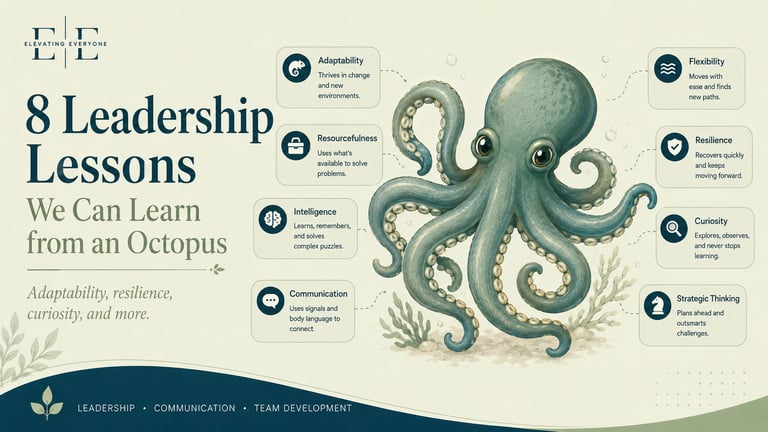
8 Leadership Lessons We Can Learn from an Octopus
Explore eight leadership lessons inspired by the octopus, including adaptability, resilience, communication, curiosity, and strategic thinking.
Doug Ward
3/3/20255 min read
Updated July 2026 with expanded leadership reflections, practical workplace applications, and additional internal resources.
8 Leadership Lessons We Can Learn from an Octopus
When we think about leadership, an octopus may not be the first creature that comes to mind.
That is exactly why the comparison works.
Octopuses are adaptable, intelligent, curious, resourceful, and surprisingly strategic. They move through complex environments with awareness and flexibility. They solve problems, recover from setbacks, and use their surroundings wisely.
Those same qualities matter in leadership.
Strong leaders do not need to have every answer before they act. They need to read the room, understand the environment, support their people, and adjust when conditions change.
Here are eight leadership lessons we can learn from the octopus.
1. Adaptability
An octopus can change color and texture to blend into its surroundings. It does this using specialized cells called chromatophores. This ability helps it respond to danger, communicate, and survive in changing conditions.
Leaders need a similar kind of adaptability. That does not mean changing direction every time something feels difficult. It means paying attention to what is happening and adjusting with purpose. Markets shift. Teams change. Customers expect more. Tools evolve. Strategies that worked last year may not work today.
A good leader notices those changes early. They help the team understand what is changing and why it matters. Then they guide the adjustment without creating unnecessary confusion. Adaptability is not chaos. It is thoughtful movement in response to reality.
2. Resourcefulness
Octopuses are known for using shells, rocks, and other objects for protection. They make good use of what is available.
That is a useful reminder for leaders.
Leadership often happens in imperfect conditions. Budgets are tight. Staffing is limited. Systems are clunky. Priorities compete for attention. Resourceful leaders do not wait for ideal circumstances. They look at what they have and ask better questions.
What can we simplify?
What can we reuse?
What process is slowing us down?
Who already has the skill we need?
What small improvement would make work easier this week?
Resourcefulness is not about doing more with less forever. That can become a dangerous excuse. It is about solving problems creatively while still being honest about constraints. The best leaders can name the limitation and still find a practical path forward.
3. Intelligence
Octopuses are impressive problem solvers. They can navigate mazes, open containers, and escape difficult spaces. That kind of intelligence is more than instinct. It reflects curiosity, memory, and learning.
Leadership also requires learning.
A leader who stops learning eventually becomes a bottleneck. Their team may grow, but their leadership habits stay the same. Intelligent leadership is not about being the smartest person in the room. It is about creating a room where smart thinking can happen. That means asking good questions. It means inviting different perspectives. It means being willing to reconsider an assumption when the facts change.
A strong leader does not need to prove they know everything. They need to build the conditions where the team can think clearly and solve problems well.
4. Communication
Octopuses communicate through color, movement, body patterns, and posture. They send signals even without words.
Leaders do the same.
A leader communicates through what they say, what they do, what they ignore, and what they reward. Teams read all of it. This is why communication cannot be limited to announcements, meetings, or status updates. Employees pay attention to consistency. They notice whether priorities match behavior. They notice whether leaders invite input and then act on it. They notice when silence replaces clarity. Clear communication helps teams move with confidence. Poor communication creates guessing, rework, frustration, and mistrust.
Leaders should ask themselves a simple question often:
What message is my team receiving from my actions?
The answer may be more important than the message sent in the last meeting.
5. Flexibility
Each octopus arm contains a complex network of neurons. The arms can act with a surprising level of independence while still serving the whole animal.
That is a powerful leadership lesson.
Great teams need both independence and alignment. If every decision has to move through one leader, the team slows down. People become hesitant. Initiative fades. Problems wait in line. If everyone acts independently with no shared direction, the team fragments. Effort gets duplicated. Priorities conflict. Progress becomes harder to measure.
The goal is coordinated independence.
Leaders should provide clear direction, strong context, and enough trust for people to act. Team members should understand the larger goal and their role in reaching it. When that happens, the team becomes faster and more capable. People can make smart decisions without waiting for permission on every detail.
Flexibility works best when clarity comes first.
6. Resilience
Octopuses can regenerate lost arms. That ability is remarkable, but it is also a reminder that survival often requires recovery.
Leaders and teams need resilience too.
Setbacks happen. Projects stall. Customers get frustrated. Employees leave. Strategies miss the mark. Change efforts take longer than expected. Resilient leaders do not pretend setbacks are painless. They acknowledge what happened. Then they help the team learn, adjust, and continue. This matters because teams watch how leaders respond under pressure.
If a leader reacts with blame, people become guarded. If a leader avoids the issue, people lose confidence. If a leader responds with honesty and direction, people are more likely to stay engaged.
Resilience is not about acting unaffected. It is about recovering with purpose.
A resilient team can name the challenge without being defined by it.
7. Curiosity
Octopuses are highly exploratory. They investigate their environments and interact with unfamiliar objects.
Curiosity helps them learn. It also helps them adapt. In leadership, curiosity is often underrated.
Many workplace problems are made worse because leaders move too quickly from observation to conclusion. They see a behavior and assume intent. They hear a concern and defend the process. They notice resistance and label it as negativity.
Curious leaders slow that reaction down. They ask what might be underneath the behavior. They look for the friction behind the complaint. They try to understand the system before blaming the person. Curiosity does not mean accepting every excuse. It means gathering better information before making decisions. Teams are more likely to speak honestly when leaders show genuine curiosity. That honesty gives leaders better visibility into what is really happening.
Curiosity creates better diagnosis. Better diagnosis creates better action.
8. Strategic Thinking
Octopuses are careful and strategic. They use camouflage, timing, movement, and intelligence to hunt or escape danger. They are not simply reacting. They are reading the environment and choosing an approach.
Leaders need that same discipline.
Strategic thinking requires more than setting goals. It means understanding the environment, anticipating challenges, and making tradeoffs. A leader cannot chase every priority at once. Teams need focus. They need to know what matters most, what can wait, and what success looks like.
Strategic leaders also connect today’s actions to tomorrow’s outcomes.
They ask:
What problem are we really solving?
What will this decision affect later?
Where are we creating unnecessary complexity?
What needs to be true for this plan to work?
A strong strategy helps people make better decisions when the leader is not in the room.
That is when strategy becomes more than a document. It becomes a shared way of thinking.
Questions for Leaders to Consider
The octopus may be an unexpected leadership teacher, but the lessons are practical.
Use these questions as a quick reflection:
Where does your team need more flexibility?
Are people empowered to make decisions with confidence?
What signals might your team be receiving from your actions?
How does your team recover after setbacks?
Where would more curiosity lead to better decisions?
What resources are already available but underused?
Is your communication creating clarity or confusion?
These questions do not require a major initiative. They require honest reflection and consistent follow-through.
Final Thought
Leadership lessons can come from business books, frameworks, and case studies. Sometimes, they can also come from the natural world. The octopus reminds us that effective leadership is not rigid. It is aware, flexible, resilient, curious, and strategic.
Leaders do not need to control every movement. They need to create the conditions for coordinated action. They do not need to have every answer. They need to keep learning. They do not need to avoid every setback. They need to help the team recover and grow.
At Elevating Everyone, we help leaders and teams turn these ideas into practical workplace habits. Through leadership development, team communication work, assessments, workshops, and facilitation, we help organizations strengthen how people lead, communicate, adapt, and perform.
The octopus may be an unlikely leadership model.
But sometimes, the most useful lessons come from unexpected places.
Explore the full archive of Articles & Insights on leadership, communication, and operational excellence.
Elevating Everyone
Stay Connected
doug.ward@elevatingeveryone.com
843-259-2055
© 2026. All rights reserved.
Elevate Everywhere Enterprises, LLC.