
Employee Workplace Assessments: A Practical Guide For Leaders
Learn how leaders can use employee workplace assessments responsibly to support development, improve communication, strengthen teams, and protect trust.
LEADERSHIP AND COMMUNICATIONELEVATING INSIGHT
1/12/20269 min read
Updated July 2026: This article has been expanded with practical guidance for leaders who want to use workplace assessments responsibly and turn results into development.
Employee Workplace Assessments: A Practical Guide For Leaders
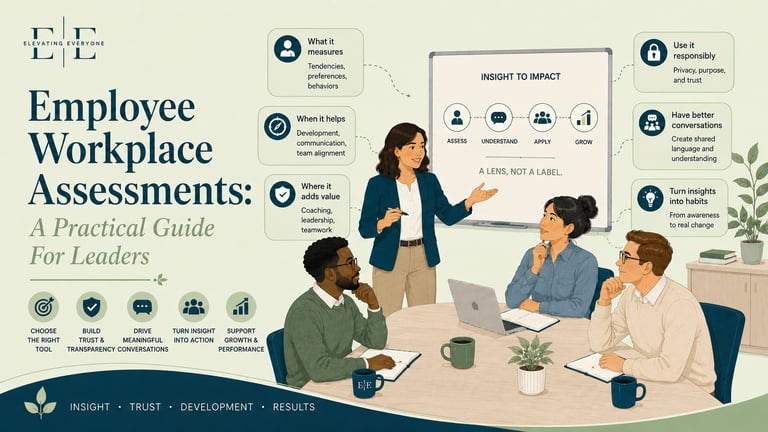
Employee workplace assessments can be useful tools for leaders, coaches, HR teams, and managers. They can create self-awareness, improve communication, support leadership development, and give teams a clearer way to talk about how people work together.
They can also create confusion when used without enough context.
Employees may wonder why the assessment is being used. Leaders may expect the results to provide more certainty than the tool can offer. Teams may turn useful language into fixed labels. A report may be discussed once, then forgotten.
The assessment is rarely the problem. The way it is introduced, interpreted, and applied usually determines whether it creates value or friction.
Used well, workplace assessments can help people better understand themselves and each other. Used poorly, they can damage trust, oversimplify people, and create resistance.
This guide explains what employee workplace assessments can do, where they have limits, and how leaders can use them responsibly.
What employee workplace assessments are
An employee workplace assessment is a structured tool used to understand some aspect of how a person works, communicates, leads, thinks, responds, or experiences the workplace.
Some assessments focus on behavioral tendencies. Others measure skills, engagement, leadership practices, strengths, values, or team dynamics. The best tools are clear about what they measure and how the results should be used.
A workplace assessment should give leaders and employees better language. It should help people reflect on patterns, strengths, preferences, and possible friction points.
It should not be treated as a complete picture of a person.
People are more complex than any assessment result. Their behavior is shaped by experience, role, environment, pressure, team dynamics, culture, and leadership expectations.
A useful assessment creates a lens. It should not create a box.
What assessments can and cannot tell you
Workplace assessments can help leaders see patterns that may otherwise be hard to discuss. They can show how someone may prefer to communicate, process information, make decisions, respond to pressure, or collaborate with others.
They can also support better coaching conversations.
For example, a manager may learn that one employee prefers direct feedback with clear next steps. Another may need more context before responding well. A team may discover that some members move quickly toward action while others need more time to assess risk.
Those insights can improve communication.
But assessments have limits.
Most workplace assessments do not predict performance with certainty. They do not measure a person’s full potential. They do not replace leadership judgment. They do not remove the need for coaching, feedback, and observation.
They also should not be used as shortcuts.
A result should never become the only explanation for someone’s behavior.
A leader might say:
“This gives us useful insight, but it does not define anyone. We will use the results to support better conversations and development.”
That framing helps employees understand the purpose.
It also reduces the risk of labeling.
Common types of employee workplace assessments
There are many types of workplace assessments. Each serves a different purpose. Leaders should choose the tool based on the problem they are trying to solve.
Behavioral assessments
Behavioral assessments focus on how people tend to act, communicate, decide, or respond in work settings.
These tools are often used for team development, coaching, leadership training, and communication improvement. They can help employees understand differences without making those differences personal.
Behavioral assessments are most useful when followed by a team conversation and practical application.
Personality-based assessments
Personality-based assessments explore traits, preferences, and patterns that may influence how someone approaches work.
They can support self-awareness and personal reflection. They may also help leaders better understand motivation, energy, and interaction preferences.
Leaders should be careful not to treat personality results as fixed predictions.
Personality language can become limiting when it is used too rigidly.
Skills and competency assessments
Skills assessments evaluate knowledge or capability in a specific area.
These may be used for training plans, development pathways, role readiness, or technical growth. They are different from behavioral or personality assessments because they usually focus on demonstrated ability or knowledge.
These tools can be useful when the expected skill is clearly defined.
Leadership assessments
Leadership assessments help leaders understand how they communicate, coach, influence, delegate, make decisions, and support team performance.
They can be valuable when paired with coaching, feedback, and a development plan.
The value is strongest when the leader is willing to reflect honestly and take action.
Engagement and sentiment tools
Engagement assessments measure how employees experience the workplace.
They may explore trust, belonging, clarity, motivation, manager effectiveness, workload, or culture.
These tools are helpful when leaders use the feedback to identify patterns and make visible improvements.
They create problems when employees provide input and never see follow-up.
Team communication assessments
Team communication assessments look at how well a team shares information, makes decisions, handles feedback, and works through friction.
These tools are useful when a team is experiencing confusion, repeated misunderstandings, weak follow-through, or unresolved tension.
The Team Communication Health Check is one example of a practical tool leaders can use to identify where communication is clear and where friction may be building.
When workplace assessments help
Assessments work best when they are connected to a clear development purpose.
They are helpful when leaders want to improve communication, strengthen teamwork, support coaching, build self-awareness, or guide leadership development.
A workplace assessment can help a team talk about differences with less defensiveness.
For example, one team member may want to move quickly. Another may want more detail before deciding. Without a shared language, those differences can become personal. With a better framework, the team can discuss pace, risk, communication, and expectations more constructively.
Assessments can also help during change.
When pressure increases, people often fall back into familiar patterns. Some become more direct. Some withdraw. Some ask for more information. Some try to keep everyone connected. Understanding those patterns can help leaders support the team more effectively.
The best use of an assessment is practical.
It should help the team answer questions like:
How do we communicate better?
How do we give feedback more effectively?
How do we make decisions with more clarity?
How do we support different working styles?
How do we handle pressure without creating unnecessary friction?
What agreements would help us work better together?
Those questions move the assessment from awareness into action.
When workplace assessments create problems
Assessments create problems when they are oversold, misused, or poorly explained.
The first risk is labeling. When people are reduced to a type, color, score, or category, the assessment starts to limit the conversation. People may use the result to explain away behavior or make assumptions about coworkers.
The second risk is confusion. If employees do not understand why the assessment is being used, they may become guarded. They may wonder who will see the results, how the information will be interpreted, and whether it could affect opportunities.
The third risk is poor follow-through. A team may complete the assessment, talk about the results once, and then move on. The experience may feel interesting, but little changes.
The fourth risk is using the wrong tool for the wrong purpose. A development assessment should not be treated like a performance measure. A team communication tool should not be expected to solve skill gaps. A personality framework should not be used as a substitute for leadership judgment.
If an assessment is used for hiring, promotion, or selection decisions, leaders should involve qualified HR and legal guidance. Selection use requires a higher standard than development use.
Trust is hard to rebuild once employees believe an assessment was used unfairly.
How leaders should introduce workplace assessments
The rollout sets the tone.
Before asking employees to complete an assessment, leaders should explain why it is being used and how the results will support development.
A strong introduction should answer several questions.
Why are we using this assessment?
Who will see the results?
How will the results be discussed?
What will the results not be used for?
How will this help the employee or team?
Clarity reduces anxiety.
A leader might introduce the assessment this way:
“We are using this assessment to better understand how we communicate, collaborate, and respond under pressure. The results will help us have a better development conversation. They will not be used as a performance rating or fixed label.”
That type of message helps protect trust.
It also reminds the team that the assessment is a starting point, not a final judgment.
How to use assessment results responsibly
Assessment results should guide conversation.
They should not define identity.
A responsible leader uses results to ask better questions, not to make quick conclusions.
For example, instead of saying:
“You are analytical, so you will probably slow this down.”
A better approach is:
“You may naturally look for risks and details. What information would help you feel confident moving this forward?”
Instead of saying:
“You are direct, so this is just how you communicate.”
A better approach is:
“Your direct style can help create clarity. Let’s also make sure the message lands in a way others can act on.”
The difference is important.
The first version boxes people in. The second version creates development.
Leaders should also use flexible language.
Helpful phrases include:
“You may tend to...”
“This could show up when...”
“Under pressure, this might look like...”
“Does this feel accurate to you?”
“Where does this fit, and where does it not fit?”
This kind of language keeps the conversation open.
It allows people to reflect, clarify, and take ownership.
Turning assessment results into team habits
The value of a workplace assessment comes after the results are reviewed.
A team should be able to turn insight into practical habits.
For example, a team may learn that some members need more detail before deciding while others prefer to move quickly. That insight can become a working agreement.
The team might decide:
meeting invitations will clarify whether the meeting is for discussion or decision
decisions will be documented with owners and deadlines
urgent requests will be labeled clearly
feedback will include specific behavior and impact
concerns will be invited before decisions are finalized
These are simple habits.
They make the assessment useful during real work.
The article Your Team Took a Workplace Assessment. Now What? explains this follow-through process in more detail.
Where Elevating Insight fits
Elevating Insight is designed to help teams understand workplace behavioral tendencies without reducing people to a fixed label.
The framework looks at how people may communicate, collaborate, respond under pressure, give feedback, and contribute to the team.
It uses four workplace tendencies:
Driving
Expressive
Steady
Analytical
The power of the framework comes from the blend.
People are not only one tendency. Most people carry a mix. That mix helps explain how someone may show up differently depending on the situation, role, relationship, or level of pressure.
Elevating Insight helps teams move from “What type are you?” to a more useful question:
“How do you operate, and how can we work better together?”
That shift helps leaders use assessment results in a more practical way.
For more on this approach, read Beyond the Box: Why Today’s Teams Need More Than a Behavioral Type.
Questions leaders should ask before choosing an assessment
Before choosing any employee workplace assessment, leaders should slow down and answer a few practical questions.
What problem are we trying to solve?
A tool should match the need. A team struggling with communication may need a different solution than a leader working on coaching skills or an organization measuring engagement.
How will the results be used?
The answer should be specific. If the results will support development, say that clearly. If the results will be discussed in a team setting, explain how.
Who will interpret the results?
Assessments are more useful when someone can help the team understand what the results mean and what they do not mean.
What language will we use?
Leaders should avoid fixed or deterministic language. The conversation should leave room for growth, context, and choice.
What happens after the assessment?
This may be the most important question. If there is no plan for follow-up, the results may fade quickly.
How will we protect trust?
Employees need to know how results will be handled. Transparency helps people participate more honestly.
The role of a facilitator or consultant
A good facilitator helps teams move beyond the report. They help people interpret results, discuss patterns, and connect insight to daily work. They also help protect the tone of the conversation. This is especially useful when a team has existing tension, uneven trust, or a history of poor communication.
A facilitator should not make the team dependent on the tool. The best facilitation builds team capability. It helps leaders and team members use the insight long after the session ends.
This is where team communication consulting can support the work. The assessment may create the starting point, but the team often needs help turning insight into stronger habits.
Common mistakes to avoid
Leaders can improve the assessment experience by avoiding a few common mistakes.
Do not introduce an assessment without explaining the purpose.
People need context before they complete it.
Do not use assessment results as labels.
A result should help someone reflect. It should not become their identity.
Do not skip the debrief.
A report without conversation has limited value.
Do not treat the assessment as the solution.
The assessment creates insight. Leadership and follow-through create change.
Do not ignore privacy and trust.
Employees should understand how results will be handled.
Do not use the same tool for every problem.
Different workplace challenges require different approaches.
These mistakes are avoidable.
The best assessment experiences are thoughtful, transparent, and connected to real work.
Related resources
Final thought
Employee workplace assessments are not solutions by themselves.
They are inputs.
They can create awareness, structure better conversations, and help leaders understand how people work. But the real value comes from how the results are used. A strong assessment process protects trust, avoids labels, supports development, and leads to practical team habits.
Used thoughtfully, assessments can help teams communicate better, coach more effectively, and work through differences with more clarity. Used carelessly, they become another activity people complete and forget.
The difference is leadership.
Ready to use workplace assessments more effectively?
Elevating Everyone helps leaders and teams use assessment results responsibly and practically.
Through Elevating Insight, facilitated debriefs, and team communication consulting, we help organizations move from assessment results to better communication, stronger trust, and more useful team habits.
Explore Elevating Insight or learn more about team communication consulting.
Elevating Everyone
Stay Connected
doug.ward@elevatingeveryone.com
843-259-2055
© 2026. All rights reserved.
Elevate Everywhere Enterprises, LLC.